
You ask your child to put on their shoes and get a meltdown. You suggest the ice cream they love and they refuse it because you suggested it. Rewards don't work. Consequences make it worse. If ordinary requests, even fun ones, set off panic, you may be looking at PDA. Here's the short answer: PDA stands for pathological demand avoidance, a profile in which everyday demands trigger anxiety so intense that a child has to avoid them, and the approaches that help look very different from standard parenting advice.
This guide covers what PDA is, the signs in children, how it's identified, what helps at home and school, and what the research does and doesn't say. It links to deeper reading on every piece.
What is PDA?
The term pathological demand avoidance was coined by Elizabeth Newson, a developmental psychologist at the University of Nottingham, in the 1980s. In 2003 she and her colleagues published a description in Archives of Disease in Childhood of children who resisted the ordinary demands of daily life in an obsessive way. The PDA Society, the UK charity founded by parents in 1997, describes PDA today as a profile on the autism spectrum characterized by a fear response to demands.
The word "pathological" upsets many parents. It doesn't mean your child is bad. It means the avoidance is far beyond what's typical and is driven by anxiety and a deep need for control, not by choice.
What are the signs of PDA in children?
Newson's original description and later clinical work point to a recognizable pattern:
- Avoiding everyday demands, including things the child wants to do, like going to a party or eating a favorite food
- Social strategies to avoid, such as distracting, negotiating, making excuses, joking or withdrawing into fantasy
- Surface sociability, where a child seems socially able but has real difficulty underneath
- Sudden mood swings, from loving to explosive in seconds, often tied to a need for control
- Comfort in role play and pretend, sometimes taking on another character to cope
- Intense focus on people, such as fixating on a friend or a family member
Demands aren't only instructions. Questions, praise, expectations, routines, time pressure and even a child's own wishes can feel like demands. Our article Why even small requests trigger instant resistance explains the threat response behind it, and Why does my child reject what they just asked for? covers one of the most confusing signs.
Is PDA a real diagnosis?
PDA is not listed in the DSM-5 or ICD-11, the manuals most clinicians use. The PDA Society explains that a PDA profile can be identified as part of an autism assessment, with wording such as "autistic with a PDA profile," to point families toward the support that helps.
The research is young and contested. A 2021 systematic review in the journal Autism found 13 studies, all of which built their identification of PDA on Newson's original descriptions, and concluded that methodological limits restrict firm conclusions. The review noted associations with anxiety and called for more research into how PDA relates to autism, anxiety and other conditions. Researchers have also questioned whether PDA is a distinct condition or a pattern that shows up across several.
For parents, the label matters less than the pattern. If standard approaches keep backfiring, that's useful information either way. Our article ODD or PDA? When the label doesn't fit covers the difference, and When early trauma looks like PDA covers another look-alike.
While you're here, take the guide
What's Underneath is free: the three body-state triggers under most meltdowns, what to say in the minute before it tips over, and how to reset afterward.

You'll get the guide instantly, plus five free articles in your inbox every week. Real challenges (meltdowns, school mornings, picky eating, big feelings) and how to actually handle them. Unsubscribe anytime.

There's a story for this exact struggle
The Little Porcupine by the Road
A tiny porcupine lives in a world that feels too loud and too fast — until he finds a place where he can finally feel safe.
Free to read. You'll also get five free articles a week. Unsubscribe anytime.
Is there a PDA checklist?
You'll find PDA checklists and quizzes online. The best-known research tool is the Extreme Demand Avoidance Questionnaire (EDA-Q), a parent-report questionnaire. It was built for research and screening, not to diagnose a child on its own. Only an experienced clinician doing a detailed assessment can tell you whether a PDA profile fits.
Why don't rewards and consequences work for PDA?
A reward is still a demand: do this to get that. A consequence raises the stakes and the anxiety. For a child whose nervous system reads demands as threats, both add pressure. That's why many families find sticker charts and time-outs make things worse. Our article When therapy makes PDA meltdowns worse explains why some standard therapies backfire.
What helps a child with PDA?
The PDA Society sums up helpful approaches with the PANDA mnemonic:
- Prioritize and compromise (it used to be called "pick your battles"): let go of what doesn't matter and soften what does
- Anxiety management: lower anxiety first, because it drives the avoidance
- Negotiation and collaboration: work it out together
- Disguise and manage demands: phrase things indirectly and reduce how many there are
- Adaptation: adjust the environment and expectations to fit your child
In practice, that looks like:
- Use declarative language. "I wonder if the shoes are by the door" instead of "Put your shoes on." Read Declarative language: what the evidence says.
- Offer real choices. Choice gives back control. See why offering choices calms a demand-avoidant child.
- Lower demands on hard days. Low-demand parenting isn't giving up. It's lowering the load so your child can come back to regulated. When some things can't be skipped, read Low-demand parenting when some things aren't optional.
- Stay calm and flexible. Your steadiness is the most regulating thing in the room.
- Work with the school. Our guide on how to explain PDA to school staff gives you the words.
Can PDA happen with ADHD?
Many parents see demand avoidance alongside ADHD, autism or both. When needs pull in opposite directions, like ADHD wanting structure and PDA resisting it, things get complicated. Read When autism, ADHD and PDA collide.
Taking care of yourself
Parenting a child with a PDA profile is exhausting, and it often looks to outsiders like you're too soft. You're not. You're adapting to how your child's nervous system works. If you're doing everything right and it's still this hard, you're not alone.
A story can help a child feel understood without a single demand attached. The Little Porcupine by the Road is about safety, protection, and softening once the world feels less dangerous.
This is what LightMap was built for. Log the hard moments, even a little at a time, and LightMap uncovers what is driving them, coaches you on how to handle each one, and shows you which hours of your day need the plan. Start free at LightMap.
For everything Birch & Light has written on demand avoidance, visit our PDA guide for parents.
Start here
Find out what's really going on
The quiz points you toward what's driving it and what tends to help.
Take the quizOr get a free 15 minute LightMap Analysis with TaraFree. No card. 15 minutes.
 Not sure where to start? Ask me.Message Tara on WhatsApp. It really is me, I read everything and will personally respond.Click here to message Tara →

Part of the award-winning Birch & Light Method, honored with the Mom's Choice Gold Award for excellence in family resources.
Sources
Sources: Newson E, Le Maréchal K, David C. "Pathological demand avoidance syndrome: a necessary distinction within the pervasive developmental disorders." Arch Dis Child 2003;88(7):595-600. Kildahl AN, Helverschou SB, Rysstad AL, Wigaard E, Hellerud JM, Ludvigsen LB, Howlin P. "Pathological demand avoidance in children and adolescents: A systematic review." Autism 2021;25(8):2162-2176. O'Nions E, Christie P, Gould J, Viding E, Happé F. "Development of the 'Extreme Demand Avoidance Questionnaire' (EDA-Q): preliminary observations on a trait measure for Pathological Demand Avoidance." J Child Psychol Psychiatry 2014;55(7):758-768. PDA Society. "About autism and PDA," "Frequently Asked Questions" and "Helpful approaches infographic: PANDA approaches."
For education and reflection, not medical advice. Our terms
A story to read together
Sometimes the easiest way in is a story you read side by side.
- The Little Porcupine by the Road
A tiny porcupine lives in a world that feels too loud and too fast — until he finds a place where he can finally feel safe.
Read the story 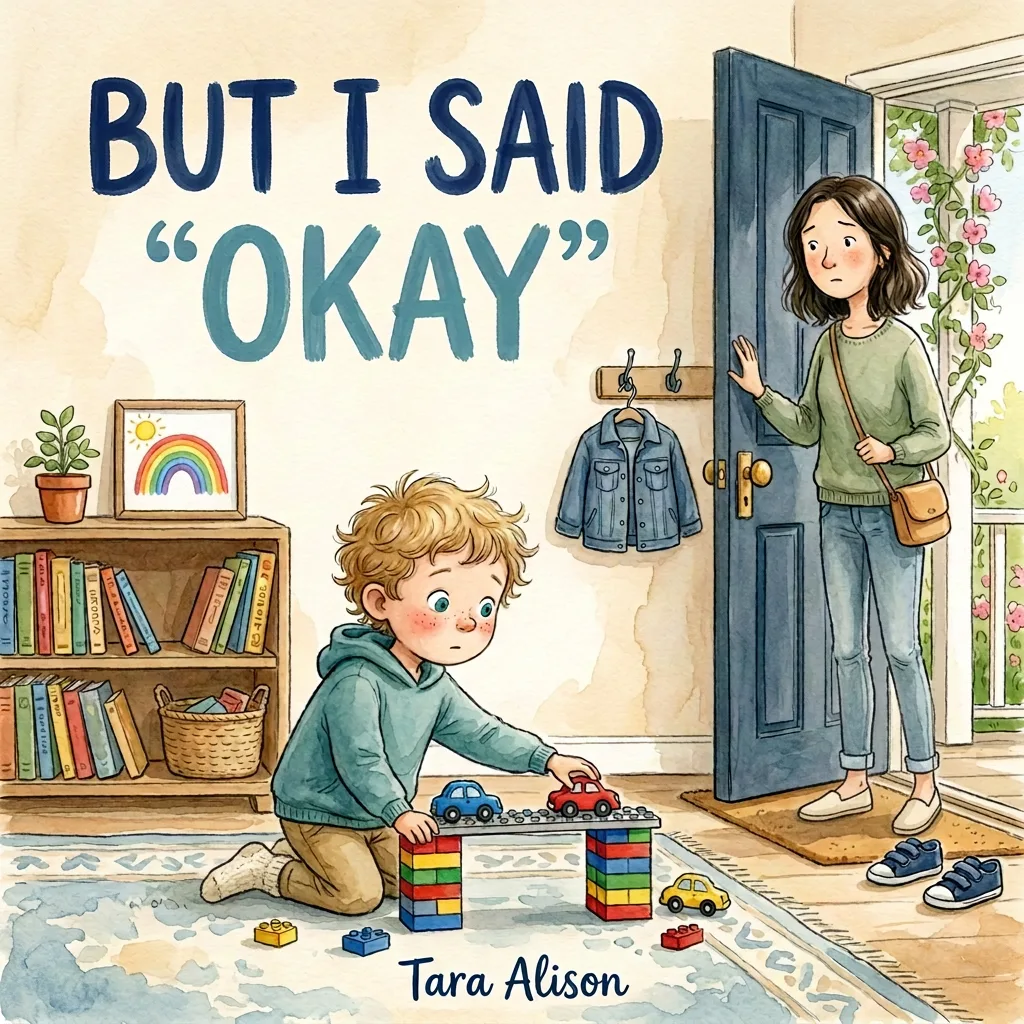 But I Said “Okay”
Owen always says okay. He means it every time. But his attention is still inside the bridge, the dragon, the cave, the music — until Mom realizes that helping him leave one thing matters more than asking him to start the next.
Read the story
Researched and drafted with AI assistance, reviewed before publication. Editorial standards