
You have spent months, maybe years, coming to understand your child's relationship with demands. You have learned that the harder you push, the more they resist — not out of defiance, but out of something that looks almost like panic. You have stopped phrasing things as instructions. You have learned to offer choices, to lower the pressure, to come at things sideways. And slowly, at home, things have gotten better.
And then there is school. Where your child is one of many, where demands are constant and non-negotiable, and where the adults — however well-meaning — may be reading your child's resistance as exactly the thing it is not: willful defiance.
Explaining demand avoidance to school staff is one of the most important and most difficult conversations a parent can have. Done well, it can transform how your child is treated. Done poorly, it can sound like excuse-making. This is about how to do it well.
Start With the Mechanism, Not the Label
It is tempting to lead with terminology — to walk in and say "my child has a demand-avoidant profile" and expect that to do the work. But labels can land as jargon, or worse, as a parent reaching for an excuse. What changes how a teacher responds is not the label. It is understanding the mechanism underneath it.
So lead with what is actually happening in your child's nervous system. The core of it is this: for your child, a direct demand — even a small, reasonable one — can register as a threat. Not a social challenge to be negotiated, but a genuine alarm signal in the body. And a nervous system in alarm does not comply. It resists, freezes, or escalates, because that is what nervous systems do when they perceive threat.
When a teacher understands that the resistance is a stress response rather than a choice, everything about their interpretation shifts. They stop seeing a child who won't and start seeing a child who, in that moment, can't.
Translate It Into What They See
Staff don't experience your child's internal state. They experience behavior. So the most useful thing you can do is connect the mechanism to the specific things they are seeing in the classroom.
The child who goes rigid when given a direct instruction. What looks like stubbornness is often a nervous system locking up under the pressure of a demand. The instruction itself — not its content — is the trigger.
The child who does the opposite of what's asked, sometimes seeming to surprise even themselves. This is not calculated opposition. It is an automatic resistance response, and the child often cannot explain it any better than the teacher can.
The child who can do something one day and not the next. This inconsistency is one of the most misread features. It is not proof that the child "can do it when they want to." It is a reflection of how much capacity the nervous system has on a given day. The same demand lands very differently on a regulated child than on a depleted one.
The child who melts down over something that seems trivial. The trivial thing is rarely the cause. It is usually the demand that arrived when the system was already full.
While you're here, take the guide
What's Underneath is free: the three body-state triggers under most meltdowns, what to say in the minute before it tips over, and how to reset afterward.

You'll get the guide instantly, plus five free articles in your inbox every week. Real challenges (meltdowns, school mornings, picky eating, big feelings) and how to actually handle them. Unsubscribe anytime.
Offer the Reframe That Actually Helps
Once staff understand the mechanism, the natural next question is: so what do we do? This is where you can offer the single most useful shift, which is about how demands are delivered rather than whether they are made.
The goal is not to remove all expectations. It is to lower the threat level of how those expectations are communicated, so the nervous system doesn't go into alarm. In practice, that often means a few specific things, and it helps to give staff concrete examples rather than abstractions.
Phrasing things indirectly rather than as direct commands — "I wonder if the worksheets are ready to be handed out" instead of "hand out the worksheets." Offering genuine choices that hand some control back to the child. Reducing the audience, since demands witnessed by peers carry extra threat. Building in warning and transition time rather than expecting instant compliance. And, crucially, not escalating when the child resists — because escalation adds threat, and threat is the engine of the whole problem.
The shift that helps most is rarely "make the child comply." It's "lower the pressure enough that compliance becomes possible."
Anticipate the Pushback
It is worth being honest with yourself going in: some staff will hear all of this as a request to let your child off the hook. The fear underneath their resistance is usually that accommodating demand avoidance means abandoning structure, lowering standards, or being manipulated.
You can address that fear directly, and it lands better than pretending it isn't there. Accommodating a demand-avoidant nervous system is not about removing expectations — it is about reaching the same expectations by a route the child's system can actually travel. The destination is the same. The road is different. A child who melts down under a direct command and completes the task when it's offered as a choice has still completed the task. You are not lowering the bar. You are building a ramp to it.
Put It in Writing
Conversations get forgotten, and staff change. Whatever you explain verbally, it helps enormously to also provide a short written summary — a single page that describes how your child's nervous system responds to demands, what it looks like in the classroom, and the specific strategies that help. This gives every adult who works with your child the same starting point, and it gives you something concrete to point back to when the approach drifts.
If your child has a formal support plan, this is exactly the kind of information that belongs in it — described in terms of nervous-system response and specific strategies, not just labels.
The Shift Worth Making
The conversation you are having with school staff is, at its heart, the same shift you made yourself: moving from "why won't this child do what's asked" to "what is making this so hard, and how do we lower it." When a teacher makes that shift, your child stops being the difficult one and starts being a child whose nervous system needs a particular kind of approach — which is something a good teacher can actually work with.
You are not asking them to lower their expectations of your child. You are giving them the key that makes those expectations reachable.
Every behavior is a clue.
If you're building a picture of how your child responds to demands to share with their school, LightMap can help you track the patterns — which kinds of demands, which conditions, what helps — so what you bring to staff is specific and grounded. Explore LightMap at birchandlight.com/lightmap.
Sources: Newson et al. on the original description of pathological demand avoidance (Archives of Disease in Childhood; PMC); PDA Society (UK) education guidance; O'Nions et al. on identifying and measuring extreme demand avoidance (PMC).
For education and reflection, not medical advice. Our terms
See what's underneath
Stop guessing which demand did it
LightMap reads your hard days together and gives you answers. Start with one moment today.
Start with 3 moments Not sure where to start? Ask me.Message Tara on WhatsApp. It really is me, I read everything and will personally respond.Click here to message Tara →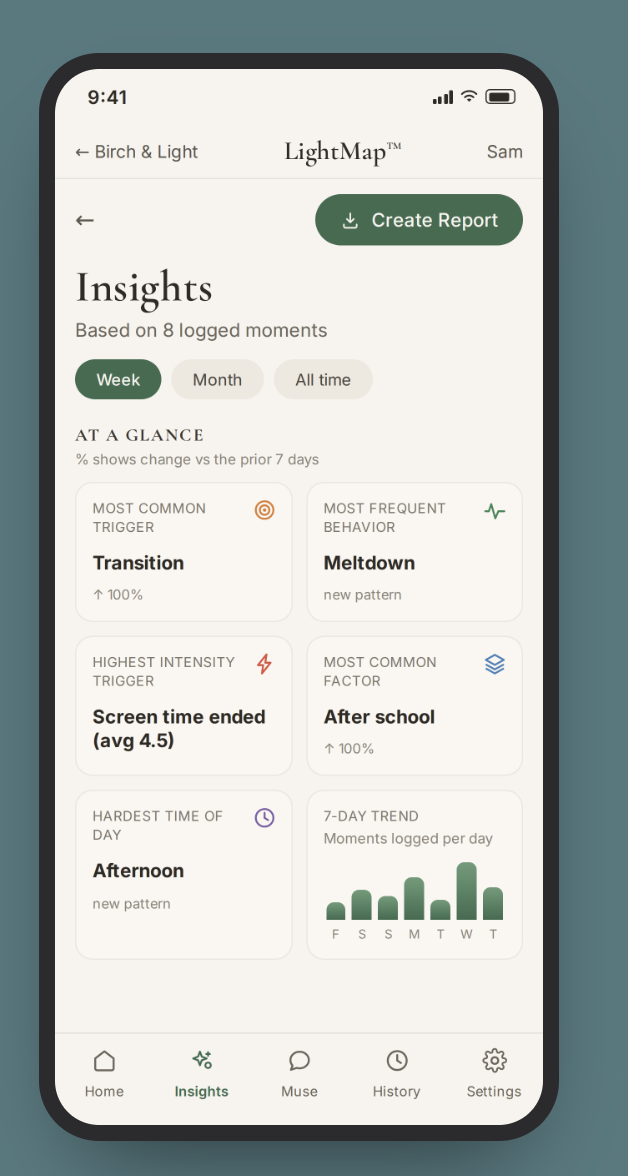

Part of the award-winning Birch & Light Method, honored with the Mom's Choice Gold Award for excellence in family resources.
A story to read together
Sometimes the easiest way in is a story you read side by side.
 But I Said “Okay”
Owen always says okay. He means it every time. But his attention is still inside the bridge, the dragon, the cave, the music — until Mom realizes that helping him leave one thing matters more than asking him to start the next.
Read the story The Tower That Looked Fine
A tower in a quiet clearing tries to stay steady through every small thing nobody else seems to notice — until one tiny breath of wind causes her to fall, and a gentle hand begins to gather the blocks back.
Read the story
If today was one of those days
A few more from the library, free to read.
Researched and drafted with AI assistance, reviewed before publication. Editorial standards