
Every parent who discovers low-demand parenting hits the same wall within about a week. The approach makes sense, the child's nervous system visibly calms when the pressure drops, and then you arrive at the parts of life that are not optional. Sleep has to happen. Medicine has to happen. The car seat, the seatbelt, the hand that gets held in the parking lot. And you find yourself wondering if this whole philosophy quietly assumes a child with no actual needs.
It does not. But almost nobody explains the next layer clearly, so here it is.
Low-demand does not mean no boundaries
The name is misleading. Low-demand parenting is not the removal of every expectation. It is the removal of unnecessary demand pressure, so that your child's threat response is not being triggered forty times a day, which leaves actual capacity for the handful of things that genuinely must happen.
Think of your child's tolerance for demands as a small daily budget. Every instruction, every transition, every "come here" spends from it. A conventional household spends that budget by 9am on things that did not matter. A low-demand approach hoards it for the things that do.
Sort everything into three buckets
Bucket one: true non-negotiables. Safety and health. Being restrained in a moving car. Medication that keeps a body working. Not running into a road. This list is much shorter than it feels. Most families who write it down honestly find five to eight items.
Bucket two: matters, but the details are flexible. Sleep matters; the exact bedtime, location, pajama status, and pre-sleep ritual are all negotiable terrain. Teeth need brushing; when, where, which toothbrush, and who holds it are not sacred. Nutrition matters; the specific vegetable does not.
Bucket three: does not actually matter. Shoes on the correct feet. Coats when they are not cold. Sitting at the table the whole meal. Saying hello to the relative. This bucket is enormous, and dropping it is what buys you bucket one.
For the true non-negotiables: hold the what, flex everything else
The outcome is fixed. The path there is where all your room lives. A few mechanics that change everything:
Let something else carry the demand. A visual routine chart, a timer the child sets, a song that means transition. A demand delivered by a laminated card lands differently than one delivered by a parent's voice, because it is not a person to push against.
Swap commands for information. "Brush your teeth" is a demand. "The bathroom light is on and your toothbrush has the blue paste on it already" is information a child can act on without surrendering. Declarative language sounds absurd until you watch it work.
Offer choices inside the boundary, never about it. Whether medicine happens is closed. Whether it happens before or after the story, with juice or water, sitting on the counter or the couch, is wide open. We have a whole piece on why choices calm a demand-avoidant child, and it applies double here.
Do it with, not at. "I am brushing my teeth now too" recruits a companion instead of commanding a subordinate. Parallel doing is one of the most reliable moves in the entire playbook.
Mind the timing. A demand issued into an already-activated nervous system fails no matter how gently it is worded. If the day has been heavy, shrink the non-negotiable to its true minimum and let the rest go for tonight.
While you're here, take the guide
What's Underneath is free: the three body-state triggers under most meltdowns, what to say in the minute before it tips over, and how to reset afterward.

You'll get the guide instantly, plus five free articles in your inbox every week. Real challenges (meltdowns, school mornings, picky eating, big feelings) and how to actually handle them. Unsubscribe anytime.
When it is genuinely urgent
Real safety moments are not teaching moments. If a child is heading toward a road or a hot stove, you act with your body first: block, lift, hold. Calmly, without lecture, and then repair afterward. "I grabbed you fast because cars cannot see kids. That probably felt sudden." One clean, calm, rare use of parental override preserves trust far better than daily battles over bucket-three items ever could. The override works precisely because it is rare.
The part nobody tells you
The non-negotiables get easier as the overall demand load drops, because you are no longer asking a flooded system to cooperate. Families consistently report that the bedtime fight, the medicine fight, the seatbelt fight shrink over months, not because the child changed, but because those requests stopped being the fortieth demand of the day and started being the fourth.
If the instant resistance itself still feels baffling, start with why even small requests trigger instant resistance. Understanding the mechanism is what makes all of this stop feeling like surrender and start feeling like strategy.
How much demand she can absorb shifts with her capacity, day to day. Logging what got refused alongside what she was already carrying that day in LightMap makes the line much easier to find.
Sources: PDA Society (UK); self-determination theory research on autonomy-supportive communication (Deci & Ryan; Joussemet et al.).
For education and reflection, not medical advice. Our terms
See what's underneath
Stop guessing which demand did it
LightMap reads your hard days together and gives you answers. Start with one moment today.
Start with 3 moments Not sure where to start? Ask me.Message Tara on WhatsApp. It really is me, I read everything and will personally respond.Click here to message Tara →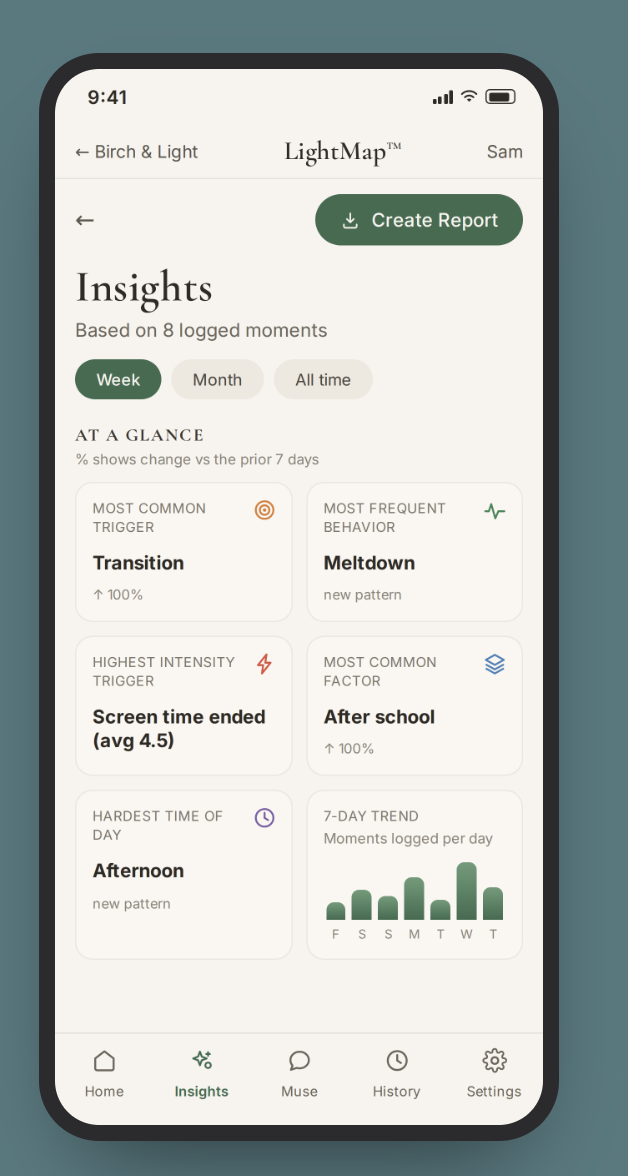

Part of the award-winning Birch & Light Method, honored with the Mom's Choice Gold Award for excellence in family resources.
A story to read together
Sometimes the easiest way in is a story you read side by side.
 The Mouse Who Heard Everything
Mina Mouse hears every creak the old house makes at night. The story gently shows that her brain isn’t broken — it’s working overtime to keep her safe — and what changes when someone sits beside her in the dark.
Read the story When Axel's Engine Stayed On
After a big, exciting day, Axel's body is tired but his engine won't quiet down. A gentle story about overstimulated kids who can't settle — and the calm grown-ups who help them.
Read the story
If today was one of those days
A few more from the library, free to read.
Researched and drafted with AI assistance, reviewed before publication. Editorial standards