
If you have spent any time in parenting groups you have watched this argument happen. One person says lowering demands helps a demand avoidant child. Another says the research shows accommodation makes anxiety worse. Both cite evidence. Both are partly right, and the reason the argument never resolves is that they are discussing three different things under two labels.
Here is what the research actually says, including the parts that do not support what most PDA parents are told.
Three things that keep getting confused
Accommodation means the expectation is removed or the parent performs it. Doing the thing for the child, providing repeated reassurance, restructuring family routines to avoid a feared situation.
Low demand parenting is a popular term with no fixed definition. Sometimes it means the above. Sometimes it means what follows. That ambiguity is why the argument keeps happening.
Autonomy-supportive communication, which includes declarative language, means the expectation stays and the delivery changes. The child still does the thing.
Almost every disagreement in this space comes from treating the first and third as the same intervention.
The accommodation research, and it is strong
Take the strongest version of the case against accommodation, because it deserves to be taken seriously.
Lebowitz and colleagues at the Yale Child Study Center ran a randomized non-inferiority trial published in the Journal of the American Academy of Child and Adolescent Psychiatry in 2020. They enrolled 124 children aged 7 to 14 with primary anxiety disorders and randomly assigned them either to SPACE, a parent-only treatment with no child-therapist contact whatsoever, or to individual cognitive behavioral therapy with no parent treatment.
SPACE works by reducing family accommodation. It was non-inferior to CBT on every primary and secondary anxiety outcome, across independent evaluator, parent, and child ratings, and produced significantly greater reductions in family accommodation and parenting stress. The trial was funded by the National Institute of Mental Health.
That result is remarkable. Treating only the parents, and specifically their accommodation, worked as well as treating the child directly with the best established therapy available.
It sits on a wider literature showing accommodation is near universal in pediatric anxiety and obsessive compulsive disorder, and that higher accommodation predicts greater symptom severity, lower functioning, and poorer treatment response.
The uncomfortable part: it replicates in autistic children
Parents often assume this research was done on neurotypical children and does not apply. It has been tested, and that assumption does not hold.
The TAASD study, published in the Journal of Clinical Child and Adolescent Psychology in 2022, followed 167 autistic youth with clinically significant anxiety, mean age 9.9, through a randomized trial comparing two CBT interventions against treatment as usual. Accommodation was common, decreased with treatment, and was implicated in post-treatment anxiety severity. The authors concluded it should be targeted in treatment for autistic youth with anxiety.
Feldman, Koller, Lebowitz and colleagues, publishing in the Journal of Autism and Developmental Disorders in 2019, examined accommodation of restricted and repetitive behaviors in 86 autistic children. Eighty percent of parents accommodated at least monthly, accommodation correlated with symptom severity, and the authors described the pattern as similar to that seen in OCD and anxiety disorders.
Storch and colleagues reported comparable findings in a smaller sample of autistic children with anxiety and CBT outcomes. A separate community sample of 132 families found the child's difficulty tolerating uncertainty was a consistent predictor across all four measured domains of accommodation.
So autism does not exempt a child from this finding. If you are removing expectations to prevent distress, the evidence suggests that maintains the anxiety rather than reducing it, and that holds for autistic children too.
What autonomy support is, and why it is a different thing
Now the other literature, which most PDA discussions never reference and which supports what parents are actually describing.
Self-determination theory, developed by Deci and Ryan over four decades, distinguishes autonomy-supportive from psychologically controlling socialization. Joussemet and colleagues operationalize autonomy support as four specific components, derived originally from Haim Ginott's empathic limit-setting work:
Providing a rationale for a request rather than issuing it bare. Acknowledging the child's feelings and perspective. Offering genuine choice and encouraging initiative. Minimizing controlling techniques.
Read that list again. Not one of those items removes the expectation. Every one of them changes how it arrives.
Declarative language is a practical application of the same principle. You narrate the situation rather than issue the instruction. The bus leaves at eight, rather than put your shoes on. The expectation is identical. What changes is whether the child experiences it as their own conclusion or as an order.
The line the literature draws explicitly
This is the sentence that settles most of the argument, and it comes from the self-determination theory literature itself rather than from anyone defending PDA.
Autonomy support should not be confused with permissiveness, meaning a lack of structure, or with neglect, meaning a lack of involvement. Autonomy support concerns how structure and involvement are provided.
The objection to low demand parenting is that it removes structure. Autonomy support does not remove structure. It is a statement about delivery. Anyone arguing that autonomy-supportive communication equals permissiveness is arguing against the definition.
There's a story for this exact struggle
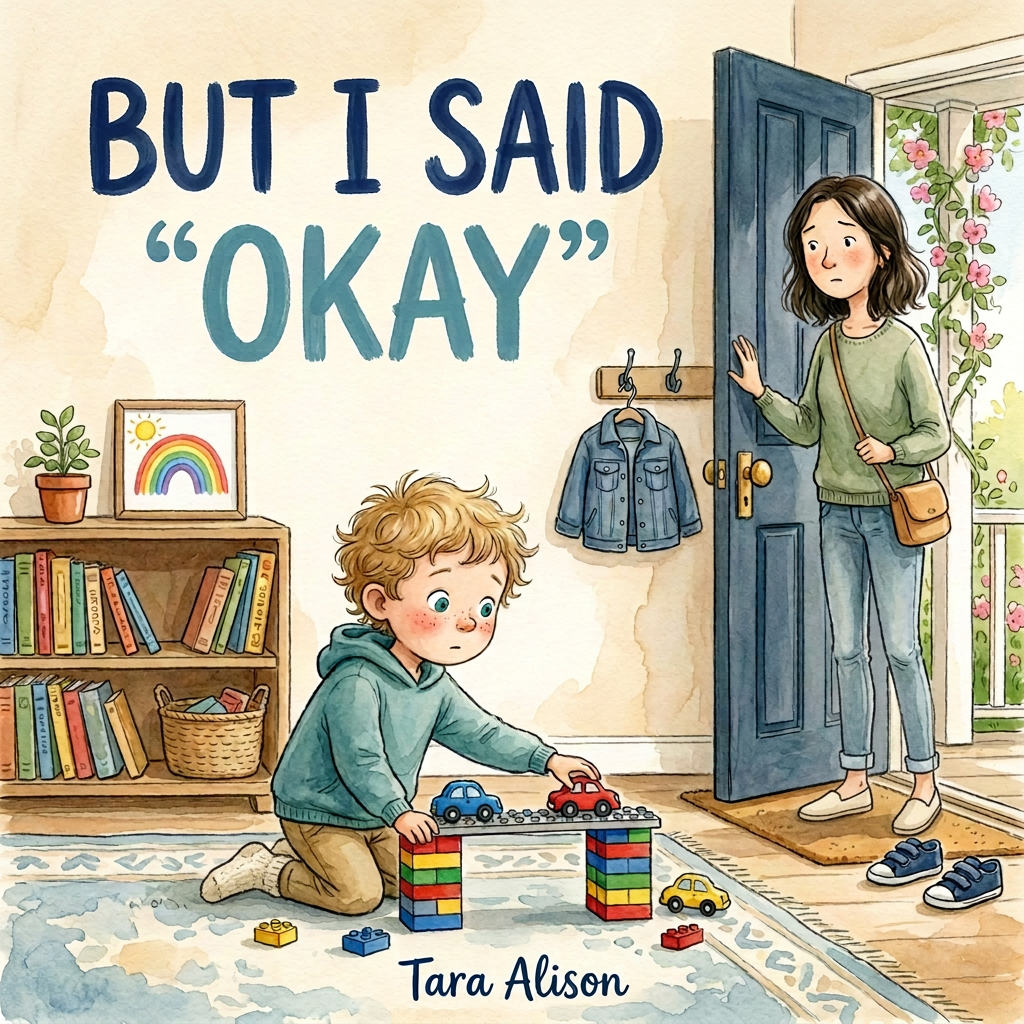
But I Said “Okay”
Owen always says okay. He means it every time. But his attention is still inside the bridge, the dragon, the cave, the music — until Mom realizes that helping him leave one thing matters more than asking him to start the next.
Free to read. You'll also get five free articles a week. Unsubscribe anytime.
Before you go, grab the free guide
The 3 body-state triggers under most meltdowns, a script for the 30 seconds before it tips over, and a reset for after. Free.

You'll get the guide instantly, plus five free articles in your inbox every week. Real challenges (meltdowns, school mornings, picky eating, big feelings) and how to actually handle them. Unsubscribe anytime.
What the evidence for autonomy support looks like
A 2024 meta-analysis of self-determination theory's dual process model tested this across cultures. Parental autonomy support was positively associated with child well-being even when controlling for psychological control, r = 0.26, and psychological control was positively associated with child ill-being even when controlling for autonomy support, r = 0.20. Critically, both effects held across regions, across degrees of national individualism and cultural hierarchy, across developmental periods, and across sexes.
These are not enormous effect sizes, and it is correlational work. But it is consistent, cross-cultural, and it separates the two constructs rather than treating one as merely the absence of the other.
Experimental evidence on delivery. A pre-registered experiment had 250 children aged 10 to 16 listen to recorded adult voices with the sentence content and the speakers held constant, varying only the tone: controlling, autonomy-supportive, or neutral. Children hearing the controlling tone anticipated lower psychological need satisfaction, lower well-being, and less willingness to disclose to that adult.
Identical words. Different delivery. Measurably different response. That is the entire claim behind declarative language, tested directly.
Evidence that it increases compliance rather than eroding it. Laurin and Joussemet followed toddlers through clean-up and toy prohibition tasks at ages 2 and 3.5. Parental autonomy-supportive strategies at age 2 predicted improvement in committed compliance, meaning genuine rule internalization rather than surface obedience, between 2 and 3.5.
Related work found autonomy-supportive framing produced greater internalization of activities that were important but uninteresting, which is the precise problem every parent of a demand avoidant child is trying to solve.
A vignette study with adolescents found the controlling condition produced more oppositional defiance than the autonomy-supportive condition.
Now the part PDA parents will not want to read
There are no randomized controlled trials of low demand parenting. None. Not one.
The support for it consists of clinical description, practitioner accounts, and parent report. Those are worth something and they are not trial evidence, and anyone telling you the approach is evidence-based is overstating it.
PDA itself remains contested. It appears in neither the DSM-5-TR nor the ICD-11. A 2024 scoping review in Frontiers in Education concluded that no consensus exists on its diagnostic validity, its features, or its relationship to other constructs. Malik and Baird's 2018 commentary in Child and Adolescent Mental Health questioned whether it identifies anything distinct. The EDA-Q, developed by O'Nions and colleagues in 2014 and refined into the EDA-8 in 2021, was built as a research instrument and not as a diagnostic tool.
Meanwhile the mechanism is unsettled even among people who accept the profile. Stuart, Grahame, Honey and Freeston proposed intolerance of uncertainty and anxiety as explanatory frameworks. Others argue anxiety is a consequence of chronic conflict rather than its cause. Recent work suggests sensory reactivity contributes meaningfully to demand avoidance in autistic children, which points at yet another mechanism.
If you want a defensible position, it is not that low demand parenting is proven. It is that autonomy-supportive communication has good evidence, that it is distinct from accommodation, and that the demand avoidant presentation plausibly makes delivery matter more than it does for other children.
Where the honest line sits
Putting the two literatures side by side gives you something more useful than either camp offers alone.
Removing expectations to prevent distress is not supported. The accommodation research is consistent, replicates in autistic samples, and suggests this maintains the difficulty. If your household has quietly stopped expecting anything, that is worth examining honestly.
Changing how expectations are delivered is supported. Rationale, acknowledgment, genuine choice, and minimal controlling language have meta-analytic support, experimental support, and evidence of increasing internalization over time.
The two get confused because both reduce conflict in the short term. That is why parents cannot tell them apart from inside the situation, and why the argument recurs.
The test worth applying: after you changed your approach, is your child doing more things or fewer things? Autonomy support should expand what a child can manage over months. Accommodation shrinks it. Same immediate relief, opposite trajectory.
What this means on a Tuesday morning
Keep the expectation. Change the sentence.
Say what is true about the situation rather than issuing the instruction. Give the reason before the request rather than after the refusal. Offer a real choice, meaning one where either answer is acceptable to you. Acknowledge that the thing is annoying, because acknowledging the perspective is one of the four components and costs nothing.
And watch the trajectory rather than the morning. If the list of things your child can do is growing, the approach is working regardless of what it is called. If it is shrinking, something needs to change, and no label protects you from that.
If demands are currently triggering explosive responses, why even small requests trigger instant resistance covers the mechanism. And low demand parenting when some things are not optional deals with the medical and safety expectations that cannot be dropped.
The trajectory question is the one worth answering with data rather than memory. Logging what your child manages week to week in LightMap shows you whether the list is growing or shrinking, which is the difference between autonomy support working and accommodation quietly taking over.
For your child: Elliot's Paths is about a boy whose no arrives before he has had any chance to choose, and the grandmother who is the first adult to see the path from where he is standing.
This article summarizes published research for parents. It is general information rather than clinical advice, and it does not replace assessment or treatment from a qualified professional.
Sources: Lebowitz et al., Journal of the American Academy of Child & Adolescent Psychiatry (2020); self-determination theory research (Deci & Ryan; Joussemet et al.); Haire L, Symonds J, Senior J, D'Urso G, "Methods of studying pathological demand avoidance in children and adolescents: a scoping review," Frontiers in Education, 2024;9:1230011, doi 10.3389/feduc.2024.1230011; DSM-5-TR and ICD-11 diagnostic classifications.
For education and reflection, not medical advice. Our terms
See what's underneath
Stop guessing which demand did it
LightMap turns scattered hard days into a pattern you can see. Start by logging one moment tonight.
Log today's hard moment, no account needed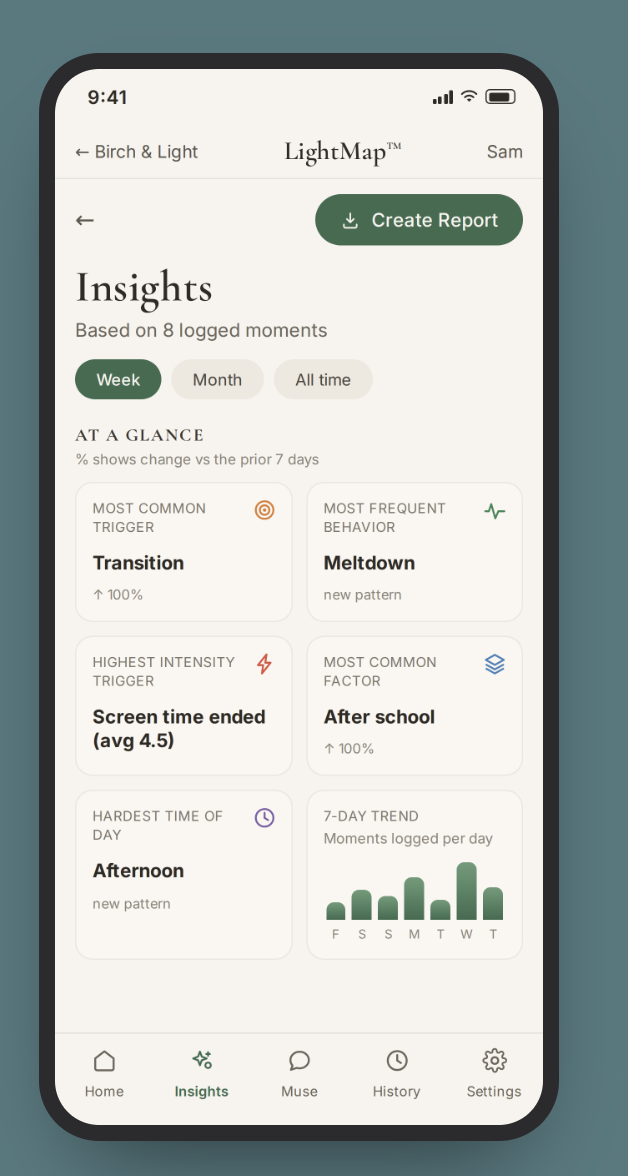
Part of the award-winning Birch & Light Method, honored with the Mom's Choice Gold Award for excellence in family resources.
A story to read together
Sometimes the easiest way in is a story you read side by side.
- But I Said “Okay”
Owen always says okay. He means it every time. But his attention is still inside the bridge, the dragon, the cave, the music — until Mom realizes that helping him leave one thing matters more than asking him to start the next.
Read the story  The Tower That Looked Fine
A tower in a quiet clearing tries to stay steady through every small thing nobody else seems to notice — until one tiny breath of wind causes her to fall, and a gentle hand begins to gather the blocks back.
Read the story
Researched and drafted with AI assistance, reviewed before publication. Editorial standards