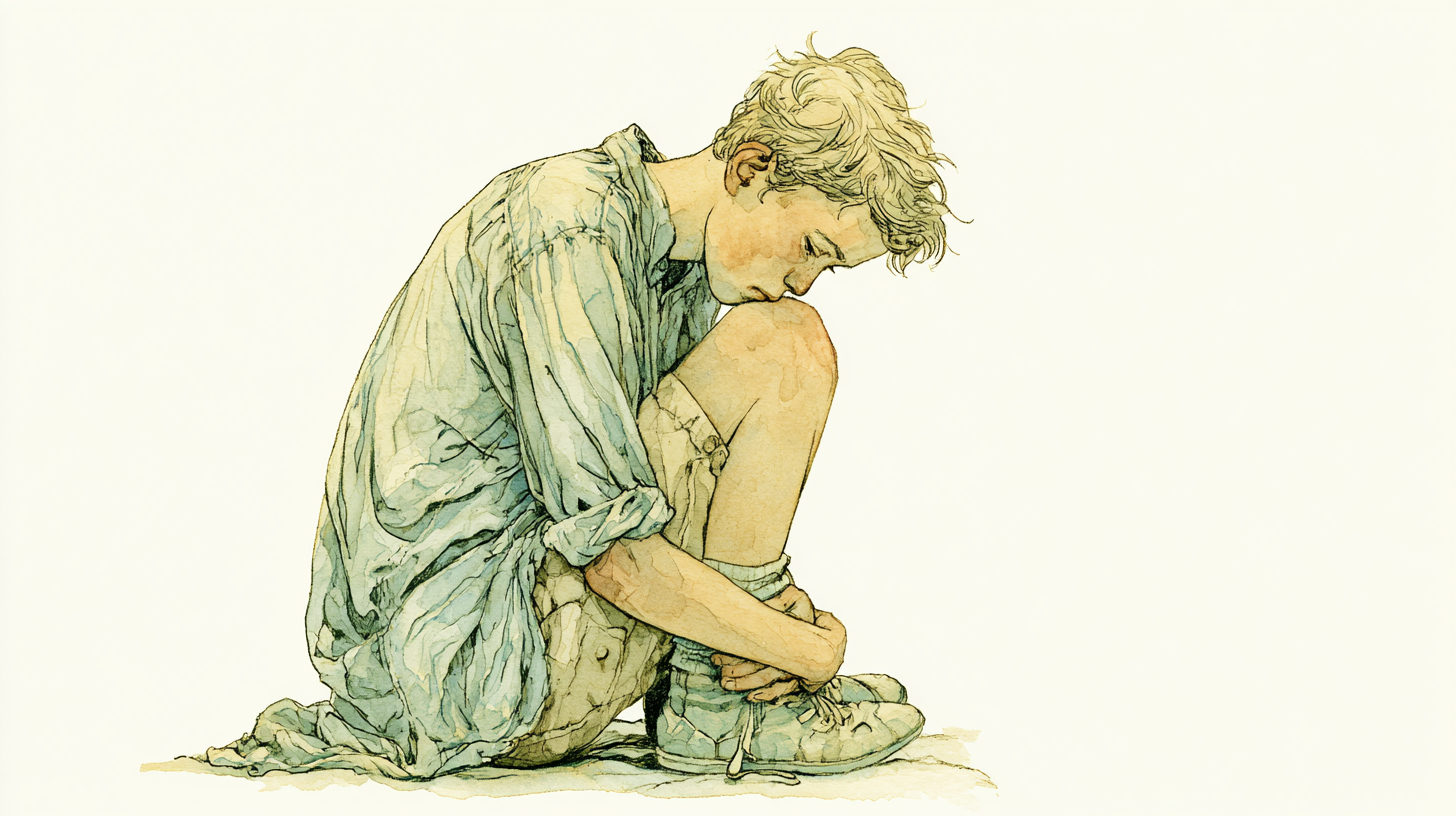
Punishment intensifies shame because a teen who already judges themselves harshly hears a consequence as proof that they are the problem. Shame pushes teens to hide, defend, or shut down instead of change. A calm, firm limit that keeps the relationship intact teaches more than a heavy consequence does.
The instinct, when a teen does something hard, is to make sure they understand it mattered. The traditional way to do that is a consequence delivered with weight.
The trouble is that many tweens and teens already carry a baseline of self-judgment that adults don't see. Into that, the same consequence can land as confirmation: I am the bad one. Once that loop starts, the behavior often gets worse, not better.
Is shame the same thing as guilt?
Guilt says I did something I'm not proud of. Shame says I am something I'm not proud of. Guilt usually motivates change. Shame usually motivates hiding, defending, or numbing.
Most punishment is delivered hoping for guilt. With teens already carrying internal criticism, it often arrives as shame instead. The difference is everything.
Why this matters more in adolescence
Teen brains are wired to be hyper-attuned to social standing and adult appraisal. A sharp tone, a "you should know better," a withdrawal of warmth — these read much louder than they would have at seven. A teen who looks unaffected often isn't.
Signs your teen has gone into shame
A teen in shame rarely says so. You see it in what follows: a flat "I don't care," a slammed door, a joke that deflects, a long silence at dinner, or blame that swings back at you. Some teens go quiet and agreeable on the outside while criticizing themselves in private. Others get louder, because defending is easier than feeling the sting.
The common thread is that the conversation stops being about the behavior. Your teen is now managing how they look to you. When you see that shift, the consequence you planned will not teach what you meant it to. Pause, lower your voice, and come back to it when they can hear you.
What tends to soften shame instead of feeding it
- Repair the relational thread first. Even one calm sentence — "we're okay" — before the conversation about the behavior.
- Slow down the timing. Most useful conversations don't happen in the heated moment. The next morning is fine.
- Separate the behavior from the person. "That choice didn't work" is different from "you're irresponsible."
- Hold the limit anyway. Compassion and a clear no can live in the same sentence.
- Don't moralize after. The teen heard you. Repeating it amplifies shame, not learning.
What the research says
The American Academy of Pediatrics addressed this in its 2018 policy statement on discipline. It points to the harm of verbal punishment such as shaming or humiliation, and it notes that harsh punishment does not improve behavior over the long term. Methods that teach right from wrong are safer and more effective.
Research on children's moral emotions points the same direction. A study that followed 380 fifth graders into young adulthood found that guilt-prone children had fewer risky and illegal behaviors later, while shame-prone children were more likely to have unprotected sex and use illegal drugs. Guilt and shame led in different directions.
While you're here, take the guide
What's Underneath is free: the three body-state triggers under most meltdowns, what to say in the minute before it tips over, and how to reset afterward.
You'll get the guide instantly, plus five free articles in your inbox every week. Real challenges (meltdowns, school mornings, picky eating, big feelings) and how to actually handle them. Unsubscribe anytime.
What does connection before correction look like?
The phrase comes out of Jane Nelsen's Positive Discipline tradition, and it is not permissiveness. It is recognizing that a teen in a shame state cannot really receive guidance — the system that takes in correction is offline. Five minutes of genuine connection is often the difference between a conversation that lands and one that bounces off armor.
For more on this, see Connection Before Correction.
What to do when you've already overcorrected
Most parents do, sometimes. The repair after a too-sharp moment is often the most important parenting move available — and one of the most underestimated. A short, real acknowledgment ("I came in too hot last night, that wasn't about you") models something a teen will silently file away for years.
Where LightMap fits
Tracking patterns helps you see whether your responses are softening or hardening something over time. Not as a report card on parenting — as information about what's working in your particular family. Try LightMap free for two weeks.
Related
Frequently asked questions
Are you saying there shouldn't be any consequences?
Not at all. Consequences and limits are part of how kids learn the shape of the world. The point isn't to remove them; it's to notice that punishment delivered into an already shame-soaked nervous system tends to deepen the shame instead of changing the behavior.
How do I hold a limit without it landing as punishment?
Tone, timing, and order of operations. The same words land differently when the relationship is intact, when the moment isn't peak activation, and when the teen feels you still see them as a whole person — not only as the behavior.
What if my teen seems unaffected by anything I do?
'Unaffected' is often a protective layer over a system that is feeling far too much. Teens who appear coolly indifferent are sometimes the ones with the loudest internal weather. Less reactive responses from you tend to give that layer permission to soften over time.
How can LightMap help here?
Tracking what tends to happen before, during, and after a hard moment helps you see whether your responses are softening the pattern or hardening it. That's information, not judgment.
For your child: Theo's Invisible Backpack is about a young bear who starts collecting invisible stones when other animals tease him, adds more of his own over the years, and whose mother finally picks each one up asking who said that.
Sources: Sege RD, Siegel BS, "Effective Discipline to Raise Healthy Children," American Academy of Pediatrics policy statement, Pediatrics, 2018. Stuewig J, Tangney JP, Kendall S, Folk JB, Meyer CR, Dearing RL, "Children's Proneness to Shame and Guilt Predict Risky and Illegal Behaviors in Young Adulthood," Child Psychiatry and Human Development, 2015, volume 46, issue 2, pages 217-227.
For education and reflection, not medical advice. Our terms
See what's underneath
Stop guessing what set it off
LightMap reads your hard days together and gives you answers. Start with one moment today.
Start with 3 moments Not sure where to start? Ask me.Message Tara on WhatsApp. It really is me, I read everything and will personally respond.Click here to message Tara →

Part of the award-winning Birch & Light Method, honored with the Mom's Choice Gold Award for excellence in family resources.
A story to read together
Sometimes the easiest way in is a story you read side by side.
 The Tower That Looked Fine
A tower in a quiet clearing tries to stay steady through every small thing nobody else seems to notice — until one tiny breath of wind causes her to fall, and a gentle hand begins to gather the blocks back.
Read the story The Boy at the Edge
A boy finds calm by watching the world move from a window. When his stillness is mistaken for defiance, the moment escalates — and he learns that being calm doesn’t always protect you from being told no.
Read the story
If today was one of those days
A few more from the library, free to read.
Researched and drafted with AI assistance, reviewed before publication. Editorial standards