
There is a whole genre of parenting content built to make you feel like you have already ruined your child.
You know the shape of it. A numbered list of mistakes. A warning that a developmental window is about to close. A line near the end telling you that most parents do these things out of love, offered as absolution right before the invitation to comment for the free guide. The list is almost always addressed to mothers.
The version circulating hardest right now argues that every adult who reaches for something to numb themselves was once a child whose parents removed their discomfort too quickly. Soothe the hard feeling every time it appears, the argument goes, and you build an adult who cannot survive one.
If you are raising a child who is anxious, autistic, ADHD, demand sensitive, or simply wired to feel things at higher volume, this genre lands on you harder than on anyone else. You accommodate more than other parents do. You have had to. And now something on your phone is telling you that the accommodating is the problem.
Here is the honest version, including the parts the guilt posts leave out.
What these posts get right
Distress tolerance is a real construct, not a wellness invention. It is the capacity to feel something unpleasant without immediately acting to make it stop, and it does strengthen with practice. Low distress tolerance is associated with a range of poor outcomes in adulthood, substance use among them.
Emotion socialization is real too. How the adults in a home respond to a child's anger, fear, and sadness shapes how that child learns to handle those states later. Dismissing feelings, mocking them, or punishing their expression is linked to weaker regulation down the line. That research is decades deep and it holds up.
And the accommodation piece has the strongest evidence of anything in those carousels, though it comes from anxiety treatment rather than addiction research. When parents systematically reduce the accommodations they have built around a child's anxiety, the child's anxiety measurably improves. That finding is robust enough that entire treatment protocols are built on it.
So the raw material is not junk. What gets done with it is another matter.
What they get wrong
There is no window that closes at age ten. This is the claim that makes the whole thing feel urgent, and it is invented. Emotion regulation continues developing into the mid twenties. Adolescence is a period of heightened neural plasticity, not the end of one. Adults learn distress tolerance skills in therapy every day and the skills work. A specific age gives a vague warning the ring of neuroscience, which is the entire reason it is there.
Two weeks does not change a decade of patterns. Evidence-based parent training programs run eight to sixteen weeks at minimum, with coaching, and the gains arrive unevenly. A two week promise is a sales figure.
One cause is never the story. Substance use disorders are substantially heritable. Age of first use matters enormously. So does access, peer environment, trauma, and whether a co-occurring condition like ADHD or depression is being treated. Plenty of people develop a dependency in their forties after a surgery and a prescription, having been raised by parents who never rescued them from anything. The claim that every unhealthy coping strategy traces back to a childhood without enough practice is not a finding. It is a story shape.
The arrow points both ways. Temperament is heritable. A child born with a more reactive nervous system is genuinely harder to soothe, and parents of those children accommodate more because the accommodating is what works. The research shows a loop, with child and parent shaping each other continuously. The guilt posts take that loop, cut it in half, and hand you the half where it is your fault.
The distinction nobody hands you
Underneath all of this sits a real question, and it is one you cannot answer with a list of five mistakes: when is stepping in the right call, and when is it the thing that keeps your child small?
The clearest way I know to think about it is this. Accommodation removes a barrier. Rescuing removes a feeling.
From the outside they can look identical. The difference is in what the action is doing.
Noise reducing headphones for a child whose auditory system genuinely cannot process a gymnasium are accommodation. The sound is not a feeling to be tolerated, it is an input that overwhelms the system. The headphones do not shrink your child's world. They are the reason your child can be in the gym at all.
Doing your child's science project the night before because they are crying and you cannot stand it is rescuing. The feeling was frustration. Frustration was survivable. What got removed was the chance to find that out.
Most real situations sit somewhere between those two, which is why a rule will not save you. What helps is a set of questions.

There's a story for this exact struggle
The Tower That Looked Fine
A tower in a quiet clearing tries to stay steady through every small thing nobody else seems to notice — until one tiny breath of wind causes her to fall, and a gentle hand begins to gather the blocks back.
Free to read. You'll also get five free articles a week. Unsubscribe anytime.
Four questions that sort it out
1. Am I removing the barrier or the feeling? A barrier is something your child's nervous system or skill set cannot currently get past. A feeling is something uncomfortable that happens on the way past it. Sensory input, executive function gaps, and genuine skill deficits are barriers. Boredom, disappointment, frustration, and mild anxiety are usually feelings.
2. Is this expanding my child's world or shrinking it? Real accommodation makes more possible over time. The headphones mean more places, not fewer. If a support has been quietly narrowing where your child can go, what they will attempt, or who they will speak to, it has drifted into something else, however it started.
3. Could they do this with support, or not yet at all? If the answer is with support, then support is the move, not doing it for them. Sitting beside them while they email the teacher is different from sending the email.
4. Who is this actually for? Sometimes you step in because your own nervous system is at the end of its rope, and stepping in is the fastest route to quiet. That is a legitimate thing to do on a hard Tuesday. It stops being fine when it is the whole strategy and you have never named it.
Before you go, grab the free guide
The 3 body-state triggers under most meltdowns, a script for the 30 seconds before it tips over, and a reset for after. Free.

You'll get the guide instantly, plus five free articles in your inbox every week. Real challenges (meltdowns, school mornings, picky eating, big feelings) and how to actually handle them. Unsubscribe anytime.
If it is rescuing, shrink it before you remove it
The instinct after reading something like this is to go cold turkey. Stop the reassurance, stop the smoothing, let them sit in it. That approach tends to blow up, particularly with kids who are already dysregulated, because you have removed a support without putting anything in its place.
Shrinking works better than stopping.
Halve it. If you normally answer the same worry six times, answer it twice and then move to a warm, repeated phrase that is not an answer. Something like we already know the answer to that one, and I know it is hard to wait.
Delay it. Add ninety seconds before you step in. Not as a test, just as room. A surprising number of moments resolve themselves inside that window when nobody fills it.
Narrate what is happening. Children who can name a state tolerate it longer. This is the frustrated part. It gets loud and then it gets quieter. You are not fixing it, you are giving them a word to hold it with.
Pick one place, not five. Choose the accommodation that is costing your family the most and work only on that one for a month. The five item list format exists because five items feel comprehensive, not because anyone can change five things at once.
About the blame
I want to be direct about the part of this that made me want to write it.
Telling parents that their child's future dependency was authored at the kitchen table is not new. It is the same move that produced refrigerator mothers and schizophrenogenic mothers, both of which were confidently asserted, widely believed, and wrong. Families carried that for decades.
Al-Anon has been telling parents for generations that they did not cause it, cannot control it, and cannot cure it. That framing exists because parental guilt around a child's substance use is corrosive and does not help anybody recover. It ranks among the least useful things a struggling family can be handed.
Which does not mean nothing you do matters. It matters a great deal. It is simply not the only thing that matters, and it is not a lever with a deadline on it.
If your child is twelve, or fifteen, or twenty, and you just read that you missed the window: you did not miss anything. The capacity to sit with a hard feeling can be built at any age, by them and by you, and the version of you who wants to build it is already the version doing the work.
The map is this: accommodation removes a barrier and rescuing removes a feeling, the difference lives in the function rather than the behavior, and no window is closing on you. Where a support has drifted, shrink it rather than tearing it out, one at a time, with your child's nervous system in mind rather than a stranger's numbered list.
The drift from accommodation to rescuing happens too slowly to notice from inside it. Logging the moments you step in through LightMap shows you the pattern that daily life hides.
Related reading: When Reassurance Makes Your Child's Anxiety Worse.
For education and reflection, not medical advice. Our terms
See what's underneath
Stop guessing what set it off
LightMap turns scattered hard days into a pattern you can see. Start by logging one moment tonight.
Log today's hard moment, no account needed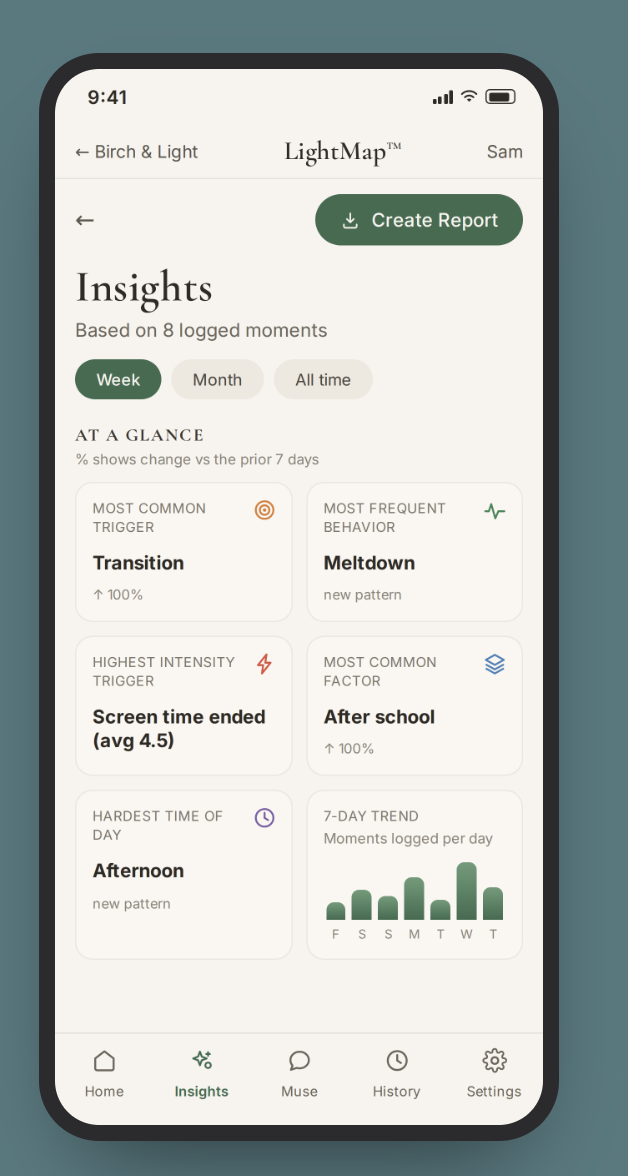

Part of the award-winning Birch & Light Method, honored with the Mom's Choice Gold Award for excellence in family resources.
A story to read together
Sometimes the easiest way in is a story you read side by side.
- The Tower That Looked Fine
A tower in a quiet clearing tries to stay steady through every small thing nobody else seems to notice — until one tiny breath of wind causes her to fall, and a gentle hand begins to gather the blocks back.
Read the story  The Boy at the Edge
A boy finds calm by watching the world move from a window. When his stillness is mistaken for defiance, the moment escalates — and he learns that being calm doesn’t always protect you from being told no.
Read the story
Researched and drafted with AI assistance, reviewed before publication. Editorial standards