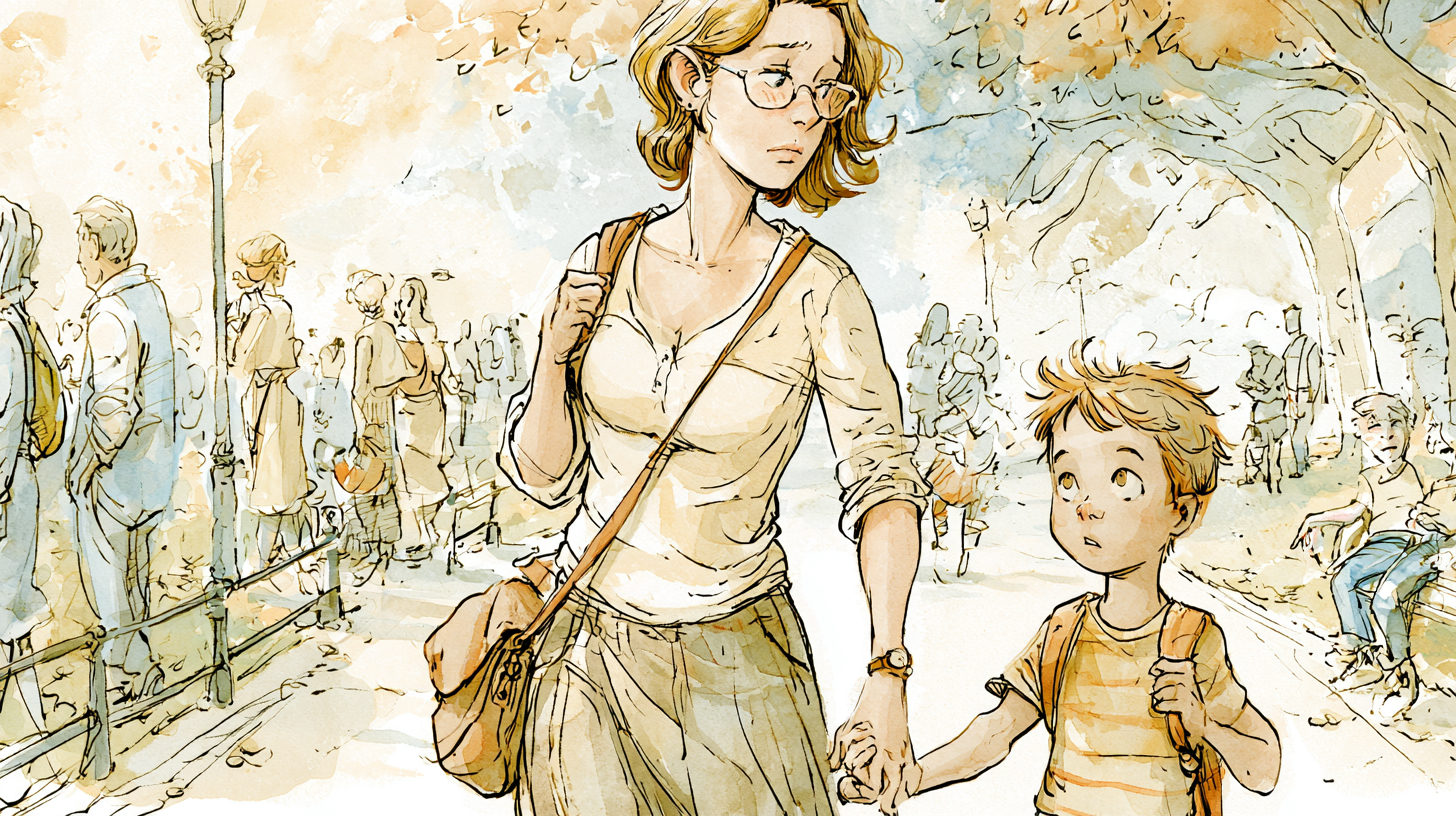
Apologizing for your child all the time is usually not shame. It is exhaustion from being his full-time translator and defender in a world that misreads him. Each sorry is a small act of protection, and you can swap it for a calm description of who he is.
There is a sentence that lives in the mouths of certain parents, ready to deploy before anyone has even reacted. "Sorry about him." "Sorry, he talks a lot." "Sorry if he was bothering you." You say it at the park, at the grocery store, at the family gathering, sometimes before your child has done anything at all, because you have learned to apologize preemptively for the space he takes up in the world. And somewhere underneath the hundredth apology, a quiet awful thought forms: I am ashamed of my own child, and hating myself for feeling it.
If that is you, put down the self-hatred for a minute, because what you are feeling is not what you think it is, and you are not the parent you are afraid you are.
You are not ashamed of your child. You are exhausted from defending him.
This distinction matters more than almost anything else here. The feeling that curdles in public is rarely actual shame about who your child is. It is the bone-deep fatigue of being your child's full-time translator and defense attorney in a world that keeps misreading him.
Every apology is a tiny act of protection. You are trying to get ahead of the judgment, to explain him before someone else can condemn him, to build a little verbal shield between your kid and the stranger's face. That is not the behavior of a parent who is ashamed of their child. It is the behavior of a parent braced, constantly, to defend one. What looks like embarrassment from the outside is love running on empty.
Are those disapproving faces real?
Here is something worth sitting with: you have become an expert reader of strangers' expressions, and expertise like that comes at a cost. When you spend years anticipating judgment, your brain gets very good at finding it, sometimes where it is and sometimes where it is not. A neutral face becomes a disapproving one. A tired cashier becomes a critic. The filter that scans every room for threat to your child does not switch off, and it is not always accurate.
Some of the judgment is real; people can be unkind about children they do not understand. But some meaningful portion of those disapproving faces exists mostly in the exhausted, hypervigilant part of your mind that has been burned before. You cannot always tell which is which in the moment, and living in that uncertainty is its own specific tax.
The apology reflex has a cost to your child
This is the gentlest hard truth in this piece. Your child hears the apologies. A kid who grows up listening to a parent constantly say sorry for his existence, even lovingly, even protectively, slowly absorbs a message: who I am is something that needs apologizing for. The reflex you built to shield him can, over years, become a small steady leak into his sense of self.
This is not one more thing to feel guilty about. It is a reason to aim the change where it actually helps, which turns out to be a relief, because the alternative is lighter than the apologizing.
While you're here, take the guide
What's Underneath is free: the three body-state triggers under most meltdowns, what to say in the minute before it tips over, and how to reset afterward.

You'll get the guide instantly, plus five free articles in your inbox every week. Real challenges (meltdowns, school mornings, picky eating, big feelings) and how to actually handle them. Unsubscribe anytime.
What can you say instead of sorry?
Drop the preemptive sorry. When you feel the reflex fire, try saying nothing, or try a neutral fact instead of an apology. "He's got a lot of energy today" is not a confession. Most strangers you were apologizing to had not formed the judgment you were racing to prevent.
If something needs saying, describe instead of apologize. "He's really excited to tell you about trains" reframes your child as a whole person rather than a disturbance. Same information, opposite message, and your child hears that version too.
Notice the public nagging. The running commentary of "calm down, stop, please" is often less about managing your child and more about performing for the audience, showing the watching strangers that you are trying. Your child does not need the performance and it rarely helps his behavior. Dropping it is better for both of you, even though it means tolerating the imagined gaze.
Find the people who do not require the apology. Every parent in this position needs at least a few spaces, and a few faces, where their kid can simply be, no translation required. Those spaces are where you both exhale, and they exist more than it feels like right now.
The reframe worth keeping
The next time the sorry rises to your lips, try to hear it for what it actually is: not evidence that you are ashamed of your child, but evidence of how hard you have been working to protect him, for how long, with how little rest. The goal is not to shame yourself out of the apologizing. It is to notice that your child was never the thing that needed apologizing for, and neither were you. If the public meltdowns themselves are part of what has you bracing, the safety plan for hard moments may help with the underneath of it.
The situations that end in an apology are more predictable than they feel from inside them. Logging them in LightMap usually reveals a handful of repeating conditions rather than a general problem.
Sources: Kinnear SH, Link BG, Ballan MS, Fischbach RL, "Understanding the experience of stigma for parents of children with autism spectrum disorder and the role stigma plays in families' lives," Journal of Autism and Developmental Disorders, 2016, 46(3), 942-953. Gray DE, "Everybody just freezes. Everybody is just embarrassed: Felt and enacted stigma among parents of children with high functioning autism," Sociology of Health and Illness, 2002, 24(6), 734-749.
For education and reflection, not medical advice. Our terms
See what's underneath
Stop guessing what set it off
LightMap reads your hard days together and gives you answers. Start with one moment today.
Start with 3 moments Not sure where to start? Ask me.Message Tara on WhatsApp. It really is me, I read everything and will personally respond.Click here to message Tara →

Part of the award-winning Birch & Light Method, honored with the Mom's Choice Gold Award for excellence in family resources.
A story to read together
Sometimes the easiest way in is a story you read side by side.
 The Tower That Looked Fine
A tower in a quiet clearing tries to stay steady through every small thing nobody else seems to notice — until one tiny breath of wind causes her to fall, and a gentle hand begins to gather the blocks back.
Read the story The Boy at the Edge
A boy finds calm by watching the world move from a window. When his stillness is mistaken for defiance, the moment escalates — and he learns that being calm doesn’t always protect you from being told no.
Read the story
If today was one of those days
A few more from the library, free to read.
Researched and drafted with AI assistance, reviewed before publication. Editorial standards