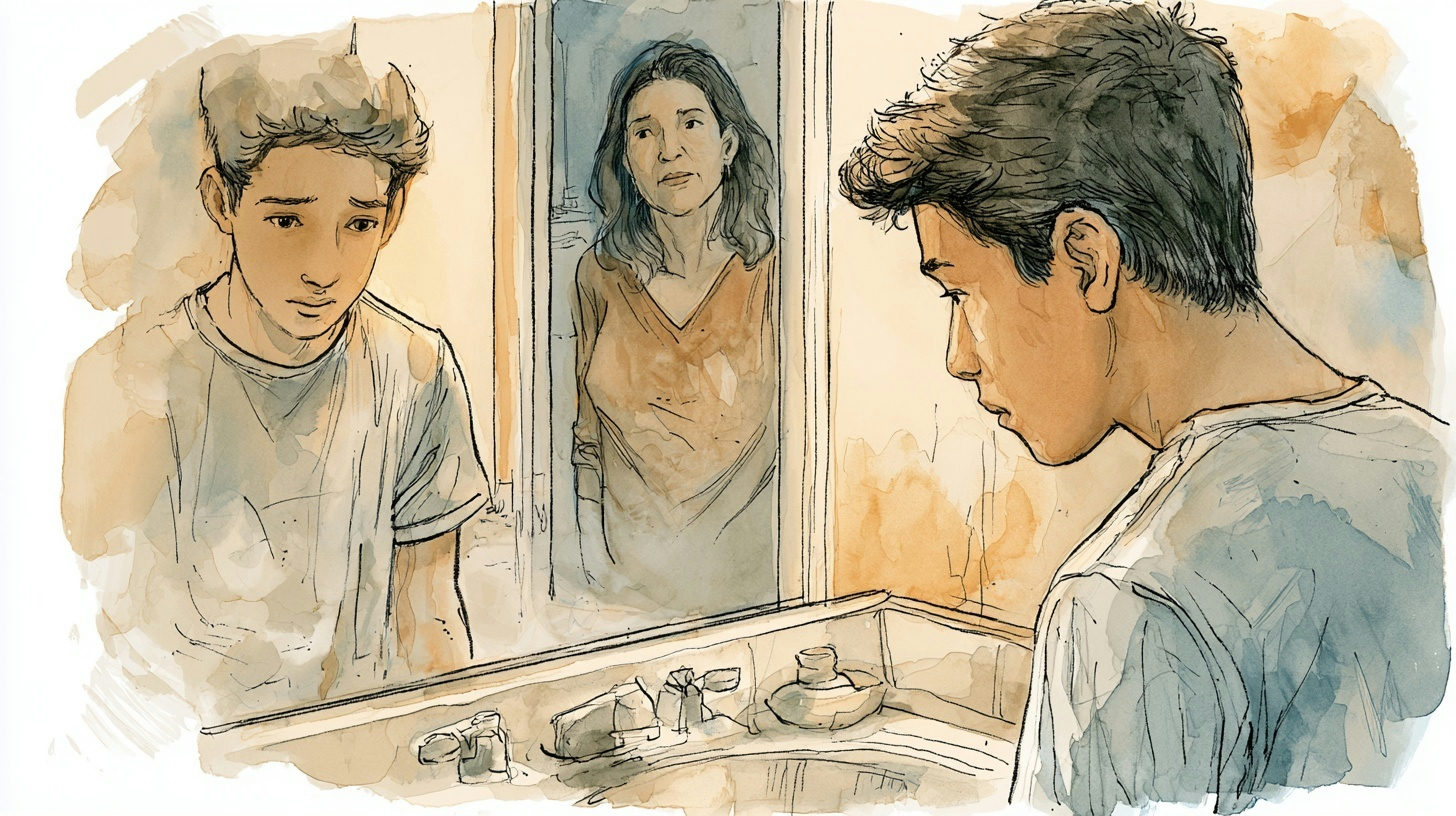
It usually starts quietly. A teenager begins spending too long in front of the mirror, or refuses to be in photos, or fixates on one specific feature that nobody else can see a problem with. You try logic. Logic bounces off. The distress is real, the feature is fine, and the gap between those two facts starts swallowing school, friends, and daily life.
And if you are a family who already knows PANS or PANDAS from another child, a specific question starts forming: could this be the same thing wearing a different costume?
It is a better question than it might sound. Here is what is actually known.
What body dysmorphia actually is
Body dysmorphic disorder is not vanity and it is not ordinary teenage self-consciousness. It sits on the OCD spectrum. The engine is an obsession, an intrusive preoccupation with a perceived flaw, paired with compulsions: mirror checking or mirror avoidance, camouflaging, comparing, asking for reassurance that never lands. That is why reasoning with it fails. The teen is not making a logic error you can correct. They are stuck in an obsessive loop, and the loop does not take arguments. BDD most often emerges in adolescence, boys included, and it frequently brings depression along with it, because living inside that loop is exhausting and demoralizing.
The honest answer on the PANS question
PANS is defined by the abrupt, dramatic onset of OCD or severe food restriction, together with other neuropsychiatric symptoms. Since BDD lives on the OCD spectrum, a sudden-onset appearance obsession is a legitimate thing to bring to a PANS-literate clinician, especially in a family where PANS already exists, because vulnerability runs in families.
Here is the part an honest writeup has to include: direct research on BDD as a PANS presentation is thin. There are clinicians who have seen OCD-spectrum symptoms, including appearance obsessions, shift when an underlying infection or inflammation was treated, and there are case-level reports, but nobody can honestly promise that treating it like PANDAS will resolve it. The question is reasonable. Certainty, in either direction, is not. Which is why the right frame is not either-or. It is both tracks at once.
While you're here, take the guide
What's Underneath is free: the three body-state triggers under most meltdowns, what to say in the minute before it tips over, and how to reset afterward.

You'll get the guide instantly, plus five free articles in your inbox every week. Real challenges (meltdowns, school mornings, picky eating, big feelings) and how to actually handle them. Unsubscribe anytime.
The clue that deserves the most attention
When two children in one house shift at the same time, after a shared change like a move, a renovation, or a new school year, that timing is data. Shared environment means shared exposures, and the most actionable version of that idea is also the most boring one: infections travel through households. A PANS-literate clinician will often want strep testing across the family, including throat cultures for people with no symptoms, because silent strep carriage in a sibling or parent can keep re-triggering a susceptible child. If a broad workup is underway, make sure the unglamorous infectious basics are on the list: throat culture, strep titers, and the household screen. Those are the findings that actually change treatment. And for any test on any panel, the question worth asking before the blood draw is the same one: if this comes back positive, what specifically will we do differently?
It is also worth naming that a move is one of the biggest stress events a family can go through, and major stress alone can ignite both anxiety-spectrum symptoms and flares in already-susceptible kids. Stress is not a consolation-prize explanation. It is a physiological one.
Do not pause the therapy while you investigate
Whatever the upstream cause turns out to be, the treatment with the strongest evidence for BDD itself is cognitive behavioral therapy with exposure and response prevention adapted for BDD, sometimes alongside medication managed by a prescriber who knows this condition. ERP is not generic talk therapy, and it is worth asking your teen's therapist directly whether that is what they are doing. Here is the reframe that helps: ERP works on the loop regardless of what lit the fuse, the same way physical therapy helps a knee no matter what inflamed it. Investigating inflammation and doing ERP are not competing plans. They are the upstream track and the downstream track of the same plan.
One more thing, said gently. BDD is heavy for teenagers, and when depression rides along, it deserves its own attention rather than being filed as a side effect of the worry. Keep the therapist and any prescriber talking to each other, and let appointments include a direct, calm question about how dark things get. Teens often answer honest questions they were never asked.
Timing is evidence in these families. Logging the intensity of the fixation day by day, alongside what is happening in the household, in a tool like LightMap, can reveal whether two kids' symptoms actually move together, which is precisely the pattern a PANS-literate doctor wants to see.
Watching a capable teen get consumed by something invisible to everyone else is heartbreaking. But you are not choosing between believing the biology and believing the psychology. Run both tracks, insist on the boring tests, keep the ERP going, and let the timeline you are uniquely positioned to see do the arguing for you.
For education and reflection, not medical advice. Our terms
See what's underneath
Stop guessing what set it off
LightMap reads your hard days together and gives you answers. Start with one moment today.
Start with 3 moments Not sure where to start? Ask me.Message Tara on WhatsApp. It really is me, I read everything and will personally respond.Click here to message Tara →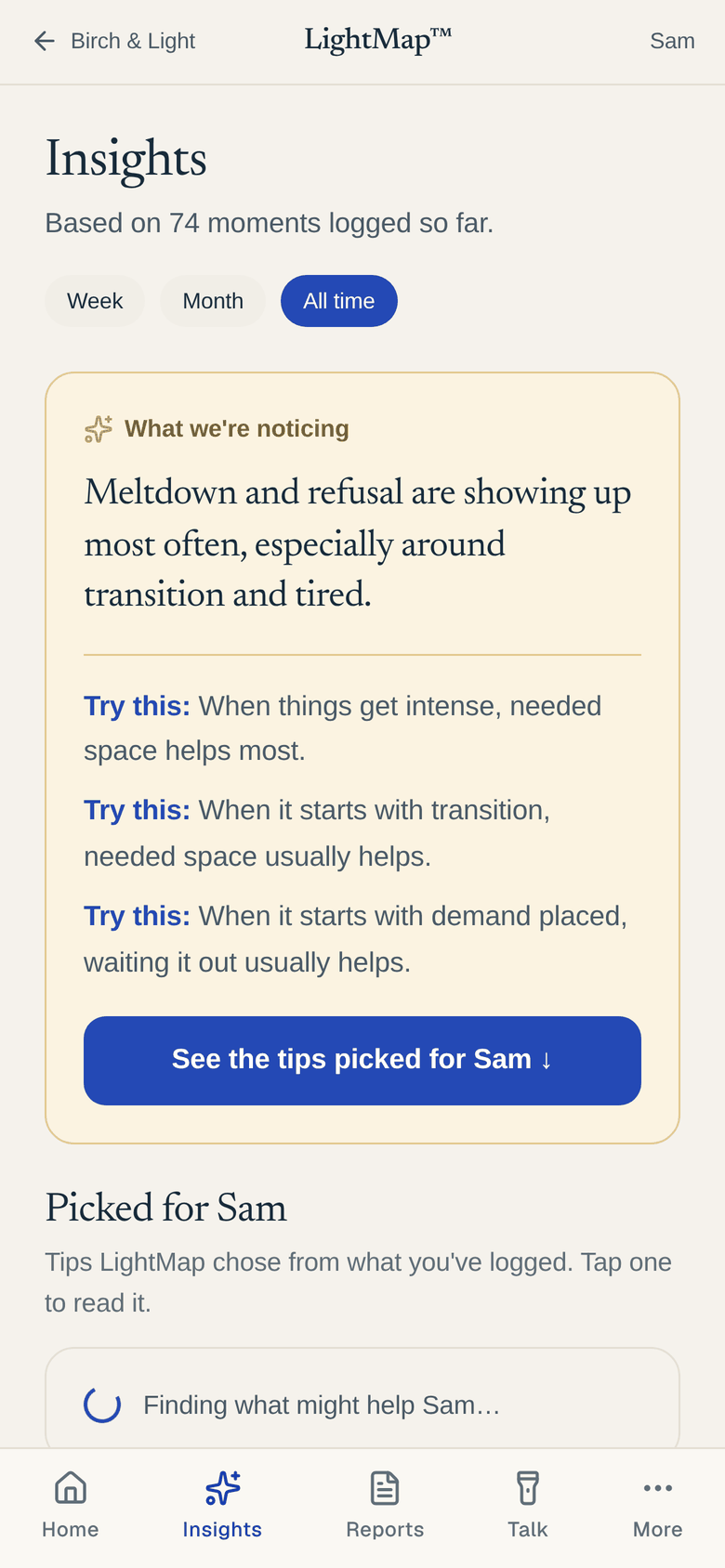

Part of the award-winning Birch & Light Method, honored with the Mom's Choice Gold Award for excellence in family resources.
A story to read together
Sometimes the easiest way in is a story you read side by side.
 The Tower That Looked Fine
A tower in a quiet clearing tries to stay steady through every small thing nobody else seems to notice — until one tiny breath of wind causes her to fall, and a gentle hand begins to gather the blocks back.
Read the story The Boy at the Edge
A boy finds calm by watching the world move from a window. When his stillness is mistaken for defiance, the moment escalates — and he learns that being calm doesn’t always protect you from being told no.
Read the story
If today was one of those days
A few more from the library, free to read.
Researched and drafted with AI assistance, reviewed before publication. Editorial standards