

Every parent of a PDA child has felt this whiplash. Your kid is falling apart, so you do the thing every gentle-parenting source told you to do. You move close, you soften your voice, you say are you okay, come here, let me help. And your child, who is clearly drowning, pushes you away harder. The very thing that should soothe them makes the storm worse, and you are left wondering what is wrong with your comfort.
Nothing is wrong with your comfort. You are using a tool built for a different nervous system.
Tired of guessing what set your child off? Log tonight's moment in LightMap.
Why ordinary co-regulation backfires
Co-regulation is real and it matters. A dysregulated child borrows a calm adult's nervous system to find their way back to steady. That part is true for every kid, PDA included. But the standard delivery, moving in with direct soothing and gentle questions, carries something a demand-avoidant nervous system cannot tolerate: it reads as a demand.
Are you okay is a question that requires an answer. Come here is an instruction. Let me help hands control to someone else. To a PDA child in fight or flight, whose entire nervous system is organized around protecting autonomy, each of those lands as one more pressure in a moment that is already unbearable. So they resist the comfort, not because they do not need it, but because accepting it in that form costs them the one thing they are desperate to keep, which is a sense of control over themselves.
This is the cruel puzzle of PDA co-regulation. The child needs connection most in the exact moments when direct connection feels most threatening to them.
Co-regulation through the side door
The answer is not to withdraw. It is to offer regulation without attaching a demand to it. Think of it as co-regulating through the side door instead of the front.
Regulate yourself first, and let her borrow it. This is the biggest lever and the most overlooked. A PDA child reads your body faster than your words. If you drop your shoulders, slow your breathing, and lower your own activation, you become a calm island she can drift toward at her own pace. You are not doing anything to her, which is exactly why it works. Your regulated body is an offer with no strings.
Offer connection with no agenda. Sit near her, not facing her, and do your own thing. Put a snack down without comment and walk away. Start an activity beside her she can join or ignore. Presence without pressure gives her the co-regulation her nervous system needs while leaving her autonomy fully intact.
Drop the words during a spike. Narration, questions, and coaching all demand processing she does not have to spare mid-meltdown. Silence is not neglect here. A quiet, calm, available adult is doing the whole job. Why calm down does not work covers the same point for any dysregulated child, including why the instruction itself adds load.
Cut the eye contact and the closing-in. For many PDA kids, direct gaze and a body moving toward them amplify threat. Sideways, loose, and a step back often lets them come to you.

There's a story for this exact struggle
The Tower That Looked Fine
A tower in a quiet clearing tries to stay steady through every small thing nobody else seems to notice — until one tiny breath of wind causes her to fall, and a gentle hand begins to gather the blocks back.
Free to read. You'll also get five free articles a week. Unsubscribe anytime.
Why it feels like you lost a skill
Parents of older PDA kids often say the same heartbroken thing: co-regulation used to be easy, and now I have no idea how to reach my child. You did not lose the skill. The skill changed, and no one told you.
At two, you regulated your child from the outside in, holding, rocking, soothing directly, and it worked because a toddler's need for closeness outweighed everything. By eight or ten or thirteen, the same direct approach collides with a nervous system that now experiences that closeness as control. It is not that your child needs you less. It is that the delivery has to get quieter and more indirect as they grow, precisely because the need for autonomy grows alongside the need for connection.
So the sighing, the sitting nearby, the wordless snack, the calm body, these are not lesser forms of comfort. They are the advanced version, the co-regulation that meets a demand-avoidant kid where they actually are.
The reframe that carries you
When your child pushes away your comfort, try hearing it not as rejection but as information: this delivery is too much pressure right now, send it another way. The bored, clingy, melting-down loop so many PDA parents describe is usually the same message underneath, can you hold steady while I fall apart, and the answer is yes, just quietly, sideways, and without asking anything back.
The pattern is worth tracking: log which soothing approaches settle your child and which escalate them, in a tool like LightMap, and within a couple of weeks you will see your own child's map, the specific side doors that work for the specific kid in front of you.
You are not failing at comforting your child. You are learning to comfort a nervous system that needs the comfort disguised as freedom. Those are different jobs, and the second one is the harder, quieter art almost no one teaches you.
For education and reflection, not medical advice. Our terms
See what's underneath
Stop guessing what set it off
LightMap turns scattered hard days into a pattern you can see. Start by logging one moment tonight.
Find out why it keeps happening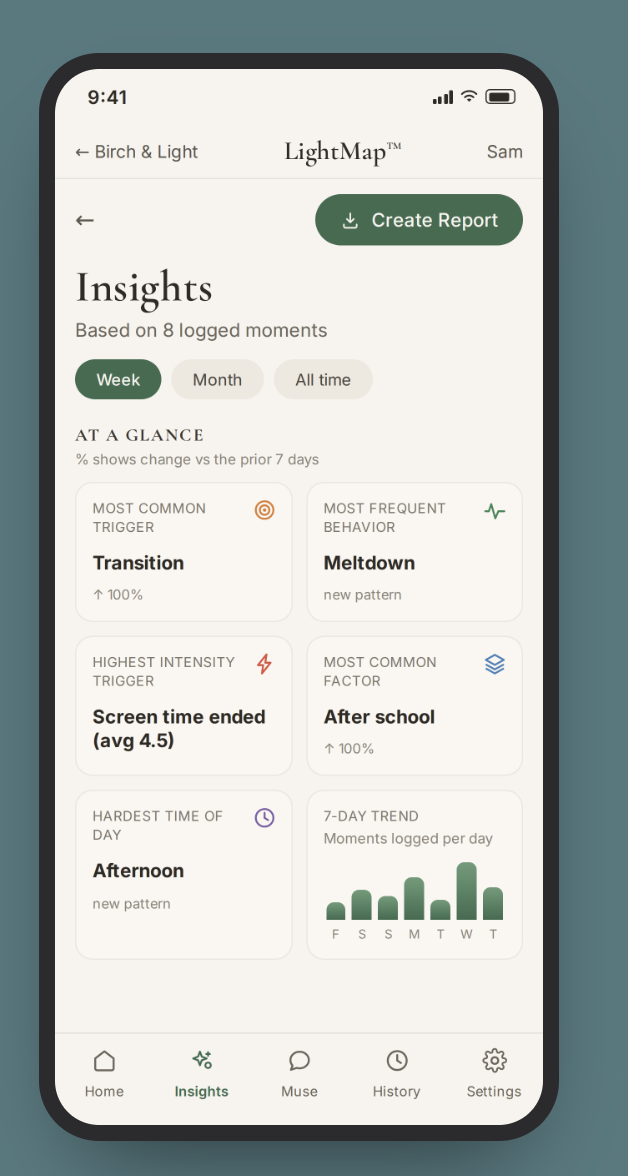

Part of the award-winning Birch & Light Method, honored with the Mom's Choice Gold Award for excellence in family resources.
Before you go, grab the free guide
The 3 body-state triggers under most meltdowns, a script for the 30 seconds before it tips over, and a reset for after. Free.

You'll get the guide instantly, plus five free articles in your inbox every week. Real challenges (meltdowns, school mornings, picky eating, big feelings) and how to actually handle them. Unsubscribe anytime.
A story to read together
Sometimes the easiest way in is a story you read side by side.
- The Tower That Looked Fine
A tower in a quiet clearing tries to stay steady through every small thing nobody else seems to notice — until one tiny breath of wind causes her to fall, and a gentle hand begins to gather the blocks back.
Read the story  The Boy at the Edge
A boy finds calm by watching the world move from a window. When his stillness is mistaken for defiance, the moment escalates — and he learns that being calm doesn’t always protect you from being told no.
Read the story
Researched and drafted with AI assistance, reviewed before publication. Editorial standards