

You are doing everything the professionals recommended. The picture cards are laminated, the routine is consistent, you model them faithfully. And your demand-avoidant child, who clearly has things to say, will use the system only when he decides to, on his terms, in his time. Everyone calls it stubbornness. You are told to be more consistent, push a little harder, stay the course.
Before you push harder, consider a reframe that changes everything: for a PDA child, a communication system can quietly become one more demand, and the resistance you are seeing may be his nervous system reading the whole thing as pressure.
Tired of guessing what set your child off? Log tonight's moment in LightMap.
How a communication tool turns into a demand
Most picture-exchange and AAC teaching is built on a compliance loop, whether or not anyone names it that way. Point to the card, then get the thing. Make the request the right way, then the need is met. Do the communication step, and the reward follows. For most kids that loop is motivating and invisible.
For a PDA nervous system, that same loop can register as a demand wearing a helpful costume. There is a correct action he must perform, in a prescribed way, to get what he needs, and his autonomy radar clocks it instantly. So he resists, not because he cannot communicate and not because he does not want the thing, but because using the tool on cue means complying, and complying is the precise thing his nervous system is built to avoid. The stubbornness is the demand avoidance, pointed at the very system meant to give him a voice.
This is why the harder you press the system, the more he digs in, and why he will happily use a card the moment it is his idea and refuse the identical card when it is asked of him.
Make communication feel like power, not compliance
The shift is to detach the tool from the demand, so that communicating gives him control rather than requiring his obedience.
Model with zero expectation. Use the cards and the device yourself, narrate your own world with them, and ask nothing of him in return. He watches a tool being used freely, with no cue to perform, and freely is the only mode his nervous system trusts.
Let the tool get him something with no strings. When using it delivers pure power, this button plays the song, this card makes the fun thing happen, and nothing is demanded back, the system stops feeling like a hoop and starts feeling like a lever he controls. Power is the one thing a PDA child will reliably reach for.
Offer, never require. A card held out as here is an option you can take is a different object than a card presented as show me the card first. Same laminate, opposite meaning. One expands his control, the other spends it.
Follow his lead into his interests. The motivation that survives demand avoidance is his own. A tool wired into what he already loves gets adopted; a tool wired into what we want him to request gets refused.
Watch for the disguised demand. Even praise can misfire, because good boy for using your words can retroactively turn the free act into a performance he was being evaluated on. Neutral, low-key acknowledgement keeps the autonomy intact.

There's a story for this exact struggle
The Tower That Looked Fine
A tower in a quiet clearing tries to stay steady through every small thing nobody else seems to notice — until one tiny breath of wind causes her to fall, and a gentle hand begins to gather the blocks back.
Free to read. You'll also get five free articles a week. Unsubscribe anytime.
You are already doing this elsewhere
Here is the encouraging part. If you have ever gotten your PDA child through a daily routine by making it feel like his idea, showing the shower cards, walking away, letting him arrive at it himself, then you already know this move. You have been co-authoring choices with him for years. Communication is the same lens pointed at a new target: less get him to request correctly, more give him a tool so powerful and so pressure-free that he chooses to pick it up.
And if a medication or another change has recently settled his nervous system, that window matters. A calmer body has more room to communicate, and a lower baseline of threat means the tool is less likely to read as one more demand. Good timing is real.
Which approaches unlock communication and which shut it down is a pattern worth tracking: log what you offered, the pressure level, and whether he engaged, in a tool like LightMap, and over a couple of weeks the conditions that let your specific child reach for his voice start to come into focus.
He is not refusing to communicate. He is refusing to be made to. Hand him a voice that feels like power instead of compliance, and a demand-avoidant child will often take it, on his own terms, which is the only way he was ever going to.
For education and reflection, not medical advice. Our terms
See what's underneath
Stop guessing what set it off
LightMap turns scattered hard days into a pattern you can see. Start by logging one moment tonight.
Find out why it keeps happening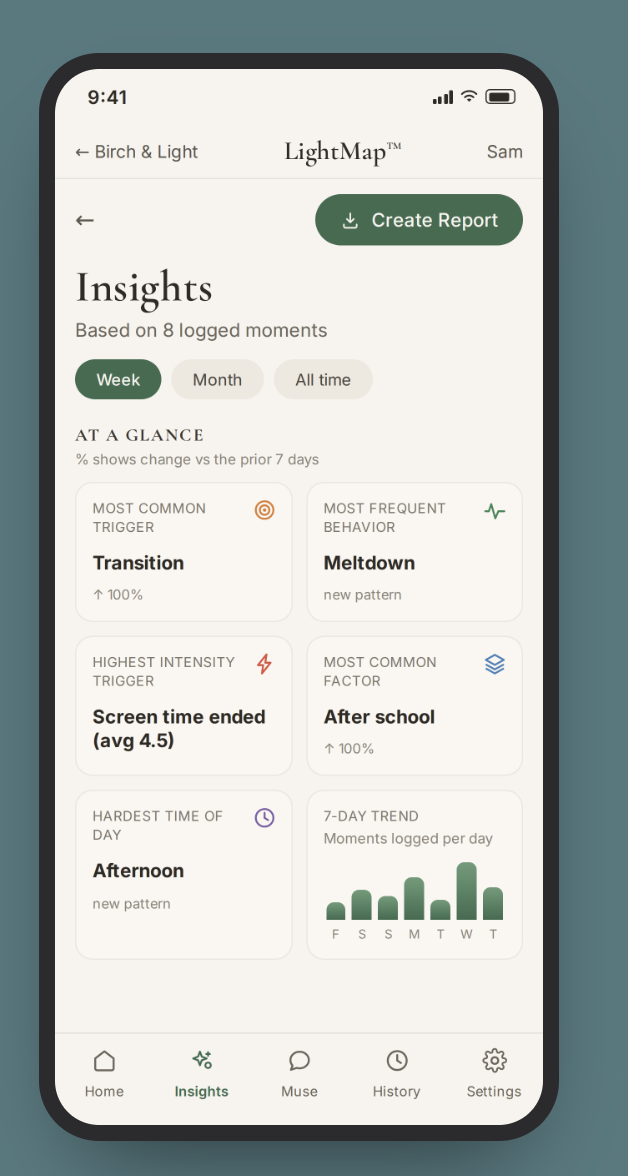

Part of the award-winning Birch & Light Method, honored with the Mom's Choice Gold Award for excellence in family resources.
Before you go, grab the free guide
The 3 body-state triggers under most meltdowns, a script for the 30 seconds before it tips over, and a reset for after. Free.

You'll get the guide instantly, plus five free articles in your inbox every week. Real challenges (meltdowns, school mornings, picky eating, big feelings) and how to actually handle them. Unsubscribe anytime.
A story to read together
Sometimes the easiest way in is a story you read side by side.
- The Tower That Looked Fine
A tower in a quiet clearing tries to stay steady through every small thing nobody else seems to notice — until one tiny breath of wind causes her to fall, and a gentle hand begins to gather the blocks back.
Read the story  The Boy at the Edge
A boy finds calm by watching the world move from a window. When his stillness is mistaken for defiance, the moment escalates — and he learns that being calm doesn’t always protect you from being told no.
Read the story
Researched and drafted with AI assistance, reviewed before publication. Editorial standards