
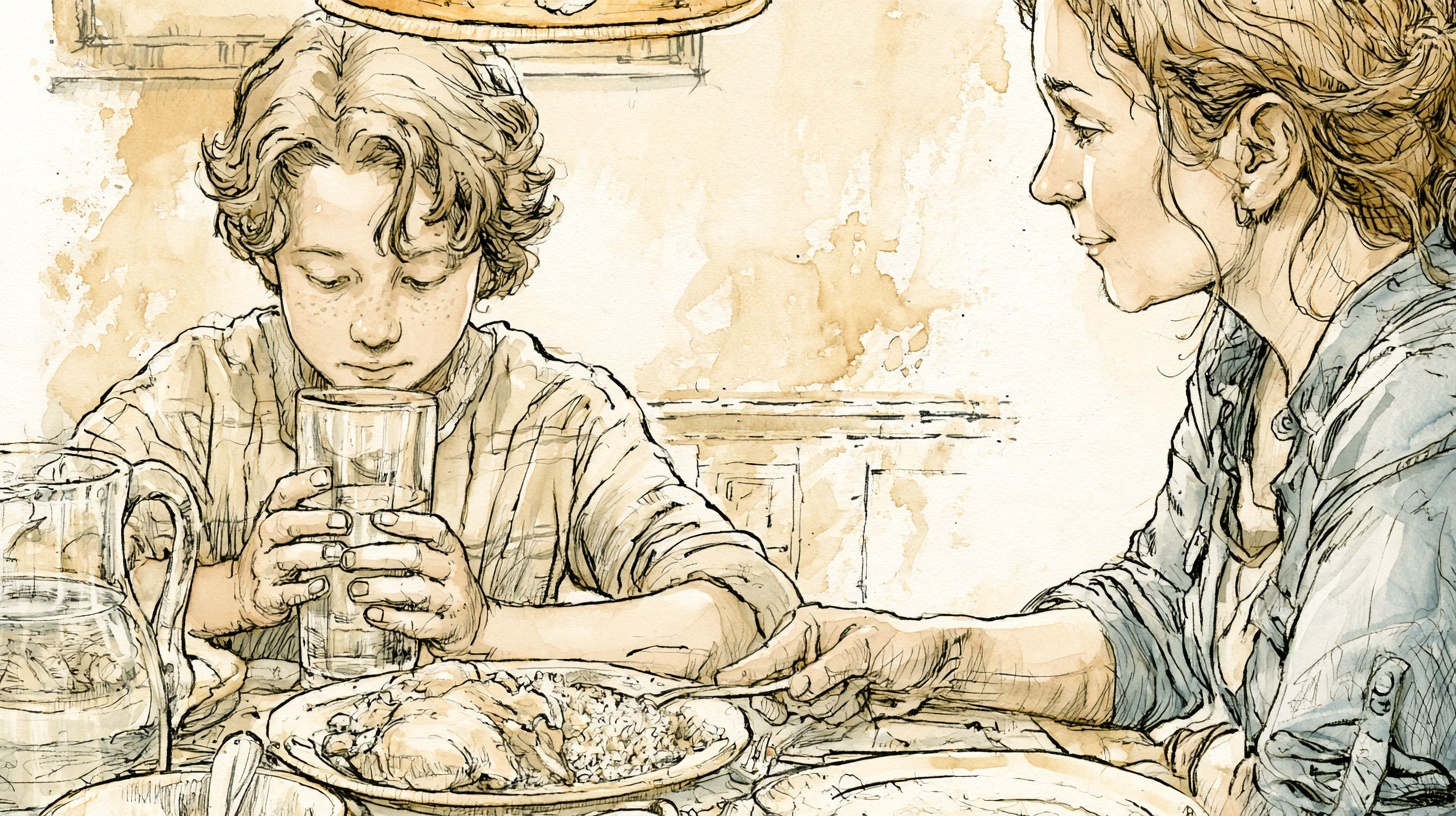
Your child gags on chicken. Drinks a whole glass of water with every few bites. Eats slowly enough that dinner takes forty minutes. Refuses whole textures and has done for years. Somebody has probably called them a picky eater, possibly several people, possibly you.
Or your child has one immune condition already, and you have started noticing that these things travel together, and a name you have never heard comes up in a group thread and you find yourself looking it up at eleven at night.
Eosinophilic esophagitis, EoE, is worth knowing about for both of those parents. It is treatable, it is frequently missed for years, and the reason it is missed is that in children it does not look like what it is.
This is a map, not medical advice. It reflects our best reading of the published research at the time of writing and is offered without guarantee. Your child's doctor is the one who can speak to your child.
What it actually is
EoE is a chronic immune-mediated disease of the esophagus. Eosinophils, a type of white blood cell involved in allergic responses, accumulate in the esophageal lining and drive ongoing inflammation. It is described in the literature as a type 2 antigen-mediated disease, meaning the immune system is reacting to something, most often food proteins, in the same broad family of responses that produces asthma, eczema and food allergy.
Prevalence estimates vary widely depending on the population studied and how cases are counted, which is worth knowing before you meet a confident number. One pediatric figure puts it at around 34 per 100,000 children. A review across all ages estimated 0.5 to 1 per 1,000 globally. Other reviews report a range as wide as 0.2 to 43 per 100,000. What everyone agrees on is that it is diagnosed far more often than it was twenty years ago, and there is genuine debate about how much of that is a real increase and how much is that people are finally looking.
The part that matters most for a parent: it is progressive. Long-running inflammation remodels the tissue, and the esophagus becomes stiffer and narrower, which is how adults end up in emergency departments with food stuck. Treated effectively, that fibrosis can reverse in some patients. That is the argument for finding it rather than waiting.
Why it gets missed in children
In adults, EoE announces itself. Food gets stuck, and that sends people for a scope.
In children it does almost nothing so obvious. The literature describes feeding intolerance and reflux-type symptoms in younger children, and vomiting, regurgitation, chest and upper abdominal pain. What that looks like in a kitchen is a child who eats slowly, drinks constantly with meals, avoids meat and bread and anything dry, cuts food into very small pieces, gags, or simply stops eating things they used to eat.
Every one of those reads as behavior. Which is how a child gets several years of being told to try one bite, or gets a feeding-therapy referral aimed at the anxiety, while nobody scopes the esophagus.
There is one detail in the research that should stop any parent of a selective eater. In a pediatric study of response to acid suppression, food refusal as the presenting symptom was significantly more common among the children whose EoE did not respond to treatment, 87.5% versus 26.3%. Food refusal is not a soft sign in this condition. It is a presenting symptom, and in that group it marked the harder cases.
How it is diagnosed
Only one way, and it is worth knowing before you ask, because it is not a blood test and not an allergy panel.
Diagnosis requires an upper endoscopy with biopsies, and the threshold is at least 15 eosinophils per high-power field in the esophageal tissue, alongside symptoms of esophageal dysfunction and the exclusion of other causes. Current gastroenterology guidance recommends six targeted biopsies from two levels of the esophagus, because the inflammation is patchy and a single sample can miss it.
The endoscopist may also see linear furrows running the length of the esophagus, white plaques, or concentric rings. Those findings are suggestive rather than diagnostic, and the tissue decides.
If your child has been scoped in the past and told everything looked normal, it is worth asking whether esophageal biopsies were actually taken and how many, because a normal-looking esophagus does not rule this out.
What treatment looks like
Four routes, and they are usually described as drugs, diet and dilation.
Acid suppression. High-dose proton pump inhibitors, typically twice daily. Cheap, simple, no dietary restriction, and it works for a substantial minority. In one pediatric cohort, 70% of children were responders after eight to twelve weeks, with 22% achieving complete histological response and 48% a partial one. It is usually the first thing tried, and it is the treatment with the smallest footprint on the rest of the immune system.
Swallowed topical steroids. Budesonide or fluticasone, taken in a form designed to coat the esophagus on the way down rather than reach the lungs. Effective, local rather than systemic, and long established.
Elimination diet. Removing the food proteins driving the reaction, most often starting with dairy and expanding from there, or in severe cases an amino acid-based elemental formula. It works, and it targets the actual trigger rather than suppressing the response. It is also the option that costs a child the most, and the pediatric literature is candid about this, naming nutritional risk, feeding disorders, financial burden and social impairment as real considerations rather than footnotes.
Dupilumab. A biologic, given by injection, which blocks part of the type 2 inflammatory pathway. Approved in the United States for EoE in patients twelve and over in May 2022, and expanded in January 2024 to children aged one to eleven weighing at least 15 kg. In the phase 3 trial in young children, 66% of those on the higher dose reached histological remission at sixteen weeks compared with 3% on placebo, and 53% sustained remission at a year. This is the option that produces remission without food restriction, which is why the families who get it tend to talk about it.
Dilation is a mechanical fix for narrowing that has already happened, rather than a treatment for the inflammation causing it.
One thing that surprises parents: success is measured by repeat biopsy, not by how your child seems. Symptoms and eosinophil counts do not track each other reliably, so treating EoE usually means a second endoscopy to confirm it worked.
The question this article exists to answer
If your family already has one immune-mediated condition, does having it make EoE more likely?
The honest answer is that the pattern is real, the size of it is disputed, and the best study of the question found something that should make everybody more careful.
Celiac disease is the best-studied overlap. One Canadian analysis found the risk of each condition raised roughly 50 to 75-fold in children diagnosed with the other. A separate pediatric celiac cohort found 10.7% of those children also had EoE, far above general-population rates.
Then a Swedish nationwide register study did something the others had not. It compared people with celiac disease to the general population and found a 6.65-fold increased risk of later EoE, which sounds like confirmation. Then it compared the same people to their own siblings, and the excess risk vanished, with a hazard ratio of 1.39 that was not statistically significant.
The authors' reading was that the association might be explained by altered health-seeking behavior or by shared genetic or early environmental factors. Which is to say: families already in the medical system get scoped, and scoped children get diagnosed. And siblings share genes and households.
That does not mean the clustering is imaginary. In the pediatric dupilumab trial, 97% of the children enrolled had at least one other type 2 inflammatory condition at baseline, food allergy, allergic rhinitis, asthma or eczema. These things genuinely do travel together.
What it means is that the mechanism is unsettled, and the honest framing is a shared underlying tendency rather than one condition causing another.
On PANS and EoE specifically
Because this comes up in those communities, it should be said directly: there is no published research establishing a link between EoE and PANS or PANDAS. Not a positive finding, not a negative one. The question has not been studied.
Families in those groups do describe both, and that is worth taking seriously as an observation. It is not evidence of a connection, and anyone presenting it as one is going beyond what exists.
What is reasonable to say is that EoE belongs to the broader group of immune-mediated conditions that co-occur more than chance would predict, and that a family already navigating one immune condition has good reason to know the symptoms of this one.
If you are weighing treatment against another condition
This is the practical question for a family already managing something immune-mediated, and the useful thing to notice is that the four treatments are not equivalent in what they touch.
A proton pump inhibitor acts on stomach acid and does essentially nothing to systemic immune function. A swallowed topical steroid is designed to act locally on the esophageal lining. An elimination diet changes nothing pharmacologically at all. Dupilumab is a systemic biologic that modulates an immune pathway throughout the body.
So a worry about a new medication disturbing a hard-won stability is a reasonable worry about one of those four and much less relevant to the other three. That is a question to put to the gastroenterologist in those terms rather than as a general anxiety about starting anything, because the answer differs by option and the conversation goes better when it is specific.
What to ask
If you suspect it and want it ruled in or out, ask for a referral to pediatric gastroenterology and say the words difficulty swallowing, food getting stuck, or long-standing food refusal, because those are the phrases that produce a scope.
If your child has already been scoped, ask whether esophageal biopsies were taken, how many, and from how many levels.
If EoE is confirmed, ask which treatment is being recommended and why that one first, what the follow-up endoscopy timeline is, and what happens if the first approach does not work.
And if your family already has an immune condition in the picture, say so out loud at the first appointment. It is context that changes how a gastroenterologist reads the whole story.
The thing to hold on to
EoE is chronic and it returns if treatment stops, so cure is the wrong word. But remission is a realistic goal, several routes get there, and the damage that untreated inflammation does over years is the thing you are actually preventing.
And if you have spent years being told your child is a picky eater, this is one of the reasons it is worth asking whether something is making eating physically difficult. Not every selective eater has EoE. But children who have it are very often called picky first.
Researched and written in 2026. This reflects our best reading of the published literature at that time and is offered without any guarantee of accuracy or outcome. It is not medical advice and it is not a diagnosis. Talk to your child's doctor.
Sources, tied to the claims they support. The diagnostic threshold of at least 15 eosinophils per high-power field alongside symptoms of esophageal dysfunction and exclusion of other causes, the endoscopic features of linear furrows, white plaques and concentric rings, progressive tissue remodeling with stricture formation, reversal of fibrosis with effective treatment, and the treatment categories of proton pump inhibitors, elimination diets and topical corticosteroids: Gonsalves NP, Aceves SS. "Diagnosis and Treatment of Eosinophilic Esophagitis." Journal of Allergy and Clinical Immunology, 2020;145:1-7. The recommendation of six targeted biopsies from two esophageal levels and use of the EoE Endoscopic Reference Score: American College of Gastroenterology clinical guidelines for eosinophilic esophagitis, as summarized in the ACG Evidence-Based GI commentary, February 2025. That current guidelines no longer require failure of response to proton pump inhibitors to establish the diagnosis, and that there is no cure, making long-term treatment necessary: Franciosi JP, Gordon M, Sinopoulou V, et al. "Medical treatment of eosinophilic esophagitis." Cochrane Database of Systematic Reviews, 2023, CD004065.pub4. Pediatric prevalence of approximately 34 per 100,000 children and the dietary treatment categories: "A Clinical Perspective on the Dietary Therapies for Pediatric Eosinophilic Esophagitis," Frontiers in Pediatrics, 2021. Global prevalence estimate of 0.5 to 1 per 1,000 and the age-dependent symptom presentation: "Diagnosis and management of eosinophilic esophagitis in children," Canadian Family Physician, 2015. Proton pump inhibitor response of 70.3% overall, 22.2% complete and 48.1% partial, and food refusal at presentation in 87.5% of non-responders versus 26.3% of responders: "High prevalence of response to PPI treatment in children and adolescents with eosinophilic esophagitis in southern Brazil," Frontiers in Pediatrics, 2024. Nutritional risk, feeding disorders, financial burden and social impairment as considerations in dietary therapy: "Challenges in Dietary Therapy in Pediatric Eosinophilic Esophagitis: A Narrative Review," 2025. Dupilumab approval for patients twelve and over weighing at least 40 kg in May 2022 and expansion to children aged one to eleven weighing at least 15 kg in January 2024, with 66% versus 3% histological remission at sixteen weeks, 53% sustained remission at fifty-two weeks, and 97% of enrolled children having at least one co-existing type 2 inflammatory condition at baseline: Regeneron and Sanofi, EoE KIDS phase 3 trial results and FDA approval announcement, January 25, 2024. The 50 to 75-fold raised risk between celiac disease and eosinophilic esophagitis in pediatrics: Stewart MJ, Shaffer E, Urbanski SJ, Beck PL, Storr MA. "The association between celiac disease and eosinophilic esophagitis in children and adults." BMC Gastroenterology, 2013;13:96. The 10.7% co-occurrence figure in a pediatric celiac cohort: "Eosinophilic esophagitis associated with celiac disease in children," 2015. The hazard ratio of 6.65 against the general population falling to a non-significant 1.39 in sibling comparison: "Association of celiac disease with eosinophilic esophagitis: Nationwide register-based cohort study with sibling analyses," 2024.
For education and reflection, not medical advice. Our terms
See what's underneath
The pattern is already in your days. Start catching it.
LightMap turns scattered hard days into a pattern you can see. Start by logging one moment tonight.
Find out why it keeps happening

Part of the award-winning Birch & Light Method, honored with the Mom's Choice Gold Award for excellence in family resources.
Before you go, grab the free guide
The 3 body-state triggers under most meltdowns, a script for the 30 seconds before it tips over, and a reset for after. Free.

You'll get the guide instantly, plus five free articles in your inbox every week. Real challenges (meltdowns, school mornings, picky eating, big feelings) and how to actually handle them. Unsubscribe anytime.
Researched and drafted with AI assistance, reviewed before publication. Editorial standards