
Standard parenting plans are written for standard children. Alternate weeks. Every other weekend. Exchange at six on Friday.
Then you have a child whose entire functioning depends on predictability, who needs four days to recover from a transition, who takes medication twice a day that has to be administered consistently, and who has an IEP meeting that both parents need to attend without it turning into something else.
Note before you read on: custody is state law and every jurisdiction handles it differently. What follows is what to think about and what to get written into a plan, not advice about your case. Anything binding needs a lawyer in your state.
The transition is the thing
For most families the exchange is a logistical detail. For yours it may be the single largest variable in your child's week.
If your child needs days to regulate after a change of environment, a plan that maximizes exchanges will look fair on paper and cost your child most of their functioning. Fewer, longer blocks are often better than frequent alternation, even when the total time comes out identical.
Things to consider building into the plan itself rather than leaving to goodwill: exchanges that happen at school rather than at a doorstep, because a neutral handoff removes the parents from the moment entirely. Exchanges on a day rather than at a time, because a rigid clock turns a hard afternoon into a violation. A stated recovery expectation so that neither parent reads the post-transition collapse as evidence about the other household.
Write the medical mechanics down
This is where these plans fail most often, and it is entirely preventable.
Who holds the prescription. Who refills it. Whether medication travels with the child or exists in both homes. Who can authorize a change of dose. Whether both parents attend appointments, and if not, how the one who did not attend gets told what happened.
What happens when one parent disagrees with a treatment decision, before it happens rather than during the fight.
Consider naming a single point of contact for the prescriber, not because one parent outranks the other, but because prescribers cannot manage two conflicting accounts of the same child and will eventually stop trying.
Write the school mechanics down too
Both parents generally retain the right to educational records and to participate in IEP or 504 meetings absent a court order saying otherwise. Assume that and plan for it.
Who communicates with the school day to day. How the other parent gets copied. Who signs consent for evaluations. What happens if one parent consents and the other does not, which can stall a process for months.
Ask the school directly to send everything to both parents. Most systems can, and most will not unless asked.
While you're here, take the guide
What's Underneath is free: the three body-state triggers under most meltdowns, what to say in the minute before it tips over, and how to reset afterward.

You'll get the guide instantly, plus five free articles in your inbox every week. Real challenges (meltdowns, school mornings, picky eating, big feelings) and how to actually handle them. Unsubscribe anytime.
Consistency across houses matters more than it does for other kids
You will not get two identical households and chasing that is not the goal.
What actually carries weight is a short list. Sleep timing. Medication timing. The core rules that a dysregulated child leans on. Screens, roughly. Everything else can differ and mostly should, because two parents are two people.
A plan that tries to legislate every rule in both houses produces litigation. A plan that names four things and leaves the rest alone tends to hold.
The thing that hurts children most here
Not the schedule. Conflict conducted in front of them, and being made a message carrier between two adults.
A child who is already struggling to regulate cannot also hold that. Use a written channel or a co-parenting app so the record exists and the child is not the record. If communication is bad enough, parallel parenting, where the two of you coordinate as little as legally possible, is a real and legitimate structure and is often better for the child than forced cooperation that keeps failing.
When one parent does not accept the diagnosis
This is common and it is the hardest version.
Arguing about whether the condition is real almost never works. What sometimes works is agreeing to a neutral third party whose assessment both of you accept in advance, and writing that agreement into the plan before there is anything to fight about.
If a parent is actively withholding treatment your child needs, that is a legal question and it needs a lawyer, not a better argument.
Where to get help that fits
Look for a family law attorney with actual experience of special needs cases, and ask them directly how many they have handled. It is a real specialty and the difference shows in the plan you end up with.
A parenting coordinator, where your state allows it, can resolve day to day disputes without going back to court every time.
Your state bar association has a lawyer referral service, legal aid handles low income cases, and if disability rights are involved your state Protection and Advocacy agency may help with that piece even though it does not handle custody.
And a plan written for a six year old will not fit a fourteen year old. Build in review points rather than assuming you will agree to reopen it later.
The measure to use
Not fairness between two adults. Every hour of this is going to be measured against something, and the only measure that holds up over years is whether your child is functioning.
Sometimes that means an arrangement that looks lopsided. A parent who takes less time because their work schedule cannot hold a medication routine is not losing. They are reading the situation correctly.
Our research says these are the things families in this position wish they had written down. It is not legal advice and it is not a substitute for counsel licensed in your state, because custody is state law from top to bottom. Check it directly. Your state bar association runs a lawyer referral service, and legal aid handles low income cases.
Sources: custody and parenting time are governed by state law and vary substantially. Consult a family law attorney licensed in your state.
For education and reflection, not medical advice. Our terms
See what's underneath
Bring answers, not an argument
LightMap reads your hard days together and gives you answers. Start with one moment today.
Start with 3 moments Not sure where to start? Ask me.Message Tara on WhatsApp. It really is me, I read everything and will personally respond.Click here to message Tara →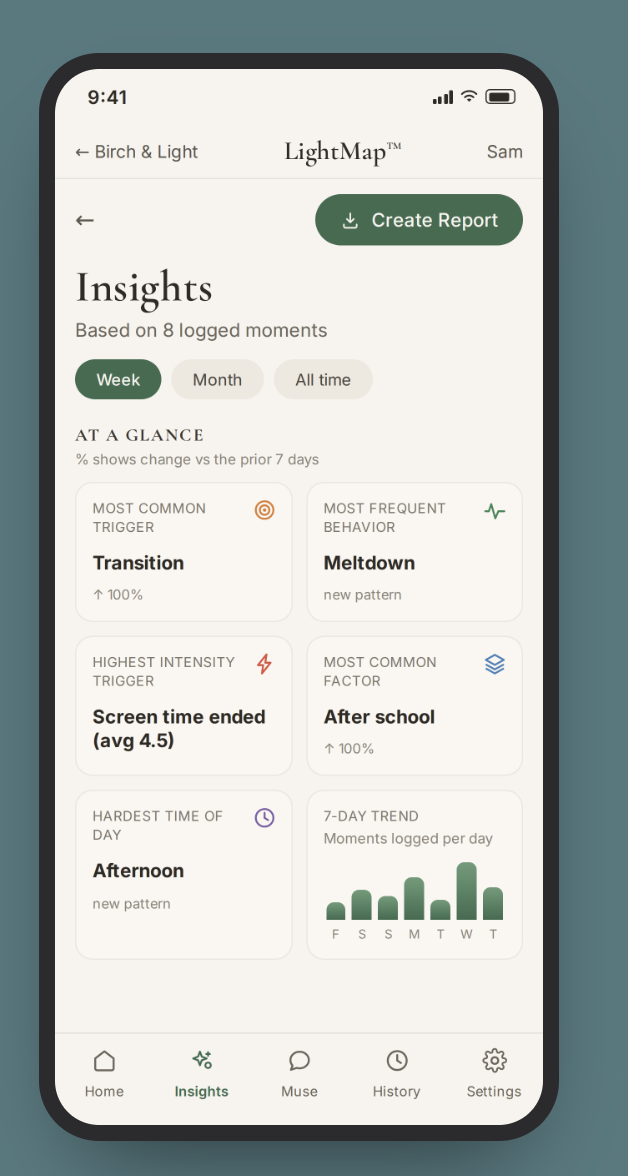

Part of the award-winning Birch & Light Method, honored with the Mom's Choice Gold Award for excellence in family resources.
If today was one of those days
A few more from the library, free to read.
Researched and drafted with AI assistance, reviewed before publication. Editorial standards