
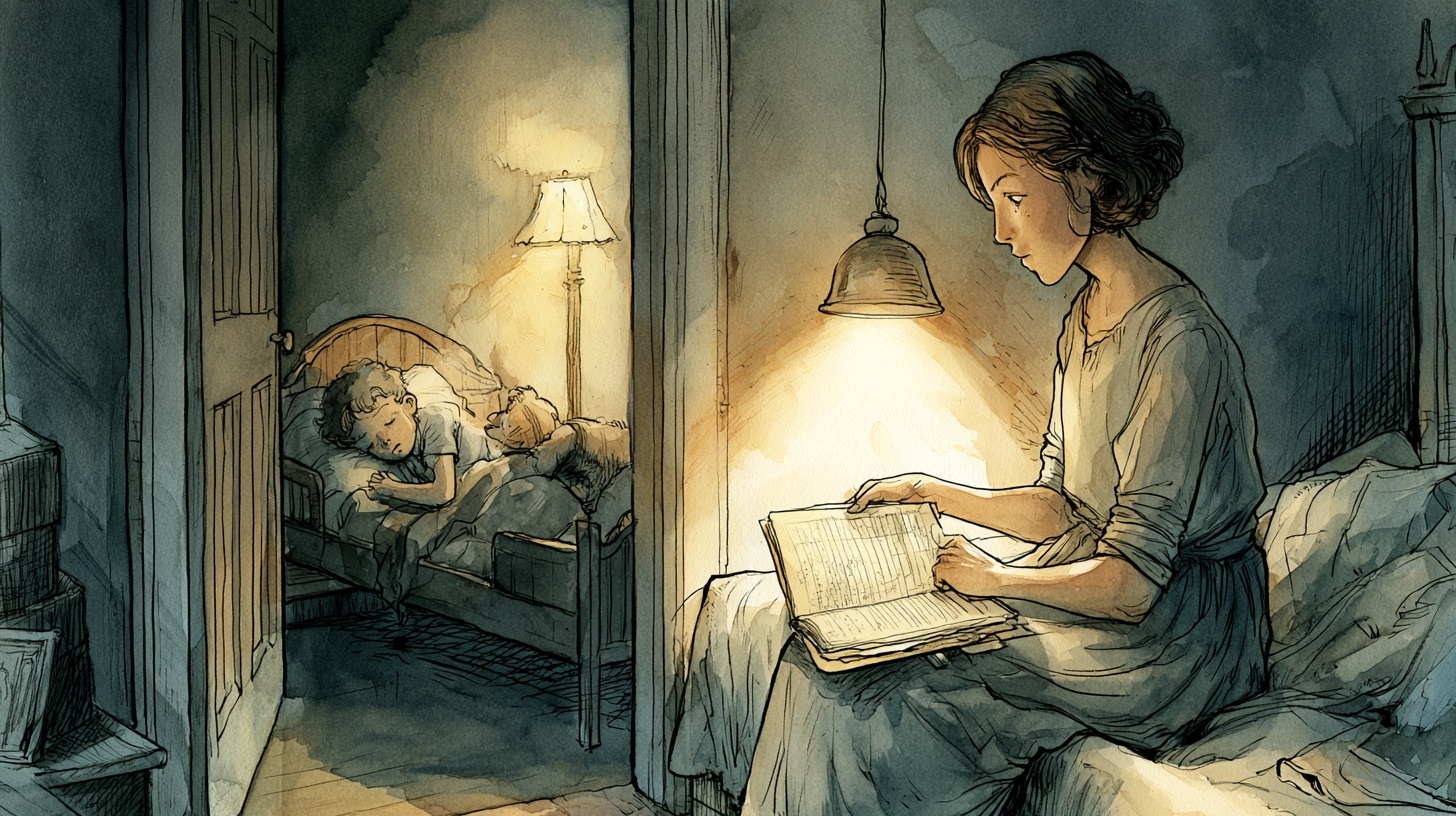
Your child had a febrile seizure. Possibly more than one. You were told it was nothing to worry about, that children grow out of them, that there is no lasting harm. And then years later something else appears, an ADHD diagnosis, a learning difficulty, a child who struggles in ways their siblings do not, and the question surfaces on its own in the middle of the night.
Did that do this?
Almost every parent who has watched a child seize asks it eventually. Very few get a real answer, because the honest one is more complicated than the reassurance offered in the emergency department and more complicated than the fears found online. It sits between them.
This is a map, not medical advice. It reflects our best reading of the published research at the time of writing and is offered without guarantee. Your child's doctor is the one who can speak to your child.
First, the distinction that changes everything
Almost every piece of research on this question separates febrile seizures into two kinds, and almost no parent is told which kind their child had.
A simple febrile seizure involves the whole body, lasts under fifteen minutes, and happens once within a 24 hour period.
A complex febrile seizure is any that lasts longer than fifteen minutes, involves only one part or side of the body, or happens more than once in 24 hours.
The great majority are simple. And when researchers find differences in outcomes, those differences cluster in the complex, the prolonged, and the repeated. That distinction is the single most useful thing you can carry out of this article, because it determines whether the reassuring research or the more cautious research applies to your child.
If you do not know which kind your child had, it will be in the medical record, and it is worth asking for.
For what to do during one, and how to tell a febrile seizure from something that needs an ambulance, that is a separate question covered in Febrile seizures: what is happening and what to do. This piece is about afterwards.
Will my child develop epilepsy?
This is usually the first fear, and here the numbers are genuinely reassuring for most families.
Around 60% of children who have a first febrile seizure have none of the recognized risk factors for later epilepsy, and their subsequent risk is about 0.9%. Roughly a third of children have one risk factor, and their risk is around 2%. About 6% have two or more, and their risk rises to around 10%.
Recurrence matters. A Danish national cohort study following 2,103,232 children born between 1977 and 2011, of whom 75,593 had a febrile seizure, found the cumulative incidence of epilepsy over thirty years was 2.2% for the general population, 6.4% after one febrile seizure, 10.8% after two, and 15.8% after three. Worth noting that this study counted hospital admissions and did not separate simple from complex seizures, so those figures blend both.
The same study looked at psychiatric diagnoses of any kind, and those numbers deserve stating because nobody mentions them. The thirty-year risk was 17.2% in the general population, 21.4% after a first febrile seizure, 25% after two, and 29.1% after three or more. Note where the baseline sits. Roughly one in six people receives a psychiatric diagnosis at some point regardless, so the shift after a single febrile seizure is from about one in six to about one in five.
Read that carefully, because the two ways of stating it feel very different. After a first febrile seizure the risk roughly triples. And after a first febrile seizure, more than 93% of children never develop epilepsy. Both sentences describe the same data.
The ADHD question
Here is the study that matters, and the reason the flat reassurance you have been given is not quite right.
Researchers in Denmark followed every child born in the country between 1990 and 2007, a cohort of 906,379 individuals, for up to 22 years, amounting to roughly ten million person-years of observation. During that time 21,079 individuals developed ADHD.
Children who had epilepsy had an adjusted incidence rate ratio for ADHD of 2.72. Children who had febrile seizures had an adjusted rate ratio of 1.28. Children who had both had a rate ratio of 3.22.
Those figures were adjusted for socioeconomic factors, perinatal risk factors, and family history of neurological and psychiatric disorders, which is a more rigorous adjustment than most studies in this area manage.
So the association is real, it survived adjustment, and it was found in one of the largest datasets of its kind. Anyone telling you there is no connection at all is overstating the reassurance.
Now the other half, which matters at least as much.
What a rate ratio of 1.28 actually means
It means the rate of ADHD among children who had febrile seizures was about 28% higher than among children who did not. Not double. Not several times over. About a quarter higher than a baseline that is already modest.
Put differently: the overwhelming majority of children who have febrile seizures do not develop ADHD, and the overwhelming majority of children with ADHD never had a febrile seizure.
Compare it to the epilepsy figure in the same study, 2.72, and you can see what the researchers meant when they described a strong association with epilepsy and, in their words, a lesser one with febrile seizures. The two are not in the same category of finding.
Why an association is not the same as a cause
This is the part that gets flattened in every direction, and it is where a parent's guilt usually lives, so it is worth being careful.
The authors of that study opened by noting that epilepsy, febrile seizures and ADHD are all disorders of the central nervous system and share common risk factors. That sentence contains the most likely explanation for the whole finding.
A brain that is more prone to seizing when a fever spikes may be a brain that differs in other ways too. Under that reading, the febrile seizure did not cause the ADHD. Both are downstream of something already present, and the seizure was the first visible sign rather than the origin.
There is another explanation that does not involve damage either, and it is one to hold loosely because it is a reasonable hypothesis rather than a demonstrated finding. A child who has been hospitalized once is a child already known to the health system, and children already known to the health system are more likely to have a later difficulty noticed, assessed and given a name. That is a recognized concern in register-based research generally. Whether it accounts for any of this particular result has not been established.
And there is a genuine possibility of some biological contribution, particularly with prolonged or repeated seizures. Animal research and some clinical work point toward effects on the hippocampus. That research exists and should not be dismissed, but it is a long way from establishing that a short febrile seizure in a two year old causes ADHD in a nine year old.
What can be said with confidence is that no study has demonstrated that a simple febrile seizure causes ADHD. What has been demonstrated is that children who have one are somewhat more likely to be diagnosed with it later, for reasons that remain genuinely unresolved.
What the cognitive research shows
Studies looking at thinking and learning rather than diagnoses point the same direction, which is that the type and number of seizures matter more than whether one happened at all.
One study found children with a history of febrile seizures scored lower on a non-verbal intelligence test at ages six to nine than healthy controls, with children who had prolonged seizures scoring lower than those who had simple ones, and children with multiple recurrences performing worse across all measures than children with a single seizure or controls. Another found that children with recurrent febrile seizures might be at risk of delayed language development. A Swedish twin study found associations between febrile seizures and epilepsy and autism and other neurodevelopmental conditions.
Set against that, and this is the part that has to be said alongside it, the largest study of the question found close to nothing. Danish researchers linked health records to military conscription records for 18,276 men born between 1977 and 1983 who had no known history of epilepsy. Of those, 507 had been hospitalized with a febrile seizure as children. Comparing their scores on a validated group intelligence test against everyone else, the adjusted prevalence ratio for landing in the bottom quartile was 1.08, and the authors concluded there was little association between febrile seizures and cognitive function. A Finnish study following a random birth cohort of 900 children likewise found no difference in academic or social outcomes at ages twelve and eighteen between children who had febrile seizures and those who did not.
So the picture is genuinely mixed, and the mix is not random. The studies finding differences tend to be smaller, and they tend to find them in the prolonged and the repeated. The studies finding nothing tend to be very large and to look at ordinary populations years later. A Swedish community-based prospective study followed a representative group of preschool children with febrile seizures to young school age, which is the design best suited to this question, because it follows an ordinary population forward rather than looking backward at children who ended up in specialist clinics.
The pattern across all of it is consistent. One simple febrile seizure sits at the reassuring end. Prolonged, focal or repeated seizures sit further along. Which returns you to the question of which kind your child had.
What this means if you are the parent asking
A few things I would want said to me.
Your instinct was not foolish. There is an association, it is documented in very large datasets, and being told there is no connection whatsoever was an oversimplification. You were not imagining a pattern.
And it is unlikely to be the explanation you are looking for. A rate ratio of 1.28 does not account for one particular child's ADHD. It describes a small statistical tilt across nearly a million people. It cannot tell you anything about your child, and no test or record will retroactively answer that question for your family.
The likeliest reading is that both things came from the same place. Not that the seizure caused what came after, but that a nervous system which reacted to fever that way was already a nervous system with its own particular wiring. That is not a failure of care and it is not something you could have prevented by acting faster or differently on the night it happened.
The question you are really asking may not be answerable. Parents look for a cause because a cause implies a moment, and a moment implies it might have gone otherwise. Sitting with the possibility that this is simply how your child's brain is built is harder than finding something to blame, and it is usually closer to the truth.
What to actually ask
If you want to close the loop rather than keep circling it, there are three useful questions and none of them are about causation.
Ask which type your child had, simple or complex, and how many. It is in the record and it determines which body of research applies.
Ask whether anything about the presentation warrants follow-up now, particularly if the seizures were prolonged, focal, repeated, or continued past age five.
And ask what would actually help the child in front of you today. This is the one that changes anything. Whatever the origin, the support that helps a child with ADHD is the same support regardless of how it arrived.
The thing to hold on to
Most children who have febrile seizures grow up without epilepsy, without ADHD, and without measurable cognitive effects. That is true and it is the most likely outcome.
It is also true that the research is not as clean as the reassurance implies, that the type and number of seizures appears to matter, and that a parent noticing a pattern is not being irrational.
Holding both of those at once is harder than picking one. It is also the only position that survives contact with what has actually been published.
Researched and written in 2026. This reflects our best reading of the published research at that time and is offered without any guarantee of accuracy or outcome. It is not medical advice and it is not a diagnosis. Talk to your child's doctor.
Sources, tied to the claims they support. The cohort of 906,379 Danish children born 1990 to 2007 followed for 22 years across approximately ten million person-years, with 21,079 developing ADHD, and adjusted incidence rate ratios of 2.72 (95% CI 2.53 to 2.91) for epilepsy, 1.28 (95% CI 1.20 to 1.35) for febrile seizures, and 3.22 (95% CI 2.72 to 3.83) for both, adjusted for socioeconomic and perinatal risk factors and family history of neurologic and psychiatric disorders: Bertelsen EN, Larsen JT, Petersen L, Christensen J, Dalsgaard S. "Childhood Epilepsy, Febrile Seizures, and Subsequent Risk of ADHD." Pediatrics, 2016;138(2):e20154654. Epilepsy risk stratified by number of risk factors, 0.9% with none, approximately 2% with one, approximately 10% with two or more, as summarized in MedLink Neurology, Febrile Seizures, clinical review, accessed 2026. The cohort of 2,103,232 Danish children born 1977 to 2011 including 75,593 with febrile seizures, the thirty-year cumulative incidence of epilepsy at 2.2%, 6.4%, 10.8% and 15.8%, and the thirty-year risk of psychiatric disorder at 17.2%, 21.4%, 25% and 29.1%: Dreier JW, Li J, Sun Y, Christensen J. "Evaluation of Long-term Risk of Epilepsy, Psychiatric Disorders, and Mortality Among Children With Recurrent Febrile Seizures: A National Cohort Study in Denmark." JAMA Pediatrics, 2019;173(12):1164-1170. Little association between febrile seizures and cognitive function in 18,276 Danish conscripts born 1977 to 1983, of whom 507 had been hospitalized with febrile seizures, with an adjusted prevalence ratio of 1.08 for scoring in the bottom quartile of the Boerge Prien intelligence test: Nørgaard M, Ehrenstein V, Mahon BE, Nielsen GL, Rothman KJ, Sørensen HT. "Febrile seizures and cognitive function in young adult life: a prevalence study in Danish conscripts." Journal of Pediatrics, 2009;155(3):404-409. The Finnish birth cohort of 900 children showing no difference in academic and social outcomes at ages twelve and eighteen, as summarized in the MedLink clinical review cited above. Definitions of simple and complex febrile seizures: Vestergaard M, Pedersen MG, Østergaard JR, et al. "Death in children with febrile seizures: a population-based cohort study." The Lancet, 2008;372(9637):457-463. Lower non-verbal intelligence scores at ages six to nine with prolonged seizures scoring below simple ones, and poorer performance across all tests in children with multiple recurrences: Kölfen W, Pehle K, König S. "Is the long-term outcome of children following febrile convulsions favorable?" Developmental Medicine and Child Neurology, 1998;40:667-671. Recurrent febrile seizures and risk of delayed language development: Visser AM, Jaddoe VWV, Ghassabian A, et al. "Febrile seizures and behavioural and cognitive outcomes in preschool children: the Generation R study." Developmental Medicine and Child Neurology, 2012;54:1006-1011. Association with autism and other neurodevelopmental disorders in a twin cohort: Gillberg C, Lundström S, Fernell E, Nilsson G, Neville B. "Febrile seizures and epilepsy: association with autism and other neurodevelopmental disorders in the Child and Adolescent Twin Study in Sweden." Pediatric Neurology, 2017;74:80-86. Prospective community-based follow-up to young school age: Nilsson G, et al. "Neurodevelopmental problems in children with febrile seizures followed to young school age: A prospective longitudinal community-based study in Sweden." Acta Paediatrica, 2022;111(1). Cognitive functioning in a representative preschool cohort: Billstedt E, Nilsson G, Leffler L, et al. Acta Paediatrica, 2020;109(5):989-994.
For education and reflection, not medical advice. Our terms
See what's underneath
The pattern is already in your days. Start catching it.
LightMap turns scattered hard days into a pattern you can see. Start by logging one moment tonight.
Find out why it keeps happening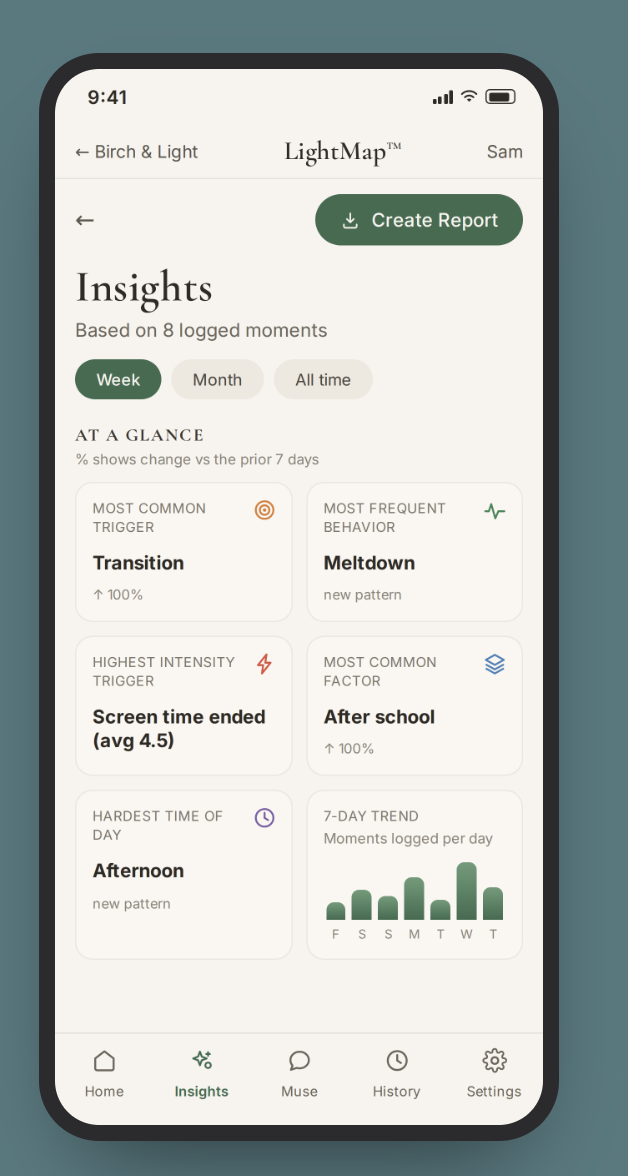
Part of the award-winning Birch & Light Method, honored with the Mom's Choice Gold Award for excellence in family resources.
Before you go, grab the free guide
The 3 body-state triggers under most meltdowns, a script for the 30 seconds before it tips over, and a reset for after. Free.

You'll get the guide instantly, plus five free articles in your inbox every week. Real challenges (meltdowns, school mornings, picky eating, big feelings) and how to actually handle them. Unsubscribe anytime.
Researched and drafted with AI assistance, reviewed before publication. Editorial standards