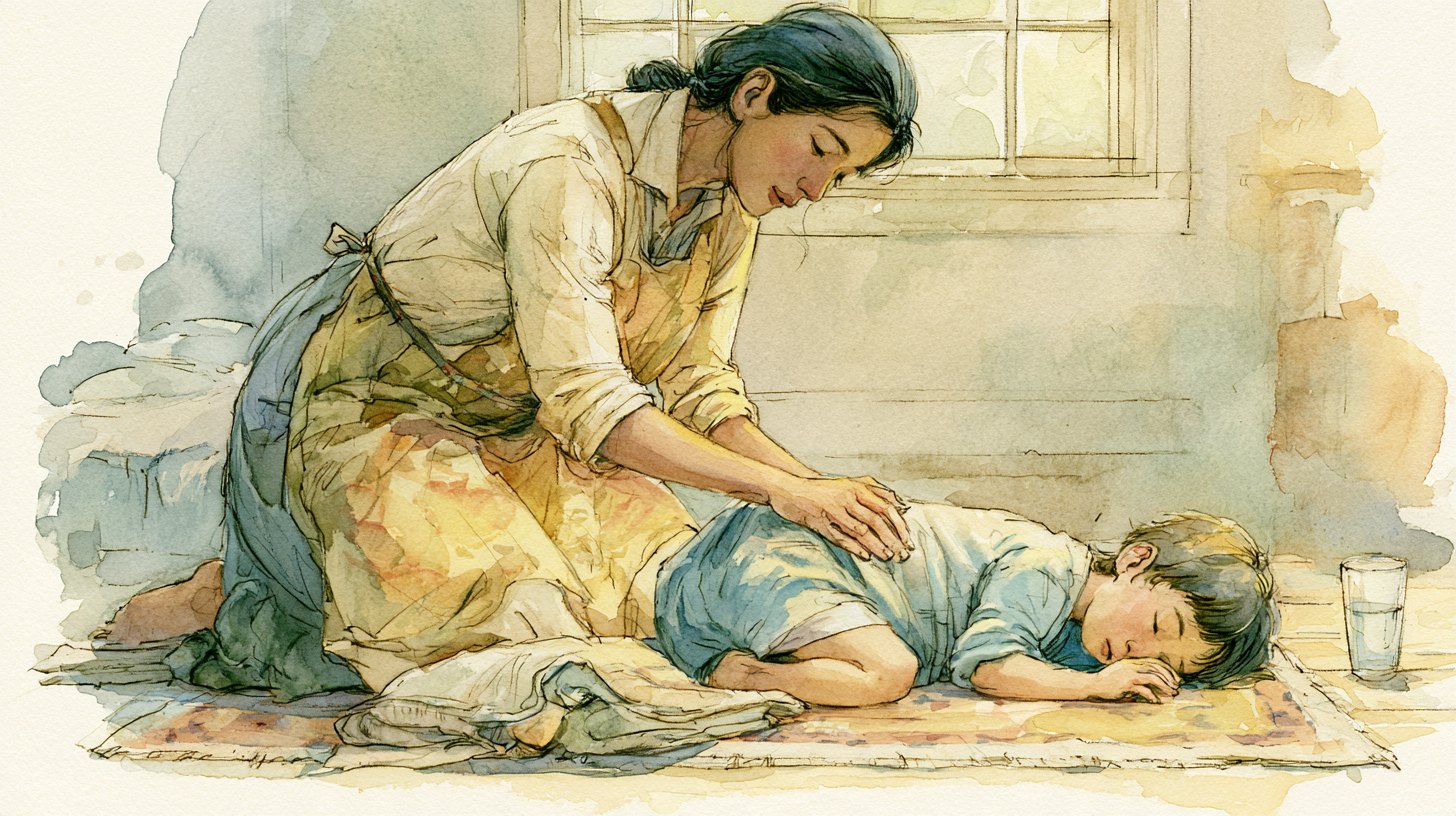
A febrile seizure is a convulsion a fever sets off in a young child, most often between six months and five years old. Your child loses awareness, stiffens, and jerks for a minute or two, usually under five minutes. It looks terrifying and almost always leaves no harm behind.
One of mine had febrile seizures. Several of them, from around age one until just over five. I can tell you what the pamphlets do not, which is that no amount of being told they are usually harmless prepares you for the first one. A fever, an ordinary sick day, and then your child is suddenly somewhere you cannot reach. We said his name and his brain was not online to hear it. You do not forget that.
So this article does two jobs. It gives you the medical picture, which is genuinely reassuring, and it takes seriously the part the pamphlets skip, which is what it does to the parent standing there.
What is a febrile seizure?
A febrile seizure is a convulsion triggered by fever in a young child, without any infection of the brain itself and without a history of seizures from other causes. It is a response of a developing brain to a rapid change in temperature, and susceptibility runs strongly in families.
The typical picture: the child loses consciousness, stiffens, and then jerks rhythmically, usually in the arms and legs on both sides. Eyes may roll back or stare. Breathing can look irregular, lips can dull in color, and the child may drool or wet themselves. During the event the child cannot see you, hear you, or respond to you. That is not because of how loudly you called. There is no volume that reaches a seizing brain, and the unresponsiveness that terrifies parents is part of the event itself rather than a sign of its severity.
Most are over in less than five minutes, and many last only a minute or two. Afterward the child is often limp, confused, or deeply sleepy for a stretch, which is called the postictal period and is normal recovery rather than a second problem.
How common are febrile seizures, and who gets them?
Between two and five percent of children have at least one febrile seizure. They occur between about six months and five years of age, with the peak in the second year of life. Most children who have one never have another, and about one in three do have at least one more, with the odds of recurrence higher when the first happens under eighteen months, when the triggering fevers run on the lower side, when the seizure comes soon after the fever starts, or when a parent or sibling had them too.
Simple versus complex, because a doctor will ask
A simple febrile seizure involves the whole body, lasts under fifteen minutes, and happens once in a twenty-four hour illness. This is the large majority.
A complex febrile seizure has any of: movement on one side of the body or starting in one part, duration over fifteen minutes, or more than one seizure in twenty-four hours. Complex features do not mean disaster. They mean the doctor will look more carefully.
Knowing which one you saw is half of what the emergency conversation will be about, which is why the timing note below matters more than anything else on this page.
What to do while it is happening
- Put the child on their side on a flat, safe surface, on the floor if you can. The side position keeps the airway clear if there is drooling or vomiting
- Clear the area. Move furniture, not the child, unless they are somewhere dangerous
- Put nothing in the mouth. Not your fingers, not a spoon, nothing. A child cannot swallow their tongue. Objects in the mouth cause the injuries this myth claims to prevent
- Do not restrain the movements. Holding the body still does not stop the seizure and can cause injury
- Look at a clock the moment it starts. Seizure time moves differently for the person watching. Thirty seconds feels like five minutes. The single most useful thing you can produce afterward is a real duration
- If you can, video it. It feels wrong to film your child in that moment. Do it anyway if there is any way to manage it, because thirty seconds of video answers questions no description can
While you're here, take the guide
What's Underneath is free: the three body-state triggers under most meltdowns, what to say in the minute before it tips over, and how to reset afterward.
You'll get the guide instantly, plus five free articles in your inbox every week. Real challenges (meltdowns, school mornings, picky eating, big feelings) and how to actually handle them. Unsubscribe anytime.
When should I call 911?
- The seizure passes five minutes and is not stopping
- The child has serious trouble breathing or their color stays wrong after the movements stop
- Another seizure starts soon after the first ends
- The child was injured, or the seizure happened in water
- The child does not begin to respond to you within a reasonable stretch after the movements end, allowing for normal postictal sleepiness
- Any signs that point beyond fever: a stiff neck, a spreading rash that does not blanch, repeated vomiting, a bulging soft spot in a baby
A first-ever febrile seizure should be seen by a doctor the same day even when it was short and the child recovered fully, because the first one is the one where the job is ruling other things out. After that, your pediatrician will tell you what warrants a visit versus a call.
What a febrile seizure is not
It is not epilepsy. Febrile seizures are their own category. After a simple febrile seizure the chance of later epilepsy is about one to two percent, against a general-population baseline of roughly half a percent to one percent. Complex features raise it further, and even then the large majority of those children never develop epilepsy.
It does not damage the brain. Follow-up studies of children after simple febrile seizures find no measurable effect on intelligence, learning, or behavior. The event looks catastrophic and leaves nothing behind.
It is not caused by letting the fever get too high, and it is not prevented by fighting the fever harder. This is the one that quietly eats parents alive, so it deserves its own paragraph. Multiple randomized trials have tested giving acetaminophen or ibuprofen around the clock during fevers in children who have had febrile seizures, and they do not prevent recurrence. The seizure often strikes early in the illness, frequently before anyone has realized there is a fever to fight, and trials that measured it found the fevers that produced seizures were high despite the medicine.
The one partial exception is a single unblinded Japanese trial in which around-the-clock rectal acetaminophen reduced repeat seizures within that same illness, so a doctor may still suggest dosing through a sick day, but it does not change the larger picture across illnesses. Treat fever for comfort, because a comfortable sick child rests better. Do not treat it as seizure prevention, and do not carry the belief that you could have stopped it by dosing sooner. You could not have.
The part that is actually about you
Your child will not remember the seizure. You will remember every second of it.
Parents routinely describe the first febrile seizure as the moment they believed their child was dying. That is not dramatics. It is an accurate description of what it looks like from the outside, and the fear does not resolve just because a calm ER doctor later says the word benign. If you find yourself checking on every fever for months afterward, taking temperatures at 2am, or feeling your stomach drop at the word virus, that is the ordinary aftermath of watching something like that, not an overreaction to it.
It helps, slightly, to hold onto what was true inside the event. He was not frightened. He was not calling for you and being ignored. His brain was fully offline to the experience, and by the next day it had left no trace on him at all. The trace it left is in you, and being gentle about that is allowed.
What to track
If your child has had one, the useful record for the next one is short: the date, what illness was underway, the duration by the clock, what the movements looked like and whether both sides were involved, how long until your child responded to you afterward, and the highest temperature you measured that day. A child with two entries like that gives a pediatrician everything needed to say whether this is the ordinary pattern or something to look at harder.
Capturing it in the moment rather than reconstructing it afterward is what LightMap is built for.
Sources, tied to the claims they support. Antipyretics not shown to reduce the recurrence of simple febrile seizures without anticonvulsants, recurrence rates by age at first seizure, the low later epilepsy risk, and the benign course: Subcommittee on Febrile Seizures, American Academy of Pediatrics. "Febrile Seizures: Clinical Practice Guideline for the Long-term Management of the Child With Simple Febrile Seizures." Pediatrics, 2008;121(6):1281-1286. Recommendation against EEG, routine bloodwork and routine neuroimaging for a neurologically healthy child with a simple febrile seizure, and lumbar puncture when meningitis is suspected: Subcommittee on Febrile Seizures, American Academy of Pediatrics. "Febrile Seizures: Guideline for the Neurodiagnostic Evaluation of the Child With a Simple Febrile Seizure." Pediatrics, 2011;127(2):389-394.
For education and reflection, not medical advice. Our terms
See what's underneath
The pattern is already in your days. Start catching it.
LightMap turns scattered hard days into a pattern you can see. Start by logging one moment today.
Start with 3 moments Not sure where to start? Ask me.Message Tara on WhatsApp. It really is me, I read everything and will personally respond.Click here to message Tara →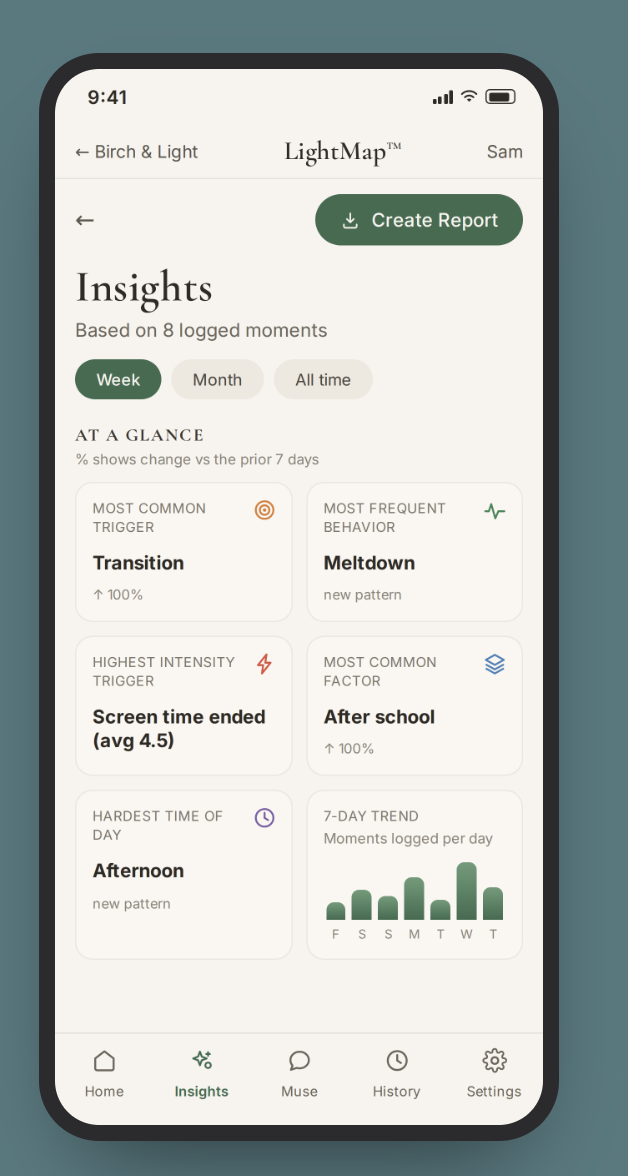

Part of the award-winning Birch & Light Method, honored with the Mom's Choice Gold Award for excellence in family resources.
If today was one of those days
A few more from the library, free to read.
Researched and drafted with AI assistance, reviewed before publication. Editorial standards