.jpg)
You've said it. Every parent has. 'Calm down.' 'You need to calm down.' 'Just take a breath and calm down.' And if you're reading this, you've probably also noticed that it almost never works — and frequently makes things worse. The child who is told to calm down tends to escalate, not settle, leaving you frustrated and them more upset than before.
It's not that you're saying it wrong. It's that 'calm down,' directed at an overwhelmed child, asks for something their brain genuinely cannot do in that moment — and carries a hidden message that makes the flooding worse. Understanding why is the key to knowing what to do instead.
Why the Brain Can't Comply
When a child is overwhelmed — flooded with big emotion, past the edge of their tolerance — their nervous system has shifted into a state of alarm. In that state, the thinking, reasoning, self-managing part of the brain becomes far less accessible. The systems that would be needed to hear an instruction, decide to follow it, and deliberately bring their own arousal down are, in effect, offline.
'Calm down' is an instruction directed at exactly the part of the brain that isn't available. You're asking a flooded child to do something that requires the regulated brain — while they're in the state where the regulated brain has gone quiet. It's a bit like asking someone to read the fine print while the lights are off. The request isn't unreasonable in general; it's just impossible right now.
"Calm down" asks the thinking brain to act, at the exact moment the thinking brain has gone offline. The child isn't refusing. They can't.
The Hidden Message That Makes It Worse
Beyond being impossible to follow, 'calm down' carries a second problem: of what it communicates. To an overwhelmed child, 'calm down' tends to land as 'your feelings are too much,' 'you're doing this wrong,' or 'what you're experiencing is a problem.' Even said gently, it reads as a kind of rejection of the child's state — a message that they need to be different than they are right now.
For a child already flooded and on alarm, that message is more threat, not less. It adds pressure to a system that's already overwhelmed. So instead of helping the child settle, it tends to push them further from settled — confirming, in the moment, that they're failing at the very thing they're being told to do, which deepens the distress.
What an Overwhelmed Child Actually Needs
If the regulated brain is offline and instructions can't reach it, what does reach a flooded child? Not words aimed at their thinking, but a regulated presence their nervous system can attune to. An overwhelmed child can't calm themselves down on command — but they can borrow calm from a steady adult nearby. That's co-regulation, and it's what actually works where 'calm down' fails.
The shift is from trying to make the child do something to being something the child can borrow from. You stop instructing and start offering — a calm body, a low voice, a steady presence — that their system can sync with and settle toward.
While you're here, take the guide
What's Underneath is free: the three body-state triggers under most meltdowns, what to say in the minute before it tips over, and how to reset afterward.

You'll get the guide instantly, plus five free articles in your inbox every week. Real challenges (meltdowns, school mornings, picky eating, big feelings) and how to actually handle them. Unsubscribe anytime.
What Tends to Help Instead
Regulate yourself first. The thing a flooded child can borrow is your calm — which means you have to have it. Before anything else, steady your own nervous system. You can't share a regulation you don't have, and your own state is the most powerful tool in the moment.
Offer presence, not instructions. Instead of 'calm down,' try simply being there — close, quiet, steady. 'I'm here.' 'I've got you.' Presence reaches a flooded child in a way that directives can't, because it doesn't require their offline thinking brain to do anything.
Lower the input. A flooded system needs less coming at it, not more. Fewer words, less noise, a quieter and calmer environment. Reducing the input gives the nervous system room to come down.
Acknowledge the feeling rather than fighting it. 'This is really hard right now' lands far better than 'calm down,' because it meets the child where they are instead of telling them to be somewhere else. Naming the feeling, gently, can itself help take some of its intensity down.
Wait. A flooded nervous system comes back down on its own timeline, not on command. Your steady presence shortens the path, but the feeling still has to move through. Patience — staying alongside without rushing it — is part of the work.
Save the conversation for after. Anything you need to teach, address, or problem-solve can happen once the child is back inside their window. In the flood, there's no one home to receive it. After, there is.
The Shift Worth Making
'Calm down' fails not because your child is defiant but because it asks the impossible — instructing a brain that's gone offline, while quietly signaling that the child's feelings are unacceptable. The alternative isn't a better phrase. It's a different approach entirely: stop trying to make the child calm down, and start being the calm they can borrow.
The next time the words 'calm down' rise up, let them be the cue to do the opposite of what they suggest — not to demand calm from your child, but to steady yourself, move closer, and offer the regulated presence their nervous system is actually looking for.
Every behavior is a clue.
If 'calm down' never works in your house, LightMap can help you track what actually helps your child settle — so the pattern beneath it becomes easier to see. Explore LightMap at birchandlight.com/lightmap.
Put it into practice
Understanding the volcano is step one. Giving your child their own tools for it is where things shift. My Big Feelings and My Fast Brain is a printable workbook that turns feeling-size, early warning signs, and calm-down tools into pages kids want to do, with a science section for the grown-up. It is $9, instant download, print at home.
Get the workbook, or find both fast brain workbooks in the bundle.
Sources: Lieberman et al. on affect labeling and emotional regulation (Psychological Science; PMC); Siegel's window of tolerance framework; Ross Greene, Collaborative and Proactive Solutions, on lagging skills; research on emotional flooding and reduced access to executive function under high arousal (PMC).
For education and reflection, not medical advice. Our terms
See what's underneath
Know which response actually works for your child
LightMap reads your hard days together and gives you answers. Start with one moment today.
Start with 3 moments Not sure where to start? Ask me.Message Tara on WhatsApp. It really is me, I read everything and will personally respond.Click here to message Tara →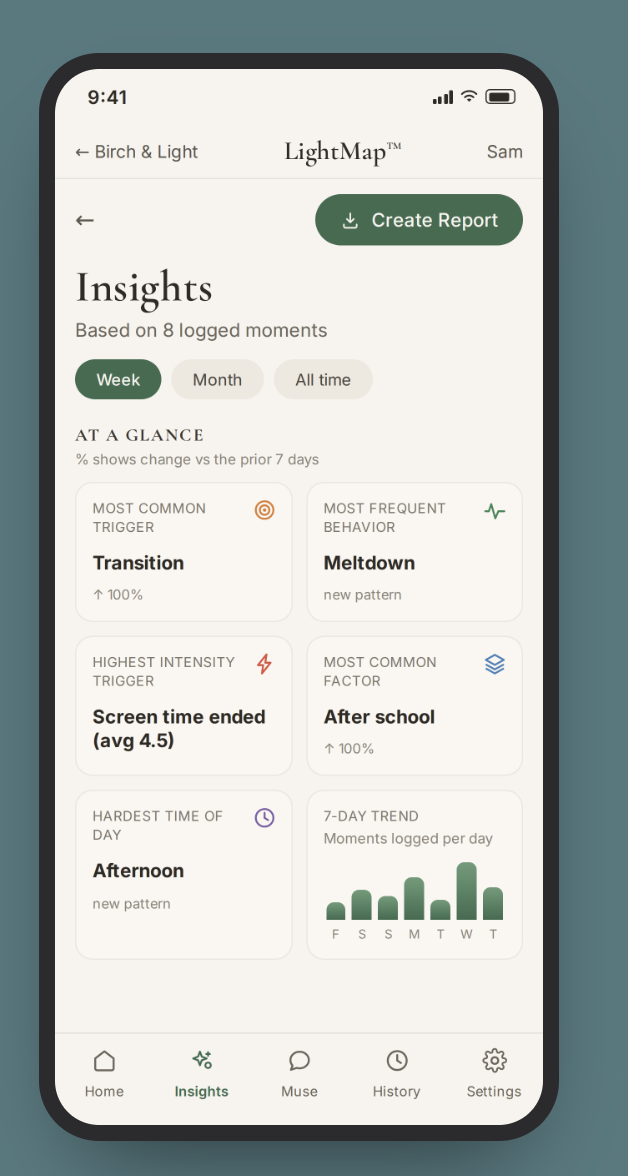

Part of the award-winning Birch & Light Method, honored with the Mom's Choice Gold Award for excellence in family resources.
A story to read together
Sometimes the easiest way in is a story you read side by side.
 The Boy at the Edge
A boy finds calm by watching the world move from a window. When his stillness is mistaken for defiance, the moment escalates — and he learns that being calm doesn’t always protect you from being told no.
Read the story Little Bird
Little Bird used to fly everywhere. Then the forest started to feel too big — and a wise voice helps her see that her wings remember more than her worries do.
Read the story
If today was one of those days
A few more from the library, free to read.
Researched and drafted with AI assistance, reviewed before publication. Editorial standards