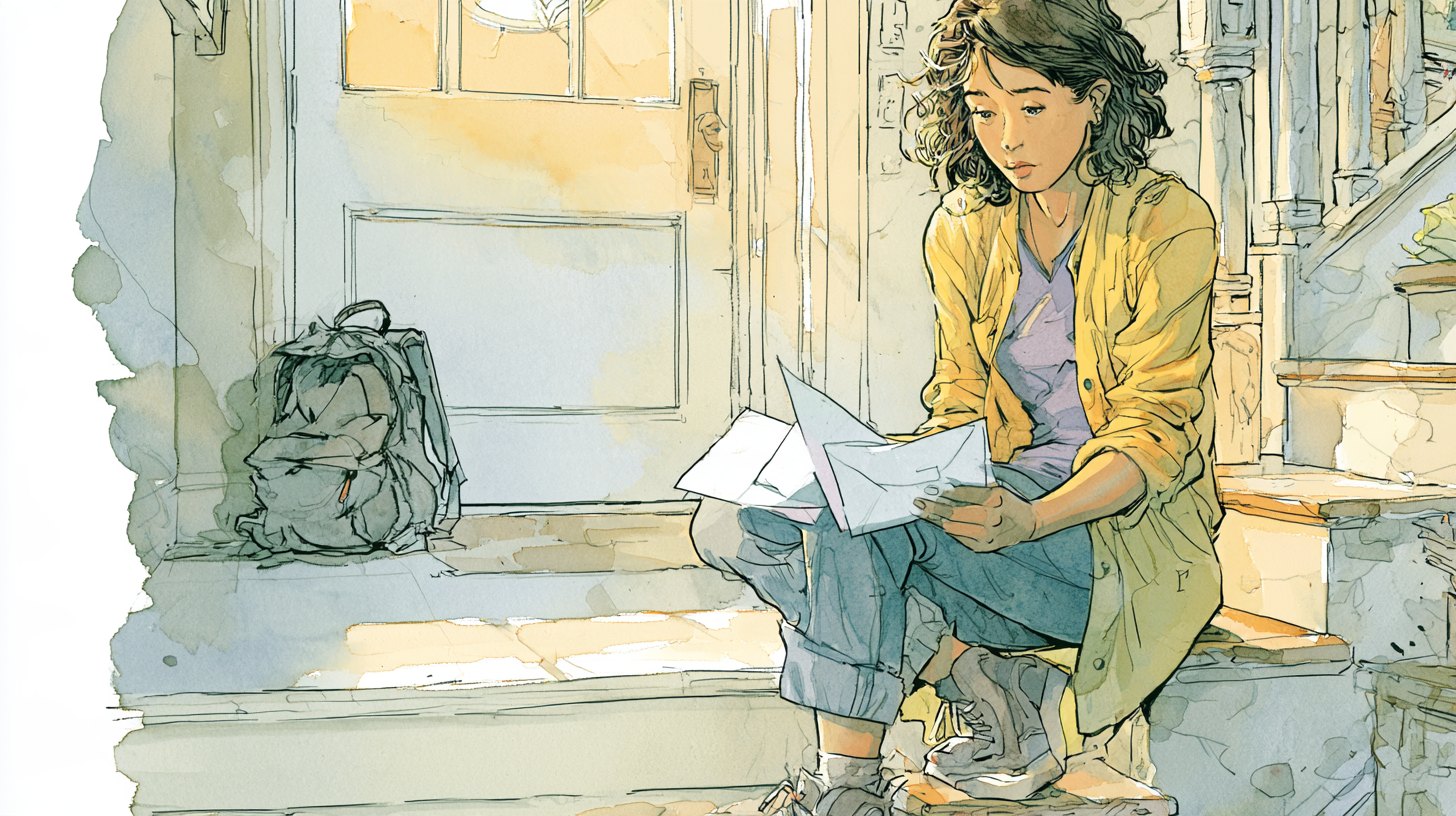
You have the diagnosis. Someone in a group mentioned there is money available, or a tax credit, or something you should have applied for two years ago. You find the form, hand it to your doctor, and a few months later a letter arrives saying your child does not qualify.
This is the most common outcome, and it usually has nothing to do with how much your child struggles. It has to do with what got written on the form.
What the credit actually is
The Disability Tax Credit is a federal non-refundable tax credit for people with a severe and prolonged impairment. For a child, a supporting parent claims it. For 2025 the disability amount is $10,138 plus a supplement for children of $5,914, so $16,052 in total.
Non-refundable matters here, and this is where parent groups go wrong. That $16,052 is not a check and it is not $16,052 off your tax bill. It is a combined figure, and the actual credit is that $16,052 multiplied by the lowest federal tax rate, which was 14.5% for 2025. So the base amount and the child supplement together reduce your federal tax by around $2,330, before any provincial amount. Any unused portion may be transferred to a supporting family member, and the CRA is direct about the rest: it is not refunded. A family with little or no tax payable gets little from this part.
One more thing about the children's supplement. It can be reduced if someone claimed child care expenses or attendant care expenses for your child in the same year, which is common in these families, so the $5,914 is a maximum rather than a flat figure.
The bigger point is that approval is a gate. Once the Canada Revenue Agency says your child is eligible, other things open behind it, including the Child Disability Benefit and a Registered Disability Savings Plan. Parents who get refused are not only losing a tax credit. They are losing the key to the rest of it.
The test is about function, not diagnosis
Nowhere in the eligibility rules does ADHD, autism, ODD or any other label appear. The CRA is asking a different question, and it is asking it about mental functions necessary for everyday life.
Three things all have to be true. Your child is unable to perform mental functions necessary for everyday life, or it takes three times longer than someone of similar age without the impairment, even with appropriate therapy, medication and devices. The impairment is present all or almost all of the time, which the CRA describes as generally 90% or more. And it has lasted or is expected to last at least 12 months.
That first one is where most applications are won or lost, and the phrase to hold onto is three times longer. A child who eventually gets dressed, but only after forty minutes and six prompts, is not a child who can dress himself in the ordinary sense. A child who can do the homework but needs an adult sitting beside her for every question is not independently doing homework. The comparison is to a child the same age, and the therapy and medication are already assumed to be in place.
The ten categories, and which ones fit
The CRA lists ten mental functions: adaptive functioning, attention, concentration, goal setting, judgment, memory, perception of reality, problem solving, regulating behavior and emotions, and verbal and non-verbal comprehension.
For a neurodivergent child, three of these tend to carry the application.
Attention includes showing awareness of danger and risks to personal safety, and demonstrating basic impulse control. A nine year old who still runs into a parking lot, who touches what he has been told not to touch, who cannot hold a thought long enough to finish a two step instruction, belongs in this category and parents rarely think to put him there.
Regulating behavior and emotions covers behaving appropriately for the situation, showing appropriate emotional responses, and controlling mood to prevent risk of harm to self or others. Daily rages, aggression toward siblings, an hour to come down from a small frustration: this is the category, and it is the one an ODD label usually sits on top of.
Adaptive functioning covers adapting to change, expressing basic needs, going into the community, and self care. The child who cannot handle a changed plan without falling apart, who will not use a public bathroom, who needs everything laid out the night before, lives here.
Most refused applications for ADHD and autism are refused because the practitioner wrote the diagnosis, the medication and a sentence about school, and never touched these categories by name.
The bit that gets misunderstood
Parents often read those ten items as ten separate tests and conclude that their child fails all of them, because no single one is catastrophic on its own. That is not how it is assessed. Mental functions are one category, and the practitioner is certifying the combined effect across those functions, not ticking them off one at a time. Attention that is poor, emotional regulation that costs her everything she has, and adaptive functioning that collapses on a changed day are read together.
Separately from that, there is a cumulative effect route, and it is often misdescribed in parent groups. It combines significant limitations in two or more different categories, meaning mental functions plus one of walking, dressing, feeding, eliminating, speaking, hearing or vision, where together they are as severe as a marked restriction in one. For a child whose mental functions limitations sit alongside real difficulty with dressing or feeding, that route exists and is under-used. Sub-functions inside mental functions cannot be stacked against each other to get there. Life-sustaining therapy is excluded from this route.
Who can sign it
For mental functions, three types of practitioner can certify: a medical doctor, a nurse practitioner, or a psychologist. This matters more than most parents realize. If the pediatrician has a six month wait and the psychologist who did the assessment can sign, the psychologist can sign. A nurse practitioner can certify all impairment types.
The practitioner is allowed to base the certification on the symptoms reported by the patient, their knowledge of the medical history, their direct observation, and their knowledge of the effects of the impairment. In other words, what you tell them counts, and it becomes the evidence.
If your practitioner charges a fee for completing the form, you pay it, but you may be able to claim it as a medical expense on your tax return.
How the application runs
The form is the T2201, and it comes in two halves.
Part A is yours. It covers your child, which parent will claim the credit, and your consent for the CRA to contact the practitioner and adjust previous tax returns. Because your child is a minor, you sign the authorization section as the legal guardian. You can complete Part A online or by phone, and you get a reference number that is valid for up to twelve months.
Part B is the practitioner's, and this part is not optional. You hand over the reference number, they use it to complete and submit Part B electronically, and the name and date of birth have to match what you entered. If you fill in Part B yourself, the application will not be processed at all.
There is still a paper route, where both parts are completed and mailed together to a tax center with handwritten signatures. The CRA's own guidance is that the online form is faster and is always the current version, and it asks applicants to download only the 2023 or later version of the paper form if they go that way.
What to give the practitioner before they write
A practitioner sees your child for twenty minutes in a quiet room. The application turns on what happens in the other hours, and they can only write what they know.
So go in with the functional picture rather than a request. Not "she has ADHD" but what a Tuesday costs: how long the morning takes and how many prompts, how often the meltdowns come and how long she is gone for, what she cannot do alone that other nine year olds do alone, what happens when the plan changes. Bring it in a form they can read in two minutes, because the sentences they write are going to come from it.
This is one of the reasons tracking matters beyond the app itself. A parent who can say "fourteen episodes over three weeks, mostly between four and six, average forty minutes to recover" is handing a practitioner something they can certify from. A parent working from memory gives them "it has been a rough patch," and that is what ends up on the form.
If the answer is no
The CRA sends a notice of determination by mail, and it says which years your child is eligible for, or why the application was refused.
A refusal is not the end of it. You can send new or updated medical reports, or a letter from a practitioner who knows the situation, through your CRA My Account or by mail, and ask for a review. Separately, you have the right to file a formal income tax objection within 90 days of the date on the notice. That 90 day clock is real and it is short, so put the date in your phone the day the letter arrives.
What approval unlocks
Back years. You can go back up to ten years. If you checked the box in Part A consenting to let the CRA adjust your previous returns, it reassesses those years for you once your child is approved. If you did not check it, you ask in writing or change the returns yourself. Either way, this is where the real money usually is for a family that has been at this for years.
The Child Disability Benefit. This is a tax free monthly payment for families caring for a child under 18 with a severe and prolonged impairment. If you already receive the Canada Child Benefit and your child is approved for the DTC, it starts automatically with no separate application. For July 2026 through June 2027 it is up to $3,480 a year, which is $290 a month, per eligible child. It begins to reduce once adjusted family net income passes $82,847.
A Registered Disability Savings Plan. DTC eligibility is what makes a child eligible for an RDSP, which attracts federal grant and bond money on top of what a family puts in.
One thing to keep straight: the Canada Disability Benefit is a different program, for people between 18 and 64. It is not the one you are applying for on behalf of an eight year old, and the names cause a lot of confusion in parent groups.
Provincial programs sit on top
Everything above is federal and works the same in every province. Provincial and territorial supports for a disabled child are separate, they vary a great deal, and many of them ask whether the DTC has been approved. Getting the federal piece done first tends to make the rest easier.
The part nobody tells you
This is an administrative process, not a judgment about your child. It is not measuring how much you love him or how hard you have worked. It is a form, read by someone who has never met him, against ten categories with specific wording.
Which means the goal is not to convey how hard it is. The goal is to make sure the person signing writes about attention, about regulating behavior and emotions, about adaptive functioning, and about how much longer everything takes. Parents who get approved are rarely the ones whose children struggle most. They are the ones whose form said the right things.
Figures and rules verified against Canada Revenue Agency guidance in September 2026. The most recent disability amounts published by the CRA are for the 2025 tax year, so those are the ones quoted here. Amounts are indexed and change annually. Note also that the federal government announced proposed changes to the DTC in May 2026, including a streamlined application for certain conditions and a wider list of practitioners who may certify. Those changes require legislative amendment and are not in force, so nothing above depends on them.
Sources: Canada Revenue Agency, "Disability tax credit (DTC): Who is eligible," canada.ca, for the marked restriction and cumulative effect of significant limitations criteria and the three times longer standard. Canada Revenue Agency, "Mental functions eligibility," canada.ca, for the ten mental functions and the sub-criteria under attention, regulating behavior and emotions, and adaptive functioning. Canada Revenue Agency, "How to apply," canada.ca, for Part A and Part B, the reference number, the list of practitioners who may certify, and practitioner fees. Canada Revenue Agency, "CRA's review and decision," canada.ca, for the notice of determination and the 90 day objection deadline. Canada Revenue Agency, "Cumulative effect of significant limitations," canada.ca, for the two or more categories rule and the exclusion of life-sustaining therapy. Canada Revenue Agency, "Claiming the credit," canada.ca, for the 2025 disability amount of $10,138, the children's supplement of $5,914, the non-refundable treatment of the credit and the ten year limit on prior years. Canada Revenue Agency, RC4064 "Disability-Related Information," for the reduction of the children's supplement where child care or attendant care expenses are claimed. Canada Revenue Agency, "Tax rates and income brackets," canada.ca, for the lowest federal rate of 14.5% for 2025. Department of Finance Canada, news release of May 29 2026, for the proposed DTC changes not yet in force. Canada Revenue Agency, "Child disability benefit," canada.ca, for the July 2026 to June 2027 maximum of $3,480 per year, $290 per month, and the reduction beginning at adjusted family net income of $82,847. Canada Revenue Agency, "Registered Disability Savings Plan (RDSP)," canada.ca, for the requirement that the beneficiary be approved for the DTC, and the Canada Disability Savings Grant and Canada Disability Savings Bond. Employment and Social Development Canada, "Canada Disability Benefit," canada.ca, for the 18 to 64 age range. Form T2201, Disability Tax Credit Certificate, 2023 version or later.
For education and reflection, not medical advice. Our terms
See what's underneath
The pattern is already in your days. Start catching it.
LightMap turns scattered hard days into a pattern you can see. Start by logging one moment today.
Log today's hard moment, no account needed Not sure where to start? Ask me.Message Tara on WhatsApp. It really is me, I read everything and will personally respond.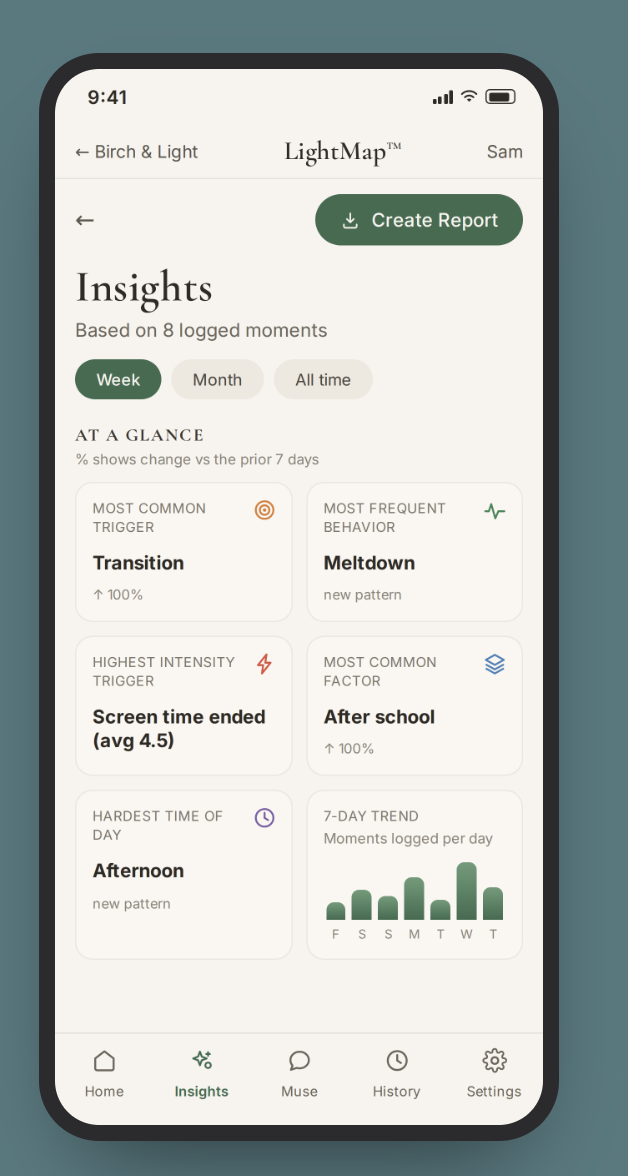

Part of the award-winning Birch & Light Method, honored with the Mom's Choice Gold Award for excellence in family resources.
Before you go, grab the free guide
The 3 body-state triggers under most meltdowns, a script for the 30 seconds before it tips over, and a reset for after. Free.

You'll get the guide instantly, plus five free articles in your inbox every week. Real challenges (meltdowns, school mornings, picky eating, big feelings) and how to actually handle them. Unsubscribe anytime.
Researched and drafted with AI assistance, reviewed before publication. Editorial standards