
Connection before correction means showing your teen they are still your person before you raise the problem, then holding the limit as firmly as you meant to. Teens read social signal fast, so the same boundary lands differently after warmth than after disapproval. The limit stays. Only the order changes.
The phrase — rooted in Jane Nelsen's Positive Discipline and echoed in Dr. Karyn Purvis's teaching to connect before you correct — shows up in a lot of parenting writing about young children. It applies just as cleanly — maybe more so — to teens.
The same words, the same limit, the same consequence will land in completely different places depending on what came before them. The change isn't in the parenting move; it's in the order.
Why does the order matter so much with teens?
A teen's nervous system is exquisitely sensitive to social and relational signal. A conversation that opens with disapproval activates the part of the brain that defends, not the part that takes in information. The actual content of what you wanted to say arrives — and bounces.
For the research on how teenagers take in social information, see Blakemore and Mills's 2014 review in the Annual Review of Psychology.
Connection first isn't softness. It's the precondition for the message landing at all.
What "connection" looks like in practice
- Eye contact without intensity.
- A few minutes in the same room without pressure to talk.
- A small offering — food, a ride, a show.
- Acknowledging something that has nothing to do with the issue.
- Tone that signals "you are still my person" before tone that signals "we have a problem."
None of this is performance. Teens read performance instantly. It's just the relational thread being visible.
What "correction" can still be
Limits, consequences, real disagreement, hard conversations, no's that don't move. All of it. Connection-first doesn't dilute correction; it lets correction be heard.
In fact, parents who lead with connection often find they can hold firmer limits, because the limit no longer doubles as a relational threat.
What if I already led with correction?
Most parents do, sometimes. The repair after — short, real, no defensiveness — is one of the most useful moves available. "I came in too hard last night. The thing I was worried about is still real, and I'm sorry for how I said it." Teens file that away silently for a long time.
For more on the shame side of this, see Why Punishment Can Intensify Shame.
While you're here, take the guide
What's Underneath is free: the three body-state triggers under most meltdowns, what to say in the minute before it tips over, and how to reset afterward.

You'll get the guide instantly, plus five free articles in your inbox every week. Real challenges (meltdowns, school mornings, picky eating, big feelings) and how to actually handle them. Unsubscribe anytime.
What the order looks like on a curfew night
Your teen comes in an hour past curfew. Correction first sounds like "Do you know what time it is?" and the next ten minutes go to defending the lateness instead of discussing it. Connection first sounds like "You're home. Are you hungry?" followed by a few minutes of ordinary talk, then a short statement of the limit: "Curfew matters and it isn't optional. We'll talk about it after school tomorrow."
The consequence can be the same in both versions. What changes is whether your teen is listening when you deliver it. You did not skip the limit, drop the consequence, or pretend the curfew was fine. You waited until the conversation could land.
What this is not
This is not a script. Teens see scripts coming. It's a quiet shift in what the teen registers in the first thirty seconds of a hard moment — whether they are still seen as a whole person, or only as the behavior in front of you.
Where LightMap helps
LightMap can help you see whether your responses are softening or tightening the dynamic over time. Not as a grade — as information.
Related
Frequently asked questions
Isn't 'connection before correction' just permissiveness with nicer language?
No. Connection doesn't replace the limit; it changes when and how the limit lands. The same boundary delivered into a connected moment tends to be received; delivered into a disconnected one, it tends to bounce off or escalate.
What if I'm too angry in the moment to lead with connection?
Then the most useful move is usually to delay the conversation. Saying 'we'll talk about this in the morning' is not weakness — it's the order-of-operations that lets the conversation actually go somewhere.
How long does the 'connection' part need to take?
Often less than people imagine. A few minutes of warm proximity, a meal together, a shared show, a car ride without an agenda. The point isn't a ceremony; it's the relational thread being intact before you pull on it.
Where does LightMap fit?
Patterns help you see whether your responses are tightening or loosening the dynamic over time. That's information about your particular family, not a verdict on parenting.
For your child: Mr. Rudy's Cheese Class is about strangers who come to learn cheese and end up connected, because hands busy and side by side does what sitting down to talk cannot.
Sources: Jane Nelsen, Positive Discipline; Karyn Purvis and the Trust-Based Relational Intervention connecting principles; Steinberg on adolescent social and emotional development (PMC); research on adolescent sensitivity to social evaluation and criticism (PMC).
Blakemore SJ, Mills KL. Is adolescence a sensitive period for sociocultural processing? Annual Review of Psychology. 2014;65:187-207.
For education and reflection, not medical advice. Our terms
See what's underneath
Know which response actually works for your child
LightMap reads your hard days together and gives you answers. Start with one moment today.
Start with 3 moments Not sure where to start? Ask me.Message Tara on WhatsApp. It really is me, I read everything and will personally respond.Click here to message Tara →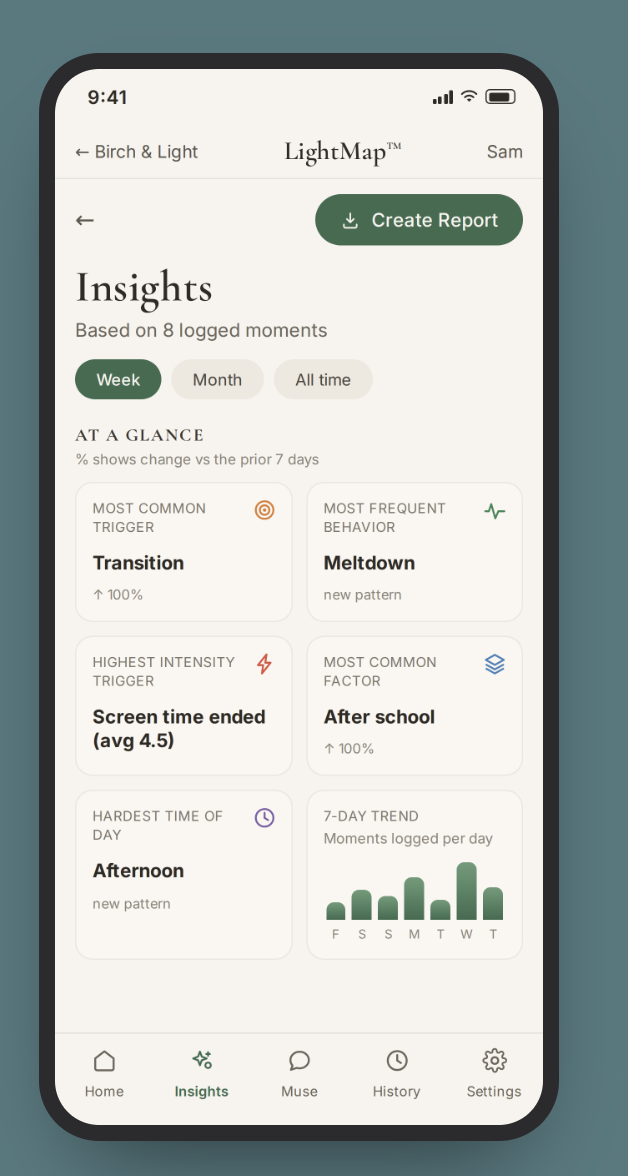

Part of the award-winning Birch & Light Method, honored with the Mom's Choice Gold Award for excellence in family resources.
A story to read together
Sometimes the easiest way in is a story you read side by side.
 The Boy at the Edge
A boy finds calm by watching the world move from a window. When his stillness is mistaken for defiance, the moment escalates — and he learns that being calm doesn’t always protect you from being told no.
Read the story Little Bird
Little Bird used to fly everywhere. Then the forest started to feel too big — and a wise voice helps her see that her wings remember more than her worries do.
Read the story
If today was one of those days
A few more from the library, free to read.
Researched and drafted with AI assistance, reviewed before publication. Editorial standards