

There is a lot of parenting advice out there, and most of it lands as one more thing you're supposedly doing wrong. So let me offer the opposite: a handful of small, repeatable habits that actually lower the temperature in a house, why each one works underneath, and how to adjust them for a child whose nervous system runs hot.
These ideas aren't new inventions, and the parents who post them in tidy graphics didn't make them up either. They come from decades of research on relationships and child development. What I can add is the part that gets left out: what to do when your child is neurodivergent, or intense, or the kind of kid these clean little rules seem to break on.
Tired of guessing what set your child off? Log tonight's moment in LightMap.
The positive-to-negative ratio (aim for about four to one)
The idea: children need roughly four warm, positive interactions for every hard or corrective one to feel securely connected to you. When that balance is there, the relationship has enough good in the bank to absorb the inevitable friction.
This one traces back to relationship researcher John Gottman, whose work on what keeps bonds strong found that thriving relationships run a heavy surplus of positive moments over negative ones. It holds for parent and child as much as for partners.
Here's what makes it usable. A positive interaction is not a gift or a reward. It's tiny. Noticing effort out loud. Pointing out a moment of kindness you saw. A smile across the room. A hand on the shoulder as you pass. Celebrating something small before anyone's earned anything. Four of those to every one "stop that" is the target, and most of us, on a stressful day, quietly invert it without noticing.
The neurodivergent adjustment: a child with ADHD or a demand-avoidant profile often collects far more corrections in a day than a neurotypical kid, through no fault of their own. The world simply asks them to redirect constantly. That means the ratio is working against you before you've said a word, and closing the gap takes deliberate effort. It also means the positives have to be genuinely low-key. For a demand-avoidant child, effusive praise can itself feel like pressure, so a quiet "I noticed you figured that out" lands better than a big celebration.
The one-ask-one-wait rule
The idea: say it once, then pause. Give it five to ten seconds before you repeat yourself.
When we ask something and get no response, the instinct is to ask again, faster and louder. The trouble is that this quietly trains a child to wait for the raised voice before responding, because that's the version that reliably means "now." The pause does the opposite. It gives the request room to actually land.
The reason this matters so much for neurodivergent kids is processing time. A child with ADHD, autism, or auditory processing differences often needs several extra seconds to move a spoken instruction from "heard" to "understood" to "ready to act." Repeating during that window doesn't speed it up. It interrupts it, and the whole process restarts. Say it once, hold the silence even though it feels long, and only then repeat if you truly need to.

There's a story for this exact struggle
The Boy at the Edge
A boy finds calm by watching the world move from a window. When his stillness is mistaken for defiance, the moment escalates — and he learns that being calm doesn’t always protect you from being told no.
Free to read. You'll also get five free articles a week. Unsubscribe anytime.
The HALT check-in
The idea: before you react to big behavior, pause and run through four basic needs that might be driving it. Hungry, angry or overstimulated, lonely or needing connection, tired.
HALT comes out of addiction-recovery frameworks, where it's used as a self-check against the states that make a person most likely to slip. It travels well to children because so many meltdowns are a dysregulated body, not a defiant choice. A kid who has gone too long without food, or absorbed too much noise and light, or hasn't had real connection all afternoon, or is simply exhausted, does not have a behavior problem in that moment. They have an unmet need wearing the costume of a behavior problem.
Running the checklist before you respond changes what you're solving for. Instead of managing the outburst, you're asking what it's pointing at. A snack, a quieter room, ten minutes of your undivided attention, or an earlier bedtime often does what no consequence could.
For sensory kids, I'd stretch the "A" beyond angry to overstimulated, because sensory overload is one of the most common and most missed triggers. The child isn't melting down at the birthday party because they're spoiled. They're melting down because their system took in more than it could hold.
The connection windows: waking, after school, before bed
The idea: three moments in a day carry outsized weight for how safe and seen a child feels. The first minutes after they wake, the reunion after school, and the wind-down before sleep. A few minutes of real presence at each does more than a whole afternoon of divided attention.
These are the hinges of the day, the transitions where a child is most porous. Meeting them there, with a hug and an "I'm so happy to see you" in the morning, a genuine "tell me the best and worst part of your day" after school, a cuddle or a story at night, tells the nervous system it's held before anything's gone wrong. It's preventive connection rather than repair.
The catch worth naming: after school is often the hardest window, because many kids, especially neurodivergent ones, are running on empty from holding it together all day. The reunion can come out sideways, as grumpiness or a meltdown, precisely because you're the safe person they can finally fall apart with. That after-school unraveling isn't a rejection of the connection. It often is the connection. Lower your expectations for that particular window and let it be quiet.
The one thing these rules leave out
Every one of these habits asks something of you, in a body that may also be running on empty. And here's what the tidy graphics rarely say: you cannot pour connection from a nervous system that's in threat mode itself. If you're depleted, the four-to-one ratio and the calm pause and the warm reunion are not going to flow, and no amount of willpower manufactures them.
So the real first rule, the one underneath all four, is that your own regulation comes first. Not as a luxury or a self-care slogan, but as the mechanism. A calm adult is what lets a child borrow calm. On the days you've got nothing left, the most useful move isn't to force a perfect reunion. It's to get yourself back to steady first, even briefly, so there's something for your child to co-regulate with. These rules work because of who you are when you use them, not just what you do.
None of this has to be done well every day. The point isn't a scorecard. It's a direction: more small moments of connection than correction, more pause than pressure, more curiosity about the need underneath than reaction to the behavior on top. That's a house that slowly gets warmer, and it starts wherever you are today.
These build slowly, and the change shows up as fewer hard moments rather than as anything you can point to. LightMap is a place to log them so you can see the slope.
For your child: Mr. Rudy's Cheese Class is about strangers who come to learn cheese and end up connected, because hands busy and side by side does what sitting down to talk cannot.
Sources: Gottman's research on emotion coaching; Tronick's still face research; child-directed interaction and special time components of Parent-Child Interaction Therapy (PMC); American Academy of Pediatrics guidance on relationships, connection, and child resilience.
For education and reflection, not medical advice. Our terms
See what's underneath
Know which response actually works for your child
LightMap turns scattered hard days into a pattern you can see. Start by logging one moment tonight.
Find out why it keeps happening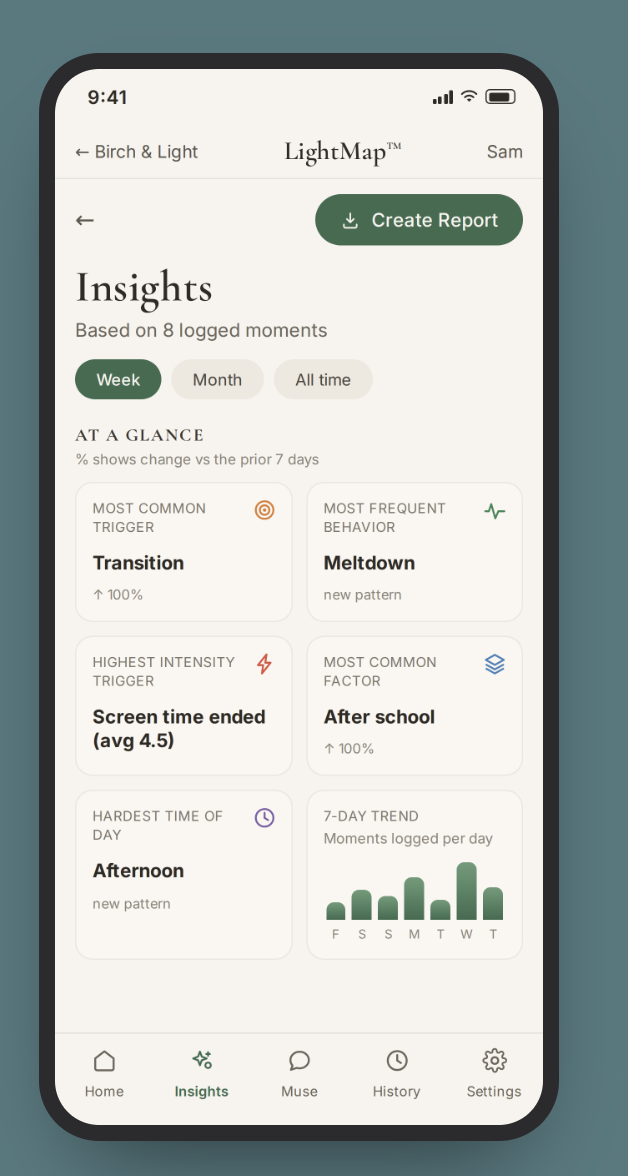

Part of the award-winning Birch & Light Method, honored with the Mom's Choice Gold Award for excellence in family resources.
Before you go, grab the free guide
The 3 body-state triggers under most meltdowns, a script for the 30 seconds before it tips over, and a reset for after. Free.

You'll get the guide instantly, plus five free articles in your inbox every week. Real challenges (meltdowns, school mornings, picky eating, big feelings) and how to actually handle them. Unsubscribe anytime.
A story to read together
Sometimes the easiest way in is a story you read side by side.
- The Boy at the Edge
A boy finds calm by watching the world move from a window. When his stillness is mistaken for defiance, the moment escalates — and he learns that being calm doesn’t always protect you from being told no.
Read the story  Little Bird
Little Bird used to fly everywhere. Then the forest started to feel too big — and a wise voice helps her see that her wings remember more than her worries do.
Read the story
Researched and drafted with AI assistance, reviewed before publication. Editorial standards