
Every piece of advice about meltdowns eventually arrives at the same instruction: stay calm. Co-regulate. Be the steady presence your child can borrow from. And it's true — your calm is the most powerful tool you have in a meltdown. But there's a problem nobody talks about enough: staying calm while your child screams, hits, or falls apart is genuinely, sometimes brutally, hard. Your own nervous system is wired to react to your child's distress, and 'just stay calm' can feel as impossible to you as 'calm down' does to them.
So this isn't another article telling you to be calm. It's about how — how you actually hold your own regulation when everything in you is being pulled toward losing it. Because the truth is, you can't share a calm you don't have, and protecting your own steadiness is the real skill underneath co-regulation.
Why It's So Hard to Stay Regulated
It helps to start by letting yourself off the hook a little. Staying calm during your child's meltdown is hard for reasons that have nothing to do with your patience or character.
Your nervous system is built to respond to your child's distress. A child's cry, scream, or panic is designed by evolution to activate the parent — to make you alert, mobilized, urgent. That's not a flaw; it's an attachment system doing its job. But it means that when your child floods, your own system is pulled to flood right alongside them. Their dysregulation is, in a real sense, contagious to you.
On top of that, you're often running on your own depleted reserves — tired, stretched, carrying the day's accumulated stress. And the meltdown may be pushing your own buttons: triggering your frustration, your fear of judgment, your own childhood echoes. So when you struggle to stay calm, you're not failing. You're a human nervous system doing exactly what human nervous systems do. The goal isn't to never feel pulled. It's to have ways back to steady when you are.
You can't share a calm you don't have. Protecting your own regulation isn't selfish — it's the whole mechanism of co-regulation.
What Helps You Hold Your Own Regulation
Notice your own activation early. The earlier you catch your own rising heat — the clenched jaw, the tight chest, the urge to yell — the more options you have. Once you're fully flooded yourself, the choices narrow. Catching it at a 3 instead of a 9 is half the battle.
Breathe out, longer than you breathe in. A slow exhale is one of the few direct, physical levers you have on your own nervous system. A long breath out signals your body toward calm in a way that thinking your way calm can't. It's small, it's available, and it works.
Drop the goal of stopping the meltdown. A lot of parental flooding comes from the pressure to make the meltdown end — now, fast, before it gets worse. Letting go of that goal, and accepting that the feeling will move through in its own time, takes enormous pressure off you. You're not failing if it's still going. You're just keeping it company.
Remind yourself what's actually happening. A quiet internal narration helps: 'This is a flooded nervous system, not a personal attack. They can't access their thinking brain right now. My job is to be steady, not to fix this instantly.' Reframing the moment lowers your own threat response.
Lower your own input, too. Just as your child needs less coming at them, you need less coming at you. If you can reduce the noise, the audience, the stakes — step to a quieter spot, let go of who might be watching — you give your own system room to stay steady.
Let 'good enough' be enough. You will not be perfectly calm every time. You don't have to be. 'Regulated enough to be a steady presence' is the bar, not serenity. And when you lose it — because you sometimes will — the repair afterward matters more than the slip.
While you're here, take the guide
What's Underneath is free: the three body-state triggers under most meltdowns, what to say in the minute before it tips over, and how to reset afterward.

You'll get the guide instantly, plus five free articles in your inbox every week. Real challenges (meltdowns, school mornings, picky eating, big feelings) and how to actually handle them. Unsubscribe anytime.
When You Lose It Anyway
You will, sometimes, lose your own regulation. You'll raise your voice, react sharply, flood right along with your child. This is human and universal, and it is not the end of the world or the ruin of your child.
What matters most in those moments is what comes after: the repair. Coming back, once you're both settled, and reconnecting — 'That was hard. I got upset too. I'm sorry I yelled. We're okay' — does more good than perfect calm would have. It teaches your child that rupture can be repaired, that people lose it and come back, that the relationship survives the hard moments. That lesson is worth more than an unbroken record of composure.
The Shift Worth Making
The instruction 'stay calm during the meltdown' is right, but incomplete — because it skips the hardest part, which is how. The how isn't willpower. It's catching your own activation early, having a few physical and mental levers back to steady, releasing the pressure to fix it instantly, and forgiving yourself when you slip.
Your calm really is the thing your child borrows to find their way back. Which means that taking care of your own regulation — protecting it, rebuilding it, being gentle with it — isn't a distraction from helping your child. It's the foundation the whole thing rests on.
Every behavior is a clue.
If staying steady through meltdowns is the hard part for you, LightMap can help you track your own patterns alongside your child's — what depletes you, what helps you hold steady — so the pattern beneath it becomes easier to see. Explore LightMap at birchandlight.com/lightmap.
Put it into practice
Understanding the volcano is step one. Giving your child their own tools for it is where things shift. My Big Feelings and My Fast Brain is a printable workbook that turns feeling-size, early warning signs, and calm-down tools into pages kids want to do, with a science section for the grown-up. It is $9, instant download, print at home.
Get the workbook, or find both fast brain workbooks in the bundle.
Sources: Peer-reviewed research on emotional contagion and parent-child physiological synchrony (PMC); Tronick on rupture and repair in caregiver-child interaction; research on parental stress reactivity and child emotion regulation outcomes (PMC); research on caregiver burnout in families of children with high support needs (PMC).
For education and reflection, not medical advice. Our terms
See what's underneath
Know which response actually works for your child
LightMap reads your hard days together and gives you answers. Start with one moment today.
Start with 3 moments Not sure where to start? Ask me.Message Tara on WhatsApp. It really is me, I read everything and will personally respond.Click here to message Tara →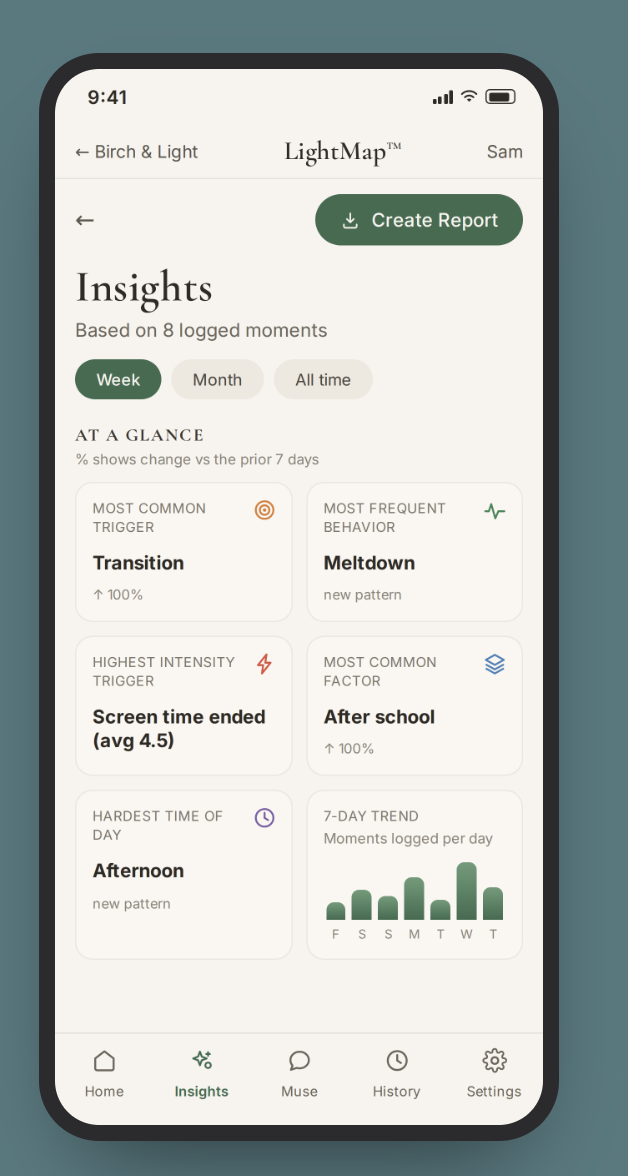

Part of the award-winning Birch & Light Method, honored with the Mom's Choice Gold Award for excellence in family resources.
A story to read together
Sometimes the easiest way in is a story you read side by side.
 The Boy at the Edge
A boy finds calm by watching the world move from a window. When his stillness is mistaken for defiance, the moment escalates — and he learns that being calm doesn’t always protect you from being told no.
Read the story Little Bird
Little Bird used to fly everywhere. Then the forest started to feel too big — and a wise voice helps her see that her wings remember more than her worries do.
Read the story
If today was one of those days
A few more from the library, free to read.
Researched and drafted with AI assistance, reviewed before publication. Editorial standards