.jpg)
The scene repeats in thousands of houses every morning. The alarm goes off. Alexa announces it is time to take meds. Your child says okay, and she means it. Ten minutes later the pills are untouched, the alarm is forgotten, and you are wondering how a person can be reminded of something and still not do it.
Here is the answer, and it changes everything about how you set up your house: reminders solve the wrong problem.
The baton drop
A reminder delivers information. But your child already has the information. She knows she takes meds in the morning. She knows homework exists. Knowing was never the broken part.
The broken part is the transit. Psychologists call it prospective memory, the ability to hold an intention and carry it across time and space until you act on it. In ADHD brains, that carrying capacity is the weakest link. The alarm fires, the intention forms, fully and sincerely, and then it has to survive the trip: down the hall, past the dog, past the phone lighting up, past a more interesting thought. It does not survive. The baton gets dropped in transit, and no amount of louder or more frequent reminding fixes a transit problem.
This is why she can be reminded and still not do it, and why it is not defiance and not laziness. The intention was real. It just evaporated on the way.
Charts fail for a cousin of the same reason. A chart is also information, sitting on a wall, requiring her to notice it, connect it to now, and launch. Charts also suffer novelty decay: they work for two weeks while they are interesting, and then they become wallpaper. If you have watched three chart systems die in your house, that was not your execution. That is the lifecycle.
Stop reminding. Start rearranging.
The fix is to shrink the transit to zero: put the task physically inside a habit that already happens every single day, so there is nothing to remember and nowhere for the intention to die.
The med bottle does not live in the cabinet with an alarm pointing at it. It lives on top of the phone charger, so the phone cannot be picked up without touching it. Morning pills sit on the breakfast plate itself, not near it, on it. The permission slip gets taped to the front door at eye level, blocking the exit. The task stops competing with her habits and starts riding them.
A few rules make this work:
Anchor to events, not times. "After school" and "8am" are abstractions that ADHD brains file loosely. "When your plate hits the table" is a physical moment that arrives on its own.
Visual beats auditory. Sounds are dismissed in two seconds and leave no trace. An object out of place keeps announcing itself until it is handled.
Pick the anchor habit that happens one hundred percent of days, no exceptions: charging the phone, brushing teeth, breakfast. If the anchor is reliable, the task inherits its reliability.
One anchor at a time. Install it, run it until it is boring, then add the next. Three new systems at once is how all three die.
While you're here, take the guide
What's Underneath is free: the three body-state triggers under most meltdowns, what to say in the minute before it tips over, and how to reset afterward.

You'll get the guide instantly, plus five free articles in your inbox every week. Real challenges (meltdowns, school mornings, picky eating, big feelings) and how to actually handle them. Unsubscribe anytime.
When the task is bigger than a pill
For homework, chores, and multi-step tasks, the broken part is usually initiation, the cold start. The fix is not another reminder, it is a warm start: do the first thirty seconds together. Sit down with her, open the notebook, read the first problem out loud, then drift away. Starting is a different neurological event than continuing, and it is the one ADHD struggles with most. You are not doing the homework for her. You are jump-starting the engine she cannot turn over alone.
For older kids and teens, move from installing systems to designing them together. One question changes the ownership: "Where would the pill bottle have to live for you to literally trip over it?" Kids who design their own anchor defend it. Kids who receive a system resent it.
The honest part
Two things are true. First, this is a developmental lag in executive function, not a character flaw, and it responds to environmental design the way nearsightedness responds to glasses. You would not lecture a child into seeing the board. You put the tool where the deficit is.
Second, every system fades. The pill bottle on the charger will eventually become invisible too. That is not failure, it is maintenance: rotate the placement, refresh the anchor, treat it like changing the batteries in the smoke detector. Adults with ADHD who thrive have not outgrown this. They have simply become excellent at rearranging their environment on purpose, and a child who grows up inside that approach walks into adulthood already fluent in the one skill that actually works.
Finding the anchor that sticks is a pattern question: log which tasks slip and which anchors hold in a tool like LightMap, and within two weeks you will know which habits in your house are strong enough to carry a task and which times of day are lost causes.
You do not have a child who ignores reminders. You have a child whose brain drops the baton in transit, and a house that can be rearranged so there is no transit at all.
For education and reflection, not medical advice. Our terms
See what's underneath
Stop guessing what set it off
LightMap reads your hard days together and gives you answers. Start with one moment today.
Start with 3 moments Not sure where to start? Ask me.Message Tara on WhatsApp. It really is me, I read everything and will personally respond.Click here to message Tara →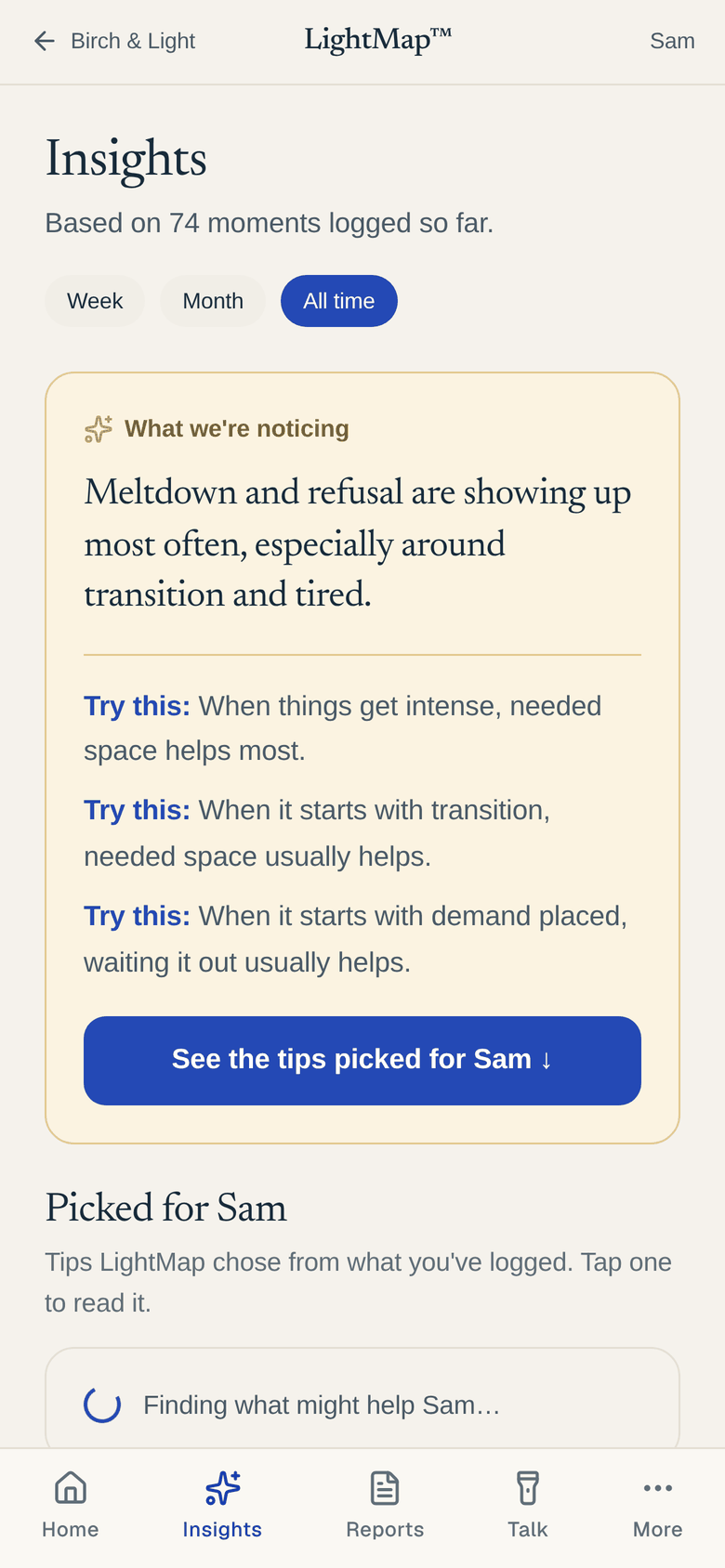

Part of the award-winning Birch & Light Method, honored with the Mom's Choice Gold Award for excellence in family resources.
A story to read together
Sometimes the easiest way in is a story you read side by side.
 The Tower That Looked Fine
A tower in a quiet clearing tries to stay steady through every small thing nobody else seems to notice — until one tiny breath of wind causes her to fall, and a gentle hand begins to gather the blocks back.
Read the story The Boy at the Edge
A boy finds calm by watching the world move from a window. When his stillness is mistaken for defiance, the moment escalates — and he learns that being calm doesn’t always protect you from being told no.
Read the story
If today was one of those days
A few more from the library, free to read.
Researched and drafted with AI assistance, reviewed before publication. Editorial standards