
A surprising amount of behavior that gets read as rebellion, defiance, or attitude turns out, on closer look, to be loneliness in motion. Not the cinematic kind. The ordinary kind — feeling unknown inside ordinary rooms.
Teens almost never name it that way. The behavior names it for them.
What teen loneliness often looks like
- An hours-long phone session that doesn't seem to satisfy
- Outsized reactions to small social slights
- "Everybody hates me" as a literal felt sense, not a tantrum
- Withdrawing from things they used to like
- Performing okay all day and collapsing at home
- Reaching for sensation, risk, or numbing in evenings
Loneliness isn't the absence of people. It's the absence of feeling known. Teens can be surrounded and still carrying it.
Why this is harder to see than it used to be
Constant low-grade contact through phones gives the appearance of connection without the substance of it. A teen can have hundreds of pings a day and almost no minutes of being met. Some of the loneliest stretches of adolescence happen inside the busiest digital weeks.
What tends to help — and what doesn't
Tends to help
- Low-pressure presence at home. Being in the room without making the teen perform anything.
- Shared activities without a conversation requirement. Cooking. Walking the dog. Driving somewhere.
- Naming what you see, lightly. "You seem a little far away this week. I'm here."
- Protecting one or two reliable family rhythms. A weekly thing nobody negotiates.
- Letting them be unimpressive sometimes. No need to be on.
Tends not to help
- "Why don't you go hang out with your friends?"
- Big planned conversations announced in advance
- Comparisons to your own teenage social life
- Treating the symptom (the phone, the withdrawal) as the issue
While you're here, take the guide
What's Underneath is free: the three body-state triggers under most meltdowns, what to say in the minute before it tips over, and how to reset afterward.

You'll get the guide instantly, plus five free articles in your inbox every week. Real challenges (meltdowns, school mornings, picky eating, big feelings) and how to actually handle them. Unsubscribe anytime.
When loneliness needs more than home
If loneliness comes with persistent low mood, sleep or appetite changes, or any hopelessness about the future, that's worth bringing to a therapist or pediatrician. Loneliness is also one of the things therapy is genuinely good for — sometimes a non-parent adult is the room a teen can put it down in.
Where LightMap helps
LightMap tends to surface social-stress patterns within a few weeks: when isolation deepens, what days are hardest, what tends to ease it. That makes both your response and any conversation with a counselor much more grounded.
Related
Frequently asked questions
How can my teen be lonely when they're constantly with friends or on their phone?
Loneliness isn't only about being alone. It's the gap between how known a person feels and how known they want to feel. A teen can be in a group chat all day and still be carrying the kind of loneliness this article is about.
What's the difference between loneliness and depression?
Overlap is real, but loneliness can exist without clinical depression. If your teen shows persistent low mood, changes in sleep or appetite, or hopelessness about the future, that's worth bringing to a therapist or pediatrician — independently of how social their week looked.
How do I help without pushing them to 'just go hang out with people'?
By making home a place where they don't have to perform connection. Low-pressure presence, shared activities without conversation requirements, and consistency over time tend to do more than a single big talk or any specific social prescription.
Where does LightMap come in?
Tracking helps surface social-stress patterns over weeks — when isolation deepens, what tends to come before it, what eases it. That makes both your response and any conversation with a counselor much more grounded.
For your child: Lyra and the Constellation That Changed is about a small star watching her closest friend slowly drift away, and letting the ache be real.
Sources: Cacioppo on loneliness as a physiological and motivational state (PMC); Eisenberger on social pain and its overlap with physical pain processing (PMC); research on adolescent loneliness and its behavioral presentation (PMC); Steinberg on adolescent development (PMC).
For education and reflection, not medical advice. Our terms
See what's underneath
See which situations cost the most
LightMap reads your hard days together and gives you answers. Start with one moment today.
Start with 3 moments Not sure where to start? Ask me.Message Tara on WhatsApp. It really is me, I read everything and will personally respond.Click here to message Tara →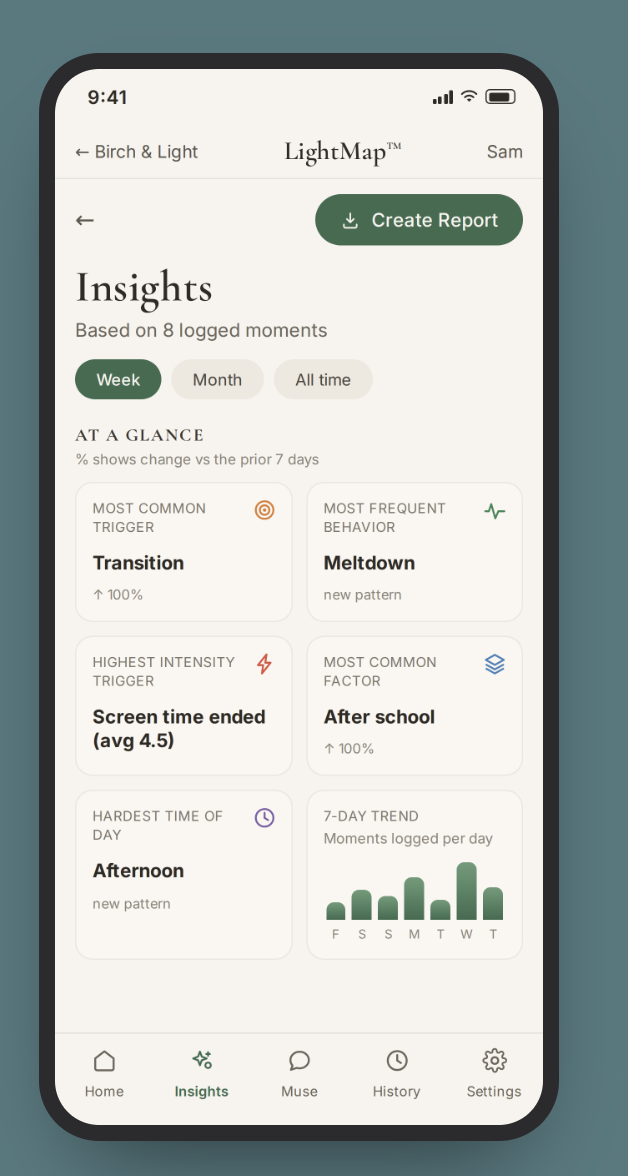

Part of the award-winning Birch & Light Method, honored with the Mom's Choice Gold Award for excellence in family resources.
A story to read together
Sometimes the easiest way in is a story you read side by side.
 Taste Bud 17
Taste Bud 17 feels everything more — and learns that big sensory feelings deserve the same care as everyone else’s.
Read the story Otto Filled Everything
Otto can't stop filling things with water. His family doesn't understand — until Grandma Willow helps them listen to what his body is actually asking for.
Read the story
If today was one of those days
A few more from the library, free to read.
Researched and drafted with AI assistance, reviewed before publication. Editorial standards