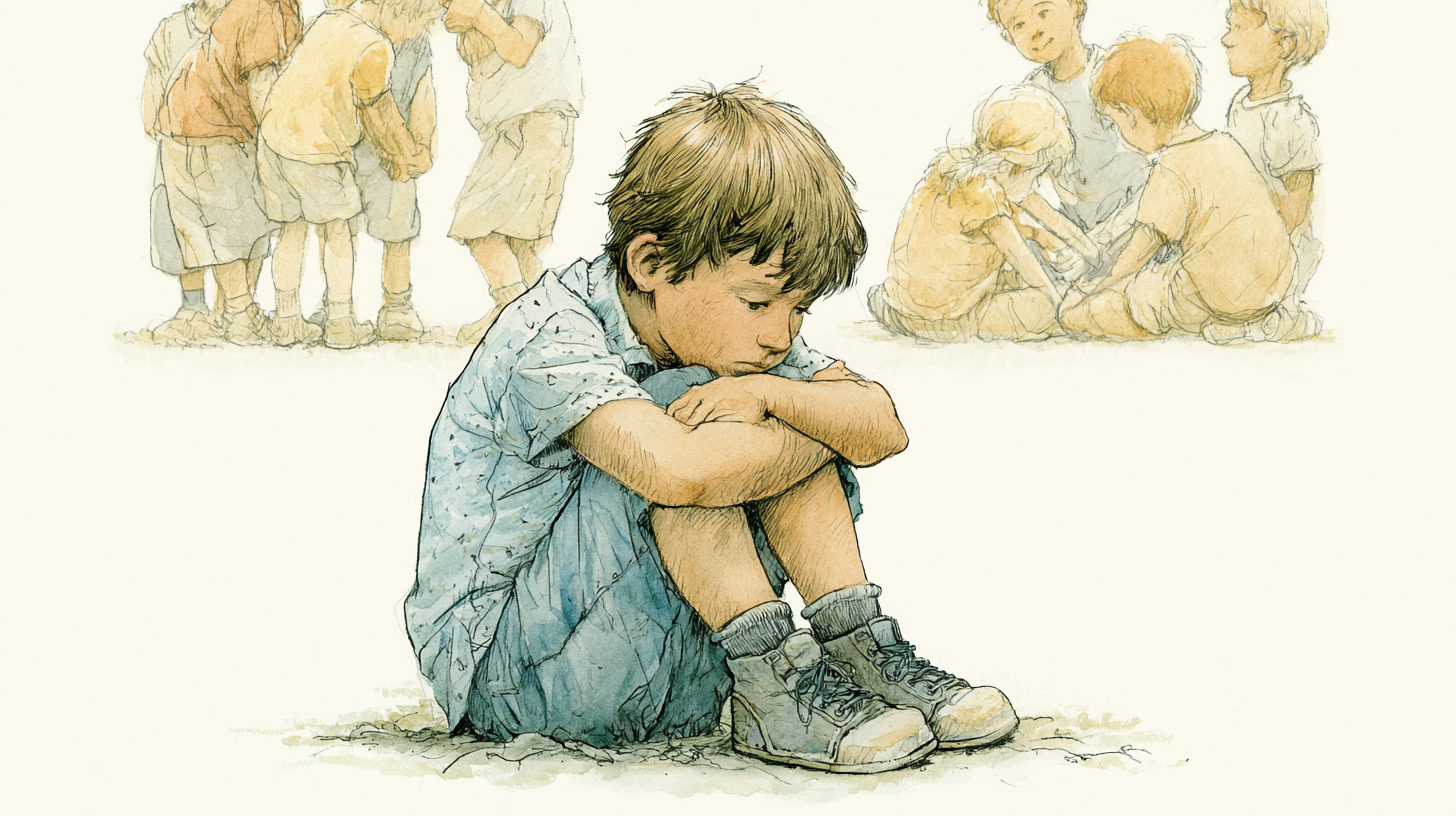
"Everyone hates me." "I don't have any friends." "Nobody ever wants to play with me."
When a child says something like this, the words land hard — and the instinct is immediate. That's not true. You can name three friends. You were there at the birthday party last week. You have evidence, and you want to hand it to your child to make the awful feeling go away.
But a lot of kids who say "everyone hates me" aren't being dramatic, and they're not actually wrong about the facts. They're describing how it feels in that exact moment — and that feeling is so total, so physically real, that it has temporarily become the truth. Here is what I want you to consider before you reach for the reassurance.
What this often looks like
- A sweeping, absolute statement — "everyone," "nobody," "always," "never" — after one difficult interaction or one perceived rejection.
- A child who seemed fine an hour ago plunged into total certainty that they're friendless and unwanted.
- The feeling arriving fast and huge, often wildly out of proportion to what actually happened.
- Reassurance bouncing right off — you list the evidence, and it changes nothing.
- For some kids, especially those with ADHD, this happening often, intensely, and seemingly out of nowhere.
Why it happens
For many children, one rough moment doesn't stay one rough moment. A single perceived rejection — a friend who didn't wave back, a turn that got skipped, a rough first day — can flood the whole system, and in that flood, the brain doesn't file it as "one bad interaction." It generalizes it into a belief: I don't belong anywhere.
This is especially common for kids with ADHD, whose nervous systems can register rejection with startling intensity. The feeling of being rejected or left out can hit them physically, like a wave, and when a child is underneath that wave, it doesn't feel like an exaggeration. It feels like the most obvious truth in the world. "Everyone hates me" isn't a manipulation or a bid for attention. It's an accurate report of what their nervous system is broadcasting in that moment.
And here's the crucial part: what their nervous system is telling them happened is not the same as what actually happened. One kid said no to playing. The child's body translated that into nobody wants me, I'm unlovable, I belong nowhere. The gap between the event and the feeling is enormous — but to the child, in the moment, there is no gap. The feeling is the event.
When we respond with "that's not true," we're aiming at the facts. But the child isn't actually making a factual claim. They're expressing a feeling, and what they most need first isn't to be corrected — it's to be understood.
What tends to help
- Meet the feeling before the facts. "That sounds like such an awful feeling" reaches a child in a way "that's not true" never can. You're not agreeing that everyone hates them — you're acknowledging that right now, it really feels that way, which is the thing they need to hear first.
- Let them feel understood before you try to shift anything. A child who feels met can usually come down from the wave on their own. A child who feels corrected often digs in, because now they have to prove how bad it is to be taken seriously.
- Help separate what happened from what it feels like — gently, and later. Once your child is regulated, you can softly help them notice the gap: "One person said no today, and your brain turned it into everyone. That's a thing brains do when they're hurting." Not as a correction, but as a tool they can eventually use themselves.
- Name the pattern over time. For a child who does this often, it can help — in calm moments — to talk about how their feelings sometimes arrive really big and really fast, and how a huge feeling isn't always a true fact. This is a skill that builds slowly.
What tends not to help
Leading with "that's not true." Even though it's loving and accurate, it tells a flooded child that you've missed what they're actually experiencing. They don't feel reassured; they feel unseen, and often they escalate to convince you it really is that bad — because being believed feels more urgent than being corrected.
Piling on evidence also tends to fail. Listing all the friends they have, all the proof they're wanted, is aimed at a reasoning brain that's temporarily offline. In the middle of the wave, facts don't land. The child isn't in a state to weigh evidence, and being handed a case file can feel like being argued with rather than comforted.
And dismissing it as drama — "you're being ridiculous," "stop being so dramatic" — does real harm. It teaches a child that their inner experience is embarrassing and that the people they trust don't take their pain seriously, which makes them less likely to come to you with it next time, not more.
While you're here, take the guide
What's Underneath is free: the three body-state triggers under most meltdowns, what to say in the minute before it tips over, and how to reset afterward.

You'll get the guide instantly, plus five free articles in your inbox every week. Real challenges (meltdowns, school mornings, picky eating, big feelings) and how to actually handle them. Unsubscribe anytime.
When additional support may be needed
If your child's sense of being rejected and unwanted is frequent, intense, and significantly affecting their friendships, mood, or willingness to keep trying socially, it may be worth talking with a professional. For some kids, especially those with ADHD, rejection sensitivity is a real and significant part of their experience, and there are approaches that genuinely help them ride the waves with less devastation.
It's also worth seeking support if the statements move beyond "everyone hates me" toward deeper hopelessness about themselves, or if the loneliness seems to be hardening into something heavier and more persistent. A child who increasingly believes they're fundamentally unwanted deserves help carrying that, and the earlier it's addressed, the better.
This is a sensitive area, and if you're ever worried about your child's wellbeing in a more serious way, reaching out to your pediatrician or a mental health professional is always a reasonable step.
Where LightMap helps
The "everyone hates me" moments can feel random — they seem to strike from nowhere — but they usually aren't random at all. They tend to follow specific triggers: a hard transition, a tired day, a particular social setting, the end of an overstimulating stretch.
Logging these moments alongside what was happening around them can reveal the conditions that set them off. When you can see that the rejection waves cluster after poor sleep, or on the days following big social events, or in a specific recurring situation, you stop experiencing them as unpredictable storms and start seeing what feeds them. That lets you get ahead of the hardest moments, and it helps your child eventually learn their own patterns too.
Every behavior is a clue.
The waves that feel random usually follow a pattern — and seeing it helps you get ahead of them. Explore LightMap at birchandlight.com/lightmap.
Frequently asked questions
My child has friends. Why do they insist nobody likes them?
Because in that moment they're describing a feeling, not the facts. One perceived rejection can flood a child's system and get generalized by the brain into a sweeping belief — "everyone hates me" — that feels completely true even when the evidence says otherwise. They're accurately reporting what their nervous system is broadcasting, which isn't the same as what actually happened.
Why doesn't reassurance work?
Reassurance aims at the reasoning brain, and in the middle of a rejection wave, that part is temporarily offline. Listing all the friends they have can even feel like being argued with rather than comforted. What reaches a flooded child first is feeling understood — "that sounds like an awful feeling" — not being corrected. The facts can come later, once they're calmer.
Is this more common with ADHD?
For many kids with ADHD, yes — rejection can register with unusual intensity, hitting almost physically and fast. A small social slight can produce a wave of feeling far larger than the event itself. It isn't drama or manipulation; it's a nervous system that feels rejection very strongly, and there are real approaches that help kids navigate those waves with less devastation.
For your child: Theo's Invisible Backpack is about a young bear who starts collecting invisible stones when other animals tease him, adds more of his own over the years, and whose mother finally picks each one up asking who said that.
Sources: Peer-reviewed research on absolutist and all-or-nothing thinking in children and its relationship to distress (PMC); Lieberman et al. on affect labeling (Psychological Science; PMC); research on rejection sensitivity in children and adolescents (PMC); Linehan on validation in dialectical behavior therapy.
For education and reflection, not medical advice. Our terms
See what's underneath
See which situations cost the most
LightMap reads your hard days together and gives you answers. Start with one moment today.
Start with 3 moments Not sure where to start? Ask me.Message Tara on WhatsApp. It really is me, I read everything and will personally respond.Click here to message Tara →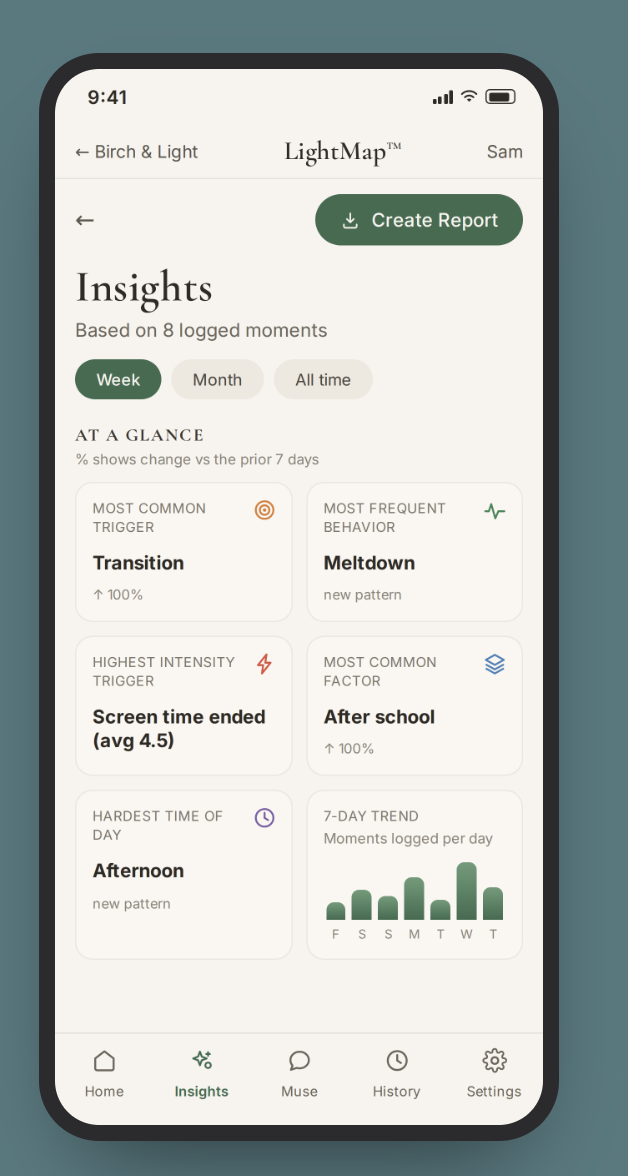

Part of the award-winning Birch & Light Method, honored with the Mom's Choice Gold Award for excellence in family resources.
A story to read together
Sometimes the easiest way in is a story you read side by side.
 Magnolia, Willow, and Pine
When the wind shifts in the clearing and Willow drifts toward Pine, Magnolia learns hurt feelings don’t have to mean closing forever.
Read the story Lyra and the Constellation That Changed
A small star watches her closest friend slowly drift away — and learns that her light was never measured by who stayed beside her.
Read the story
If today was one of those days
A few more from the library, free to read.
Researched and drafted with AI assistance, reviewed before publication. Editorial standards