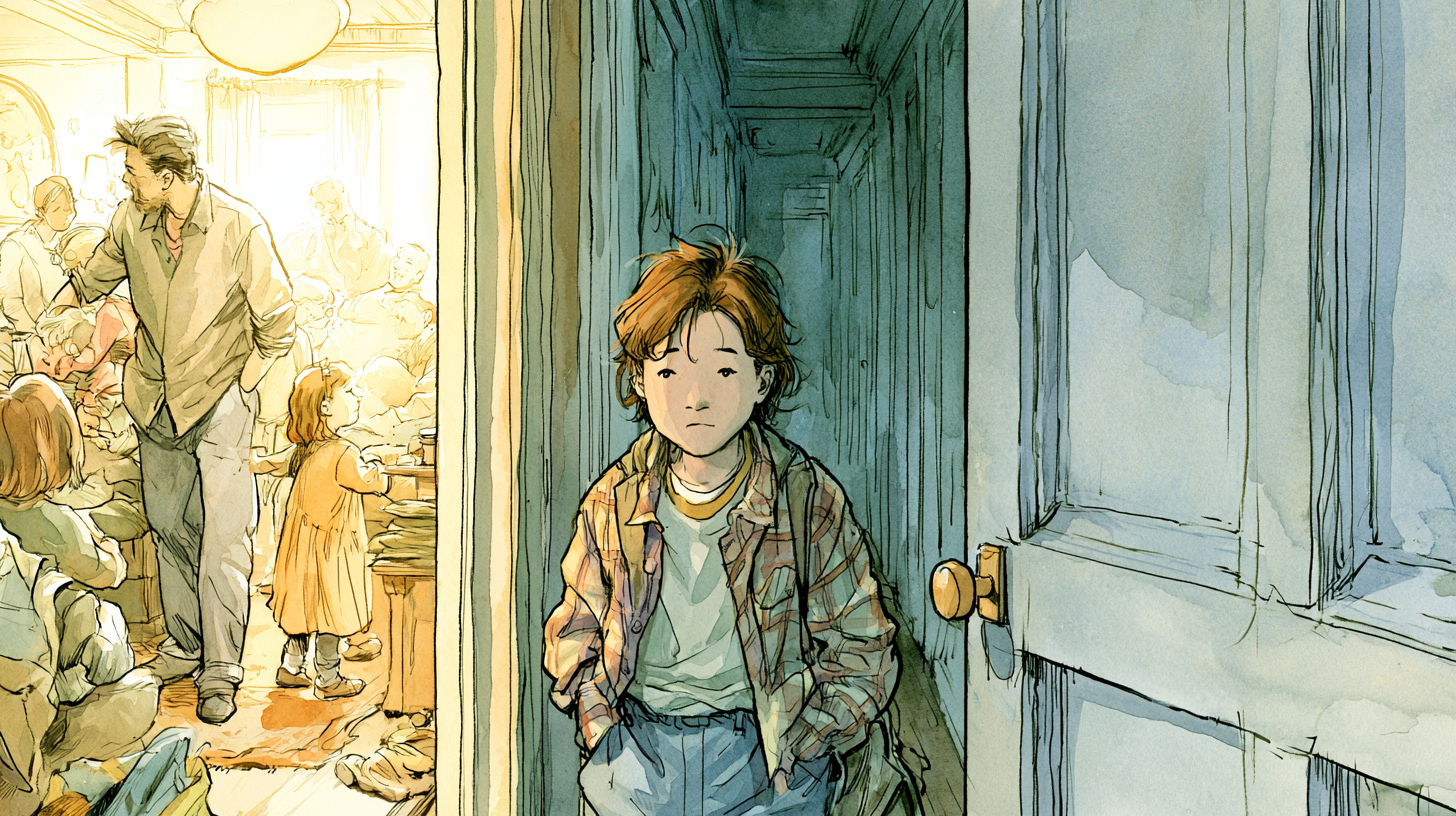
Your child feels left out because being included and feeling wanted are different things. They can be at the party, on the team, at the lunch table, and still sense they are not really part of it. Sometimes that is accurate, and sometimes an anxious mind is reading rejection into neutral moments.
They were invited to the party. They were on the team. They sat with the group at lunch, you have confirmation from the teacher. And they came home and said, with complete conviction: "Nobody wanted me there. I was left out the whole time."
You have the evidence. They have the experience. And arguing evidence against experience is a game parents lose every time, because your child is not reporting the seating chart. They are reporting something real that the seating chart cannot see.
Included is a fact. Belonging is a feeling.
A child can be physically present in every scene and still be socially outside all of them: not quite in the joke, half a beat behind the game, tolerated but not sought. Kids are exquisitely accurate detectors of the difference between being allowed and being wanted. When your child says "left out," they usually mean the second thing was missing, and about that, they may be right, even though the invitation was real.
This matters more than it sounds. Psychologists Roy Baumeister and Mark Leary reviewed decades of research and concluded that the need to belong is a powerful, fundamental, and extremely pervasive human motivation, and that lacking social attachments is linked to poorer health, adjustment, and well-being. A child who feels outside is not being dramatic. They are reacting to a need going unmet.
So the first move is to stop litigating attendance. "But you WERE included" teaches them their radar is broken, or that you cannot be told the truth. Try instead: "So you were there, but it felt like you weren't really in it. Tell me about that." Watch how much more information you get.
What if my child's left-out radar is running too hot?
That said, some children's left-out detector fires on everything. Anxious kids and kids with a bruised season behind them, a betrayal, a move, a friendship that ended badly, start scanning every interaction for exclusion evidence, and a scanning brain always finds some. Two friends laughing become laughing at them. A pause before "sure, you can play" becomes proof of reluctance. Not chosen first becomes not wanted at all.
This is not lying and it is not drama. It is a threat-detection system doing its job too well. The feeling is real; the interpretation is running ahead of the facts. And it compounds: a child braced for exclusion comes in guarded and flat, gets a lukewarm reception because of it, and collects the evidence they were braced for.
Research on children backs this up. Geraldine Downey and colleagues studied fifth to seventh graders and found that children who expected rejection, and braced for it with anger, were more distressed when a peer's snub was ambiguous. Children high in rejection sensitivity went on to have more interpersonal difficulties over time.
How to tell which one you're looking at
Listen to the specifics. A child who can tell you concrete mechanics, "they kept talking about the sleepover I wasn't at," "every time I said something the game just went around me", is usually reporting real peripheral status. A child whose evidence is atmospheric, "I could just tell," "they looked at each other", may be reporting the radar. Many kids are some of both, and the same kid can be different on different days. The pattern across weeks tells you what one afternoon cannot.
While you're here, take the guide
What's Underneath is free: the three body-state triggers under most meltdowns, what to say in the minute before it tips over, and how to reset afterward.

You'll get the guide instantly, plus five free articles in your inbox every week. Real challenges (meltdowns, school mornings, picky eating, big feelings) and how to actually handle them. Unsubscribe anytime.
Joining is a skill, and it has moves
Many "left out" children are not being shut out so much as stuck at the edge. Research on how children enter play groups, including work by Kenneth Dodge and colleagues and by Martha Putallaz and John Gottman, finds that the kids who get accepted tend to watch first, work out what the group is doing, and then join the activity already in progress. Kids who announce themselves, ask to play, or try to redirect the game are turned away more often, because to the group that reads as an interruption.
If your child hovers and waits to be summoned, or arrives with a big opener, coach the quiet middle step. Watch for a minute. Then do something that fits the game already going. Practice at home with a game you are already playing, and rehearse one concrete line, like "I'll be the goalie," instead of "Can I play?"
What can I do when they say they were left out?
Validate the feeling without ratifying the verdict. "Feeling on the outside is one of the worst feelings there is" is always true and always safe. It commits you to nothing about whether Emma is secretly evil.
Unpack one scene, gently. Later, calm, curious: walk through one specific moment together. What happened right before? What did you do next? Not to cross-examine, but because the mechanics matter: hovering at the edge waiting to be summoned reads as disinterest to other kids, and many "left out" children are waiting for an engraved invitation that peers simply do not issue. Joining is a skill with actual moves, and it can be taught.
Right-size the pond. Chronic edge-of-group living sometimes means wrong group, not broken child. One good reciprocal friendship outweighs peripheral membership in a large one. If they are always the extra in that crowd, help them find the crowd where they are the point.
Feed real belonging somewhere. A child getting genuine "we wanted you here" signals somewhere, a cousin, a club, a team where they matter, has a calmer radar everywhere. Belonging in one place recalibrates the detector in all of them.
Take the chronic version seriously. If every setting reads as rejection, if the belief has gone from "they left me out today" to "I am the kind of person people leave out," that is identity forming around a wound. Worth real support, a counselor who works with anxious kids can teach the radar-checking skills directly, and worth watching your own household narration, because kids borrow their self-descriptions from the ones they overhear.
Radar or reality? The honest answer is usually a ratio, and LightMap can help you find yours: log the left-out reports, the setting, the specifics given, and what the day had already contained. The pattern, hot after bad sleep, only in big groups, only around one particular friend, points at what to actually fix.
For your child: The Only Blue Macaroon is about the one nobody picks, sitting at the edge of every tray.
Sources: Roy F. Baumeister, Mark R. Leary, "The need to belong: Desire for interpersonal attachments as a fundamental human motivation," Psychological Bulletin, 1995, 117(3), 497-529. Geraldine Downey, Amy Lebolt, Claudia Rincón, Antonio L. Freitas, "Rejection Sensitivity and Children's Interpersonal Difficulties," Child Development, 1998, 69(4), 1074-1091. Kenneth A. Dodge, David C. Schlundt, Iris Schocken, Joseph D. Delugach, Merrill-Palmer Quarterly, 1983, 29(3), 309-336. Martha Putallaz, John M. Gottman, Child Development, 1981, 52(3), 986-994. Eisenberger on social pain (PMC); research on rejection sensitivity and interpretive bias in children (PMC); research on subjective belonging as distinct from objective inclusion (PMC).
For education and reflection, not medical advice. Our terms
See what's underneath
See which situations cost the most
LightMap reads your hard days together and gives you answers. Start with one moment today.
Start with 3 moments Not sure where to start? Ask me.Message Tara on WhatsApp. It really is me, I read everything and will personally respond.Click here to message Tara →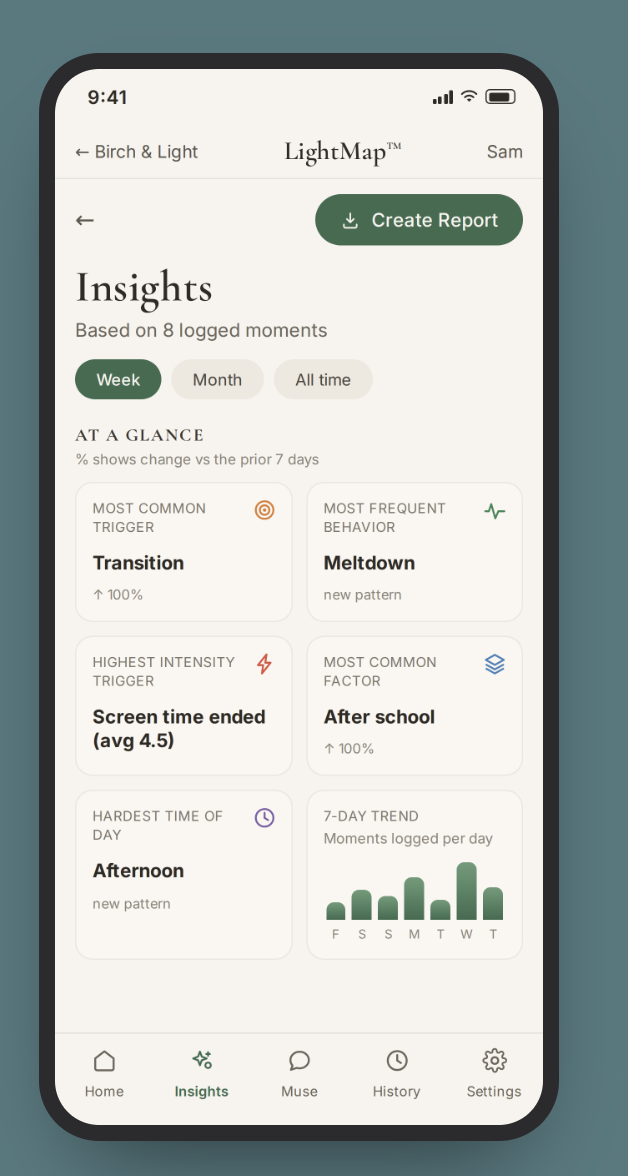

Part of the award-winning Birch & Light Method, honored with the Mom's Choice Gold Award for excellence in family resources.
A story to read together
Sometimes the easiest way in is a story you read side by side.
 Magnolia, Willow, and Pine
When the wind shifts in the clearing and Willow drifts toward Pine, Magnolia learns hurt feelings don’t have to mean closing forever.
Read the story Lyra and the Constellation That Changed
A small star watches her closest friend slowly drift away — and learns that her light was never measured by who stayed beside her.
Read the story
If today was one of those days
A few more from the library, free to read.
Researched and drafted with AI assistance, reviewed before publication. Editorial standards