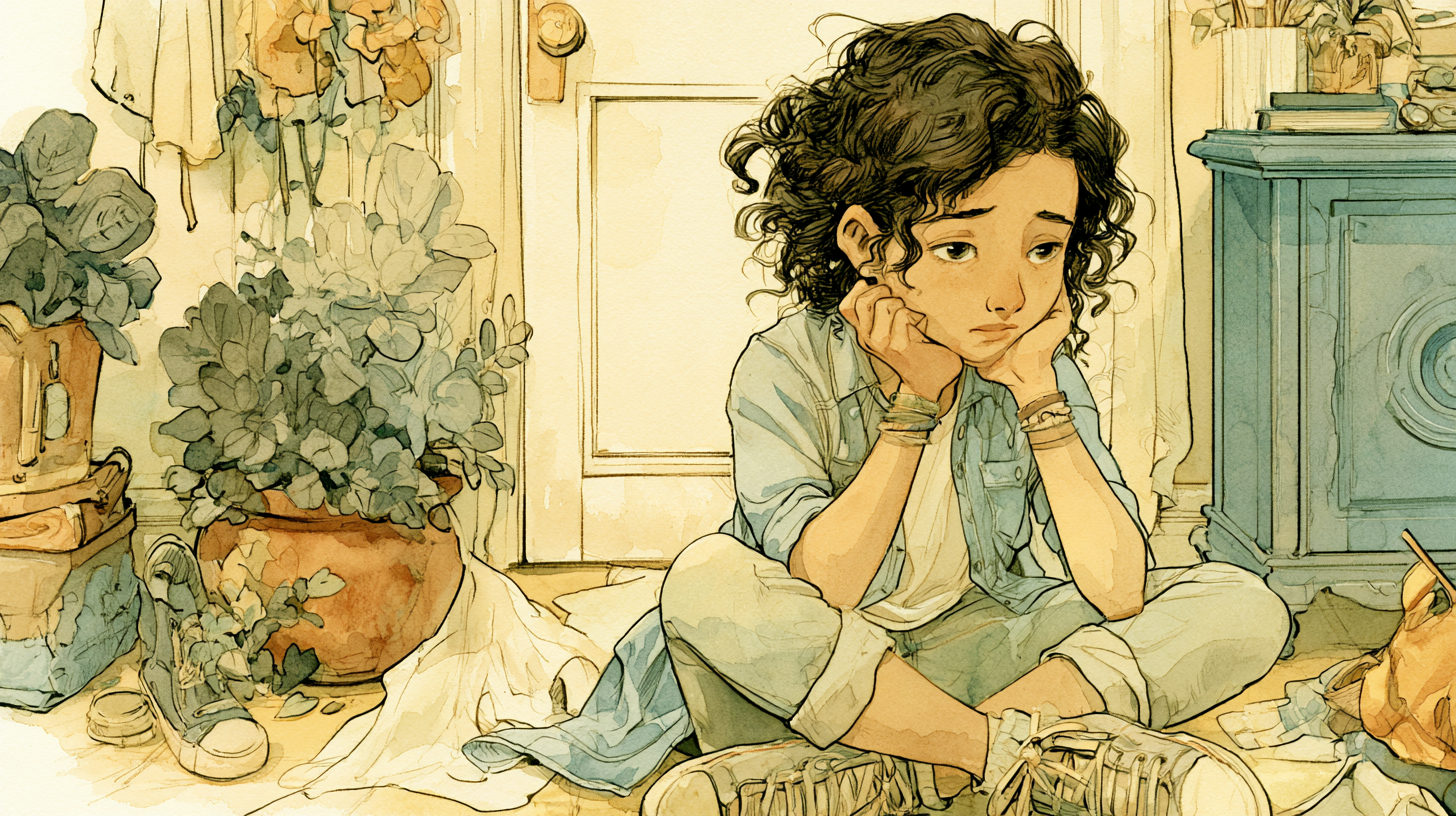
Other parents tell you how polite your child is. How helpful, how easygoing, how lovely to have around. And you nod, because you're glad — and also because the child they're describing is not always the one who lives in your house. At home, the same child can be demanding, explosive, rigid, and quick to fall apart. The gap between the two versions can be wide enough to leave you wondering which one is real.
They both are. And the difference between them isn't a sign that your child is two-faced, manipulative, or worse-behaved for you on purpose. It's a sign of something most parents would be relieved to understand: your child saves their hardest moments for the place and the people that feel safest. That place is home. Those people are you.
The Effort of Being 'Good' Elsewhere
When your child is at a friend's house, at school, or out in the world, they are doing constant, low-level work to hold themselves together. Reading the social environment, managing their impulses, suppressing big feelings, performing the regulated and agreeable version of themselves. For many children — especially sensitive or neurodivergent ones — this isn't effortless. It's a sustained act of self-management that draws down a real and limited reserve.
They do it because, on some level, the stakes feel high. Out there, falling apart has costs — social costs, the risk of judgment, the uncertainty of how others will respond. So they hold it together. And holding it together works. It's exactly why other parents see the easy, polite child.
But it isn't free. By the time they come home, the reserve that powered all that holding-together is running low.
Why Home Gets the Hard Version
Home is where the effort can finally stop. And it stops there for the best possible reason: home is safe.
Your child has spent their day or their visit holding it together in places where falling apart felt risky. At home, with you, the calculation is different. Here, falling apart is survivable. Here, love doesn't depend on composure. Here, someone will still be there on the other side of the meltdown. So the held-together version, no longer needed, dissolves — and everything that was being suppressed comes out, often over something small, often aimed at the people who feel safest.
The hard version isn't the real child and the polite version a performance. They're the same child — one holding it together, one finally able to stop.
Why This Is Actually Good News
It rarely feels like good news at 5pm on a hard day. But the pattern is, genuinely, a sign of something healthy. A child who unloads their hardest feelings at home is a child who has a safe place to unload them. They've correctly identified you as the person they can fall apart with — and that trust is something many people spend their whole lives looking for.
If your child held it together everywhere, including with you, that would be the more concerning picture: a child who never feels safe enough to stop performing. The fact that you get the unguarded version means you've given them somewhere their real, unmanaged self is welcome. That's not a parenting failure. It's a parenting achievement that happens to be exhausting.
While you're here, take the guide
What's Underneath is free: the three body-state triggers under most meltdowns, what to say in the minute before it tips over, and how to reset afterward.

You'll get the guide instantly, plus five free articles in your inbox every week. Real challenges (meltdowns, school mornings, picky eating, big feelings) and how to actually handle them. Unsubscribe anytime.
What This Doesn't Mean
It doesn't mean anything goes at home, or that the hard behavior shouldn't be addressed. Children still need limits, still need to learn, still need help building the capacity to manage their feelings. Understanding why the hard version shows up at home doesn't mean accepting everything it brings.
What it changes is the interpretation — and therefore the response. You're not dealing with a manipulative child who is 'fine when they want to be.' You're dealing with a depleted child who is finally safe enough to show you how hard their day actually was. That reframe shifts you from correction-first to connection-first, which is what actually helps.
What Tends to Help
Lower the demands at re-entry. The transition home — from school, from a friend's — is when the collapse tends to hit. Building in a low-demand decompression window, rather than stacking the after-school hours with requirements, gives the depleted reserve a chance to refill before anything else is asked.
Don't take the meltdown personally. When the hard behavior lands on you, it's tempting to feel singled out or to read it as disrespect. It's closer to the opposite — it lands on you because you're safe. Holding that in mind makes it easier to stay steady.
Offer connection before correction — the ordering Positive Discipline made famous. A child unloading a depleted, dysregulated reserve needs co-regulation first — calm presence, not a lecture. The teaching can come later, once they're back inside their window. In the moment, being a steady presence is the intervention.
Hold limits with warmth. Safe to fall apart doesn't mean free of boundaries. You can hold the limit — 'I won't let you hit' — while still understanding the overwhelm underneath it. Both at once: the boundary and the compassion.
Take the outside reports as reassurance. When others tell you how lovely your child is, let it land as genuinely good news rather than a confusing contradiction. It means the skills are there. The home meltdowns mean the safety is there too. You want both.
The Shift Worth Making
The child who is polite for the world and impossible for you isn't showing you their worst self while saving their best for others. They're showing you their most honest self — the one they only dare to show where it's safe. The polite version is real, and so is the hard one; the difference is simply who they feel safe enough to stop performing for.
That's you. And while it's tiring to be the place where the day finally lands, it's also a quiet sign that you've built exactly the kind of safety a child needs.
Every behavior is a clue.
If your child is one person out in the world and another at home, LightMap can help you track what the day cost and what helps the re-entry — so the pattern beneath it becomes easier to see. Explore LightMap at birchandlight.com/lightmap.
For your child: Until I Don't is about a girl who shines at school, at dance, and with the neighbors, and comes apart over small things at her own kitchen table.
Sources: Hull and Lai on camouflaging and masking in autistic people (Autism; PMC); research on after-school restraint collapse and regulation depletion (PMC); attachment research on the safe base and the expression of distress (PMC).
For education and reflection, not medical advice. Our terms
See what's underneath
See which situations cost the most
LightMap reads your hard days together and gives you answers. Start with one moment today.
Start with 3 moments Not sure where to start? Ask me.Message Tara on WhatsApp. It really is me, I read everything and will personally respond.Click here to message Tara →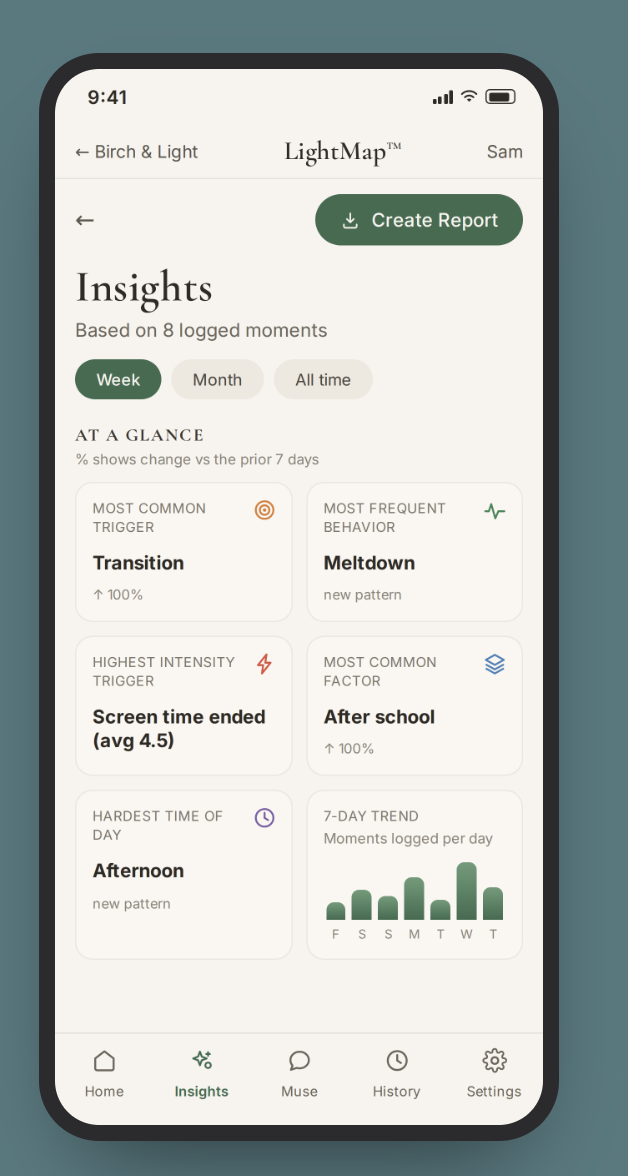

Part of the award-winning Birch & Light Method, honored with the Mom's Choice Gold Award for excellence in family resources.
A story to read together
Sometimes the easiest way in is a story you read side by side.
 Magnolia, Willow, and Pine
When the wind shifts in the clearing and Willow drifts toward Pine, Magnolia learns hurt feelings don’t have to mean closing forever.
Read the story Lyra and the Constellation That Changed
A small star watches her closest friend slowly drift away — and learns that her light was never measured by who stayed beside her.
Read the story
If today was one of those days
A few more from the library, free to read.
Researched and drafted with AI assistance, reviewed before publication. Editorial standards