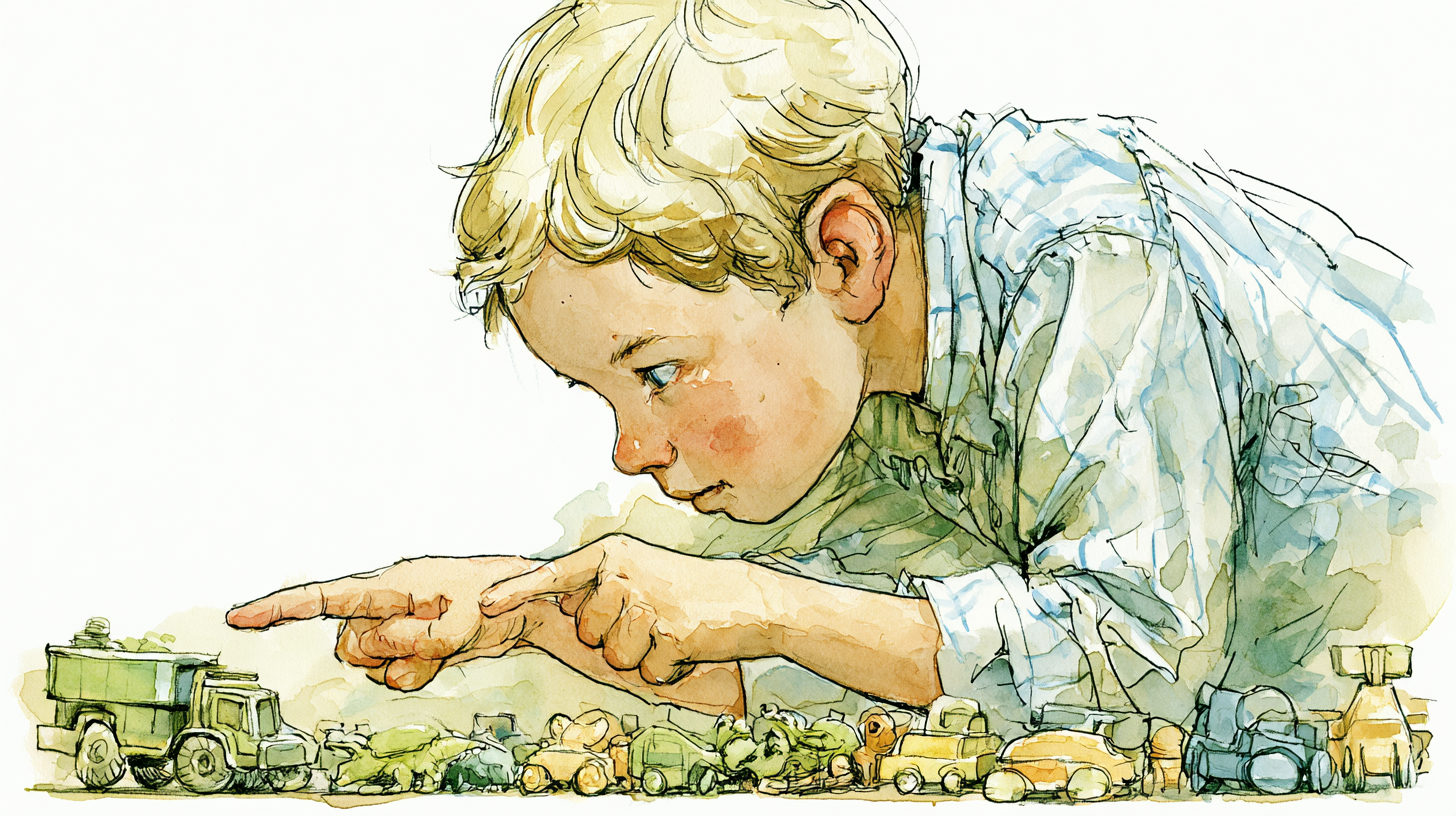
Every game has to be their game. Every rule, their rule. They tell the other kids what to do, how to do it, who plays which part — and when another child pushes back or wants to change the plan, it falls apart. You watch it happen at playdates and birthday parties, and you cringe a little, worried your child is the bossy one, the one other kids will stop wanting to play with.
The instinct is to correct it — to tell them to share control, let others lead, stop being so domineering. And while the goal is right, the framing usually misses what's actually driving the behavior. Because a child who has to control the play is, most of the time, not power-hungry. They're anxious.
What Controlling Play Is Usually About
Directing every detail of a game looks like confidence — like a child who thinks they're in charge. But underneath, it's very often the opposite: a child trying to manage a situation that feels unpredictable and therefore unsafe.
Open-ended social play is genuinely uncertain. You don't know what the other child will do, where the game will go, whether something will happen that you can't handle. For a child who finds uncertainty threatening, that openness isn't fun — it's a low-grade alarm. And controlling the play is how they try to shut the alarm off. If they decide everything, then nothing can surprise them. If they hold all the rules, the game can't go somewhere they can't manage.
The bossiness, in other words, is a strategy for safety. It's a child imposing predictability on a situation that feels dangerously unpredictable, because predictability is what their nervous system needs in order to cope.
A child who controls every game usually isn't trying to dominate. They're trying to feel safe in a situation that otherwise feels unpredictable.
The Other Things That Can Drive It
Anxiety about uncertainty is the most common driver, but it's worth naming a few others, because each points toward a slightly different kind of support.
Fear of failure. If a child controls the game, they can't lose, can't be wrong, can't be shown up. For a child sensitive to failure, directing the play removes the risk of falling short in front of others.
Rigidity and a need for things 'right.' Some children have a strong internal picture of how things should go, and deviation feels genuinely distressing — not a preference but a kind of wrongness they can't tolerate. Controlling the play keeps reality matching the picture in their head.
Social uncertainty. A child who isn't sure how to navigate the give-and-take of play may default to controlling it because directing feels more manageable than the harder skill of collaborating. It's the social move they actually know how to make.
Difficulty with perspective-taking in the moment. When a child is focused on their own vision of the game, holding another child's wants in mind at the same time is a real cognitive demand. Under stress, that capacity can drop, and the play narrows to their agenda alone.
While you're here, take the guide
What's Underneath is free: the three body-state triggers under most meltdowns, what to say in the minute before it tips over, and how to reset afterward.

You'll get the guide instantly, plus five free articles in your inbox every week. Real challenges (meltdowns, school mornings, picky eating, big feelings) and how to actually handle them. Unsubscribe anytime.
Why Correction Alone Doesn't Work
Telling a controlling child to 'let others have a turn deciding' addresses the behavior but not the engine underneath it. If the controlling is driven by anxiety, then asking them to give up control is asking them to give up their coping strategy — to sit in the exact uncertainty that overwhelms them — with nothing offered in its place. Usually that produces more distress, not more flexibility.
The behavior loosens not when control is forbidden, but when the underlying situation feels safe enough that control is no longer so necessary.
What Tends to Help
Lower the uncertainty. More structured play — games with clear rules, defined activities, predictable shapes — gives an anxious child the predictability they're trying to manufacture through control. When the structure provides the safety, the child doesn't have to.
Build flexibility in low-stakes moments. Practicing small surrenders of control when the stakes are low — at home, with you, in safe play — gradually grows the capacity to tolerate not-being-in-charge. You're building the muscle in conditions where failure is survivable.
Name what you see, gently. 'It feels good to know exactly how the game will go, doesn't it?' Naming the need underneath, without shame, helps a child understand themselves and feel seen rather than corrected.
Address the anxiety, not just the bossiness. If uncertainty or fear of failure is the driver, the real work is helping your child feel safer with not-knowing and with imperfection — broader work than any single playdate, but the work that actually loosens the grip.
Coach collaboration as a skill. Some children control because they genuinely don't know how to share the lead. Explicitly teaching and practicing turn-taking in direction — 'you pick what happens next, then she picks' — gives them a concrete alternative to control.
The Shift Worth Making
The child who takes over every game is not, in most cases, a budding tyrant who needs to be taught humility. They're a child managing anxiety the only way they know how — by making the unpredictable predictable. When you can see the control as a bid for safety rather than a grab for power, your whole response changes: less correcting the bossiness, more lowering the uncertainty that makes the bossiness feel necessary.
Help them feel safe enough, and the need to control everything quietly begins to ease.
Every behavior is a clue.
If your child has to direct every game, LightMap can help you track when the controlling is strongest and what eases it — so the pattern beneath it becomes easier to see. Explore LightMap at birchandlight.com/lightmap.
Sources: Peer-reviewed research on control-seeking and the need for predictability under anxiety in children (PMC); research on cognitive flexibility and executive function in play (PMC); PDA Society (UK) on demand avoidance and autonomy; Parten's stages of social play.
For education and reflection, not medical advice. Our terms
See what's underneath
See which situations cost the most
LightMap reads your hard days together and gives you answers. Start with one moment today.
Start with 3 moments Not sure where to start? Ask me.Message Tara on WhatsApp. It really is me, I read everything and will personally respond.Click here to message Tara →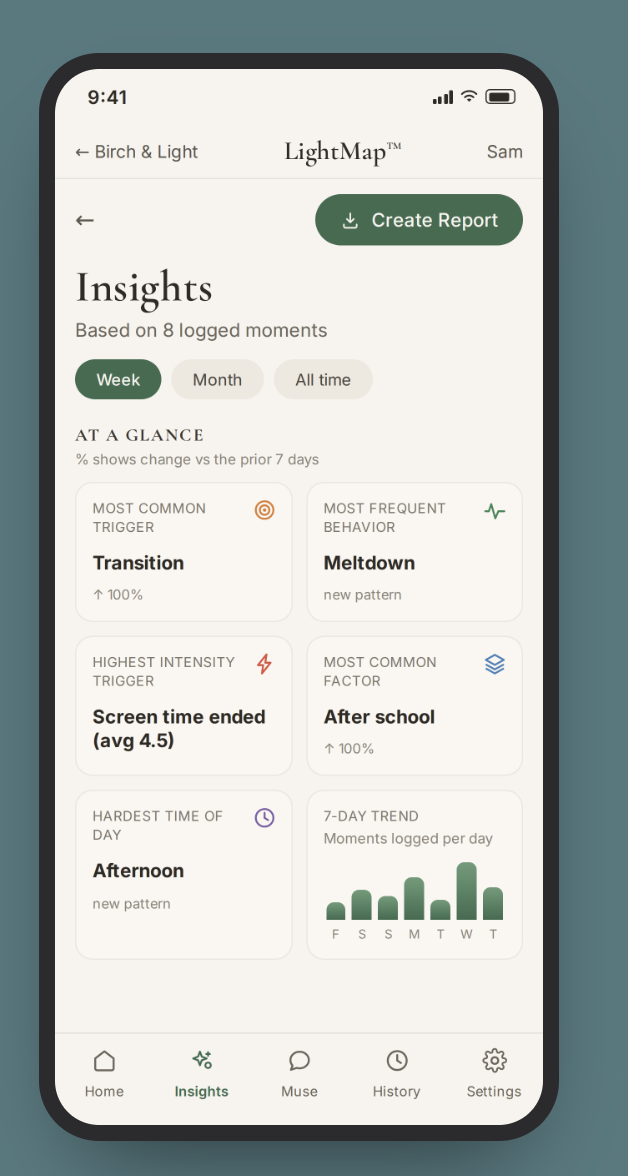

Part of the award-winning Birch & Light Method, honored with the Mom's Choice Gold Award for excellence in family resources.
A story to read together
Sometimes the easiest way in is a story you read side by side.
 Magnolia, Willow, and Pine
When the wind shifts in the clearing and Willow drifts toward Pine, Magnolia learns hurt feelings don’t have to mean closing forever.
Read the story Lyra and the Constellation That Changed
A small star watches her closest friend slowly drift away — and learns that her light was never measured by who stayed beside her.
Read the story
If today was one of those days
A few more from the library, free to read.
Researched and drafted with AI assistance, reviewed before publication. Editorial standards