
There's a particular kind of quiet that can settle over a teen — not sad exactly, not angry, just gone. They're in the room. The lights aren't fully on.
For most parents, that quiet is harder than the loud moments. It's also one of the most misread states in adolescence.
What shutdown actually is
Shutdown is what a nervous system does when activation gets too high for too long and there's nowhere safe to put it. The system steps down — heart rate drops, voice flattens, affect mutes — as a way of protecting itself.
It is, in a sense, the opposite of indifference. It's a system that has cared so hard, for so long, that it has gone offline to keep going.
What it can look like
- Flat tone, monosyllabic answers
- Long stretches behind a closed door or inside a phone
- "I don't care" energy that doesn't quite track
- A kind of distance even when physically close
- Activities that used to land flatly now
What tends to help
Almost nothing in shutdown responds to pressure. The system experiences pressure as more input, and more input is what it was already too full of. What does tend to help is lower-stakes, lower-stimulation presence:
- Be in the room without requiring conversation. Sit nearby. Read. Cook. Don't fill the silence with questions.
- Offer small, low-demand entries. A snack. A drive without anywhere to be. A show neither of you have to talk about.
- Lower the household tempo. Less scheduling. Quieter mornings. Fewer "how was your day" probes at the door.
- Name what's happening, lightly. "You seem pretty full this week. I'm here if you want company." Then drop it.
- Stay warm, not bright. Performed cheerfulness reads as more demand.
While you're here, take the guide
What's Underneath is free: the three body-state triggers under most meltdowns, what to say in the minute before it tips over, and how to reset afterward.

You'll get the guide instantly, plus five free articles in your inbox every week. Real challenges (meltdowns, school mornings, picky eating, big feelings) and how to actually handle them. Unsubscribe anytime.
What tends to make it worse
- Repeated questions about how they're really doing
- "You used to be so..." comparisons
- Punishing the disconnection
- Filling every silence
- Big planned conversations announced in advance
When to bring in support
Shutdown that lasts many days, includes changes in eating or sleeping, or carries any expression of hopelessness about the future is worth a conversation with a therapist or pediatrician. You don't need certainty to make the call. A few weeks of LightMap data — what came before, what days were hardest, how sleep tracked — gives a clinician something concrete to work from.
Related
Frequently asked questions
Is shutdown the same as not caring?
No. Shutdown is usually the opposite of not caring — it's a system that has cared so much, for so long, that it has gone quiet to protect itself. The flat affect is a symptom of overload, not absence.
Should I push my teen to talk when they go quiet like this?
Pushing tends to deepen shutdown. What more often helps is ordinary, low-pressure presence — being in the room without making the teen perform a conversation. Words can come later, sometimes much later, sideways.
When should I be more concerned?
Shutdown that lasts for many days, comes with changes in eating or sleeping, or includes any expression of hopelessness about the future is worth bringing to a therapist or pediatrician. Trust your instinct here; it's usually accurate.
How does LightMap help with this?
Logging shutdown days alongside sleep, social stress, and other variables often surfaces the cycle — what tends to come before a shutdown stretch, and what tends to soften it. That makes both response and conversation with a professional more grounded.
Sources: Peer-reviewed research on dissociation and hypoarousal in adolescents (PMC); Raymaker et al. on autistic burnout (Autism in Adulthood; PMC); Steinberg on adolescent development (PMC); Porges' polyvagal account of shutdown states, noting that it remains debated within the research literature.
For education and reflection, not medical advice. Our terms
See what's underneath
See it coming before the shutdown
LightMap reads your hard days together and gives you answers. Start with one moment today.
Start with 3 moments Not sure where to start? Ask me.Message Tara on WhatsApp. It really is me, I read everything and will personally respond.Click here to message Tara →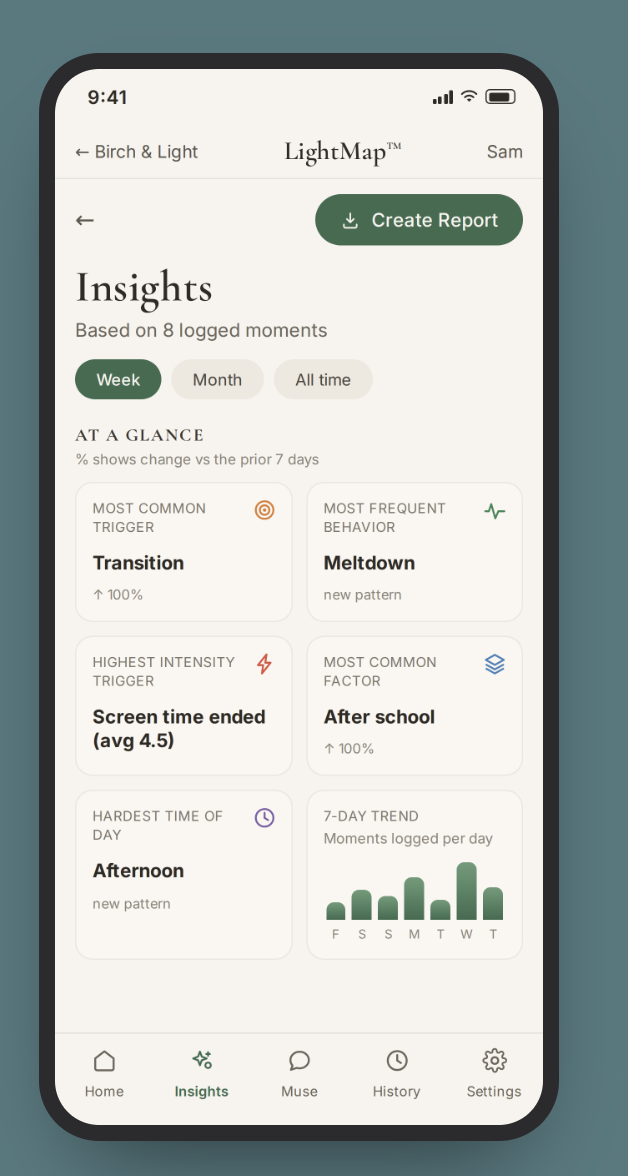

Part of the award-winning Birch & Light Method, honored with the Mom's Choice Gold Award for excellence in family resources.
A story to read together
Sometimes the easiest way in is a story you read side by side.
 Until I Don't
Rosie shines at dance, at school, with neighbors. At home, the smallest thing can tip her over. One quiet hallway moment helps her family finally find language for the part of her nobody else sees.
Read the story The Tower That Looked Fine
A tower in a quiet clearing tries to stay steady through every small thing nobody else seems to notice — until one tiny breath of wind causes her to fall, and a gentle hand begins to gather the blocks back.
Read the story
If today was one of those days
A few more from the library, free to read.
Researched and drafted with AI assistance, reviewed before publication. Editorial standards