.jpg)
Most people know what a meltdown looks like.
It's loud. It's visible. It takes up space. A child in meltdown is impossible to miss — the crying, the shouting, the physical expression of a nervous system that has completely lost its capacity to regulate.
A shutdown is the opposite of that.
A shutdown is quiet. A shutdown looks like stillness. A shutdown looks like a child who has gone somewhere else entirely — present in body, absent in every other way that matters.
And because it doesn't look like distress, it very often doesn't get recognized as distress. It gets misread as rudeness. As sulking. As a child who is giving you the silent treatment, making a point, being deliberately difficult in a quiet way.
It isn't any of those things. It is a nervous system that has hit its limit and done the only thing it had left to do: shut down.
What's Actually Happening in a Shutdown
To understand a shutdown, it helps to understand what the nervous system does when it reaches overwhelm.
Most of us are familiar with fight and flight — the activated responses to threat or overwhelm. A child in fight is loud and combative. A child in flight is running, escaping, avoiding.
But there is a third response that gets far less attention: freeze. And shutdown is freeze.
When the nervous system has exhausted its other options — when fighting hasn't worked and fleeing isn't possible — it can move into a state of profound withdrawal. Heart rate slows. The body goes still. The thinking brain becomes largely inaccessible. The child is present but not reachable.
This is not a choice. It is a physiological state. And it is every bit as real, and every bit as distressing from the inside, as a full meltdown — even though it looks like nothing from the outside.
What Shutdown Looks Like in Real Life
Because shutdown presents so differently in different children, it can be hard to recognize. Here are some of the ways it tends to appear.
The child who goes silent and still. She was present in the conversation, and then she wasn't. She's looking at you but nothing is registering. You ask a question and she doesn't respond — not rudely, not deliberately, but as if the question didn't reach her. Her face is flat. Her body is quiet. She is somewhere else.
The child who moves to a small space. Some children in shutdown seek enclosure — a corner, under a table, inside a closet, beneath a weighted blanket. This is the nervous system trying to create containment when it has lost the ability to contain itself internally.
The child who can't speak. This is one of the most frightening manifestations for parents. A child in deep shutdown may be genuinely unable to produce words. Not unwilling. Unable. The language centers of the brain become less accessible in a freeze state, and for some children this means that speech simply isn't available.
The child who seems fine but isn't. Some children's shutdowns are less obvious — a kind of flatness, a going-through-the-motions quality, a child who is complying with everything asked of them but who is clearly not present. These shutdowns are the easiest to miss and the most important to catch, because a child who is regularly shutting down without anyone noticing is a child who is regularly experiencing overwhelm without any support.
The child who needs hours to come back. Recovery from a shutdown is not quick. The nervous system needs time to move out of freeze and back into a state where connection and engagement are possible. Trying to reach a child who is in the middle of a shutdown — demanding answers, requiring interaction, insisting on eye contact — tends to extend the shutdown rather than end it.
While you're here, take the guide
What's Underneath is free: the three body-state triggers under most meltdowns, what to say in the minute before it tips over, and how to reset afterward.

You'll get the guide instantly, plus five free articles in your inbox every week. Real challenges (meltdowns, school mornings, picky eating, big feelings) and how to actually handle them. Unsubscribe anytime.
What Tends to Precede a Shutdown
Shutdowns rarely come from nowhere. There is almost always a buildup — a period of accumulating demand, sensory input, social pressure, or emotional weight that the nervous system has been managing until it couldn't manage anymore.
This is part of what makes shutdowns so disorienting for parents. The thing that finally tipped the child into shutdown is often something small — a request, a transition, a slightly too-loud sound. And because that small thing doesn't seem like enough to produce this response, parents are left confused about what happened.
The small thing wasn't what happened. It was the last thing. Everything that came before it is the story.
Common contributors to shutdown include long days in demanding environments, extended social interaction for children who find social interaction costly, sensory accumulation over hours or a full day, situations where the child felt unable to communicate distress or ask for help, and environments where masking — performing okayness when not okay — has been required for a sustained period.
What Helps During a Shutdown
The most important thing to know about a child in shutdown is that they cannot be talked out of it.
Logic doesn't reach a frozen nervous system. Explanations don't help. Questions don't help. Consequences absolutely don't help. What the nervous system needs in a shutdown state is safety, stillness, and time.
Staying nearby without making demands is often the most powerful thing a parent can do. Not hovering, not speaking, not requiring anything — just being a calm presence in the vicinity.
Reducing sensory input helps. Dimmer light, quieter sounds, less physical proximity if touch feels overwhelming, more physical proximity if it feels regulating — it depends on the child, and you will learn over time which way your child goes.
Offering something small and concrete — a glass of water, a blanket, a familiar object — can provide a gentle re-entry point without requiring the child to engage socially or verbally.
Waiting. This is the hardest one for parents who want to fix it. But the nervous system moves through shutdown on its own timeline, and the attempts to speed that process up tend to extend it.
The conversation about what happened — if one is needed at all — belongs to later. Much later. When the child is fully back and the nervous system has settled.
The Bigger Picture
A child who shuts down regularly is telling you something important about the gap between what their nervous system can handle and what is being asked of it.
That gap is worth understanding. Not labeling, not pathologizing — understanding. Because when you understand where the gap is, you can begin to look at what might close it. What modifications to the environment might help. What the child needs more of, or less of, in order to get through their day without reaching that limit.
The shutdown is not the problem. The shutdown is the signal.
Every behavior is a clue.
If your child shuts down and you're never quite sure what led there, LightMap can help you start tracking the patterns — what tends to precede the shutdown, how long recovery takes, and what seems to help. Explore LightMap at birchandlight.com/lightmap.
Sources: Peer-reviewed research on dissociative and hypoaroused stress responses in children (PMC); research on internalizing presentations being underrecognized relative to externalizing behavior (PMC); Raymaker et al. on autistic burnout (Autism in Adulthood; PMC); STAR Institute for Sensory Processing.
For education and reflection, not medical advice. Our terms
See what's underneath
See it coming before the shutdown
LightMap reads your hard days together and gives you answers. Start with one moment today.
Start with 3 moments Not sure where to start? Ask me.Message Tara on WhatsApp. It really is me, I read everything and will personally respond.Click here to message Tara →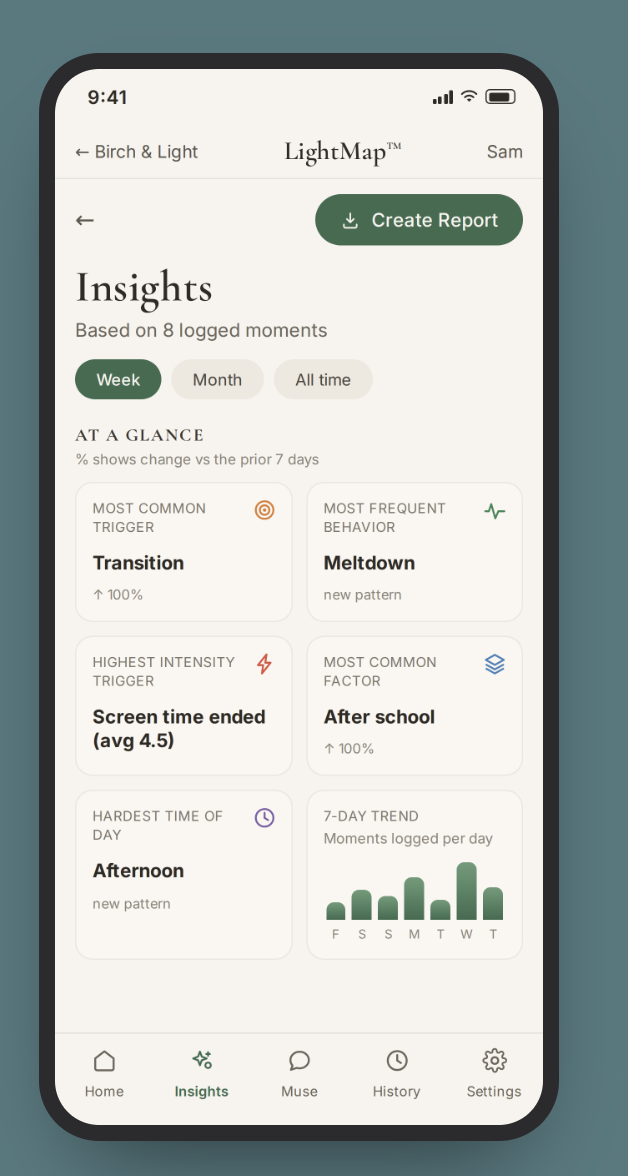

Part of the award-winning Birch & Light Method, honored with the Mom's Choice Gold Award for excellence in family resources.
A story to read together
Sometimes the easiest way in is a story you read side by side.
 Until I Don't
Rosie shines at dance, at school, with neighbors. At home, the smallest thing can tip her over. One quiet hallway moment helps her family finally find language for the part of her nobody else sees.
Read the story The Tower That Looked Fine
A tower in a quiet clearing tries to stay steady through every small thing nobody else seems to notice — until one tiny breath of wind causes her to fall, and a gentle hand begins to gather the blocks back.
Read the story
If today was one of those days
A few more from the library, free to read.
Researched and drafted with AI assistance, reviewed before publication. Editorial standards