
Some children, when they're overwhelmed, erupt — they scream, cry, rage, fall apart loudly and visibly. Others do the opposite. They go quiet. They withdraw, shut down, disappear into themselves. If you have one of each, the contrast can be striking. And if you have a child who goes quiet, you may have spent years not realizing they were overwhelmed at all, because their distress looks so different from the textbook picture of a child in crisis.
Both responses come from the same place — a nervous system pushed past what it can handle. But they travel in opposite directions: one outward into a meltdown, one inward into a shutdown. Understanding why your particular child tends toward quiet, and what that means, helps you see and support a kind of overwhelm that's easy to miss.
Two Directions, One Cause
When a nervous system becomes overwhelmed, it shifts into a survival state — and that state can take more than one form. A meltdown is the system in a fight-or-flight surge: outward, loud, escalating. A shutdown is the system dropping into a freeze or collapse: inward, quiet, withdrawn. Same overload, same root cause, opposite expression.
So a child who goes quiet under stress isn't experiencing less overwhelm than the child who explodes. They're experiencing the same overwhelm, but their nervous system's default response is to power down rather than ramp up. The quiet isn't the absence of distress. It's distress wearing a different face.
The child who goes quiet isn't less overwhelmed than the one who explodes. Their nervous system just defaults to powering down instead of ramping up.
Why Some Children Default to Quiet
Why does one child melt down and another shut down? There's no single answer, but several factors shape which direction a child tends toward.
Some of it is simply how a given nervous system is wired — individual differences in how the body's stress response defaults. Some of it is temperament. And some of it is learned: a child who has found, over time, that going quiet is safer or draws less negative attention than exploding may lean increasingly toward shutdown. For some children, withdrawing inward is the response that has felt least dangerous, and so it becomes the default.
It's also worth knowing that the same child can do both — meltdown in some situations, shutdown in others, sometimes shutdown after a meltdown when the system is utterly spent. The two aren't fixed types so much as two available directions, and a child may travel one or the other depending on the situation and how depleted they are.
Why the Quiet Response Is Easy to Miss — and Risky
The central challenge with a child who shuts down is that their overwhelm is so easy to overlook. A meltdown demands a response; a shutdown can pass unnoticed, or be misread as calm, sulking, compliance, or defiance. A child who goes quiet may get none of the concern or support a child who explodes would automatically receive.
This carries real risks. A child whose distress is consistently missed because it's quiet may learn that their overwhelm doesn't register, that they have to handle it alone. Their needs go unmet not because anyone is unwilling, but because no one realized there was a need. And because shutdowns are internal, a quietly overwhelmed child can be struggling profoundly while looking, to everyone around them, like they're doing fine. The very invisibility of the response is what makes it dangerous to overlook.
While you're here, take the guide
What's Underneath is free: the three body-state triggers under most meltdowns, what to say in the minute before it tips over, and how to reset afterward.

You'll get the guide instantly, plus five free articles in your inbox every week. Real challenges (meltdowns, school mornings, picky eating, big feelings) and how to actually handle them. Unsubscribe anytime.
What Tends to Help
Learn your child's quiet signs. Because a shutdown doesn't announce itself, it helps to know what overwhelm looks like in your specific child — the particular signs of withdrawal, going silent, stillness, or zoning out that signal they've hit their limit. Recognizing the early signs lets you respond before the shutdown deepens.
Take the quiet seriously. Treat your child's withdrawal as the distress signal it is, not as calm or cooperation. A child who goes quiet under stress deserves the same concern and support as one who falls apart loudly.
Respond with less, not more. A shutting-down child needs reduced demands, reduced input, and space — not pressure to engage or 'snap out of it.' Lower the load and let the system recover.
Offer quiet presence. Co-regulation for a shutdown is calm and low-key: being nearby, steady and undemanding, giving the child something safe to return toward without forcing interaction.
Don't mistake re-emergence for 'it was nothing.' When a child comes back from a shutdown, it's easy to assume nothing much happened because it was quiet. But they've just moved through real overwhelm. Acknowledging it, gently, helps them feel seen rather than invisible.
Make sure the quiet child gets their share. In a busy family, the loud distress naturally draws the attention. It takes intention to ensure the child who shuts down quietly gets noticed and supported as much as the one who melts down loudly.
The Shift Worth Making
A child who goes quiet instead of exploding isn't handling things better, being calmer, or being difficult. They're overwhelmed in exactly the way a melting-down child is — the same nervous system at its limit, simply traveling inward instead of outward. The quiet is the distress, not its absence.
When you can recognize the shutdown as overwhelm, you stop overlooking your quiet child's hardest moments and start meeting them — learning their signs, taking the withdrawal seriously, and offering the reduced demands and steady presence that a quietly overwhelmed child needs just as much as a loud one.
Every behavior is a clue.
If your child withdraws and goes quiet under stress, LightMap can help you learn their particular signs and what helps them recover — so the pattern beneath it becomes easier to see. Explore LightMap at birchandlight.com/lightmap.
For your child: The Boy at the Edge is about a quiet boy who keeps drifting to a window because watching settles his body, and the father who treats the drifting as defiance.
Sources: Peer-reviewed research on dissociative and hypoaroused stress responses in children (PMC); research on internalizing presentations being underrecognized relative to externalizing behavior (PMC); Raymaker et al. on autistic burnout (Autism in Adulthood; PMC); STAR Institute for Sensory Processing.
For education and reflection, not medical advice. Our terms
See what's underneath
See it coming before the shutdown
LightMap reads your hard days together and gives you answers. Start with one moment today.
Start with 3 moments Not sure where to start? Ask me.Message Tara on WhatsApp. It really is me, I read everything and will personally respond.Click here to message Tara →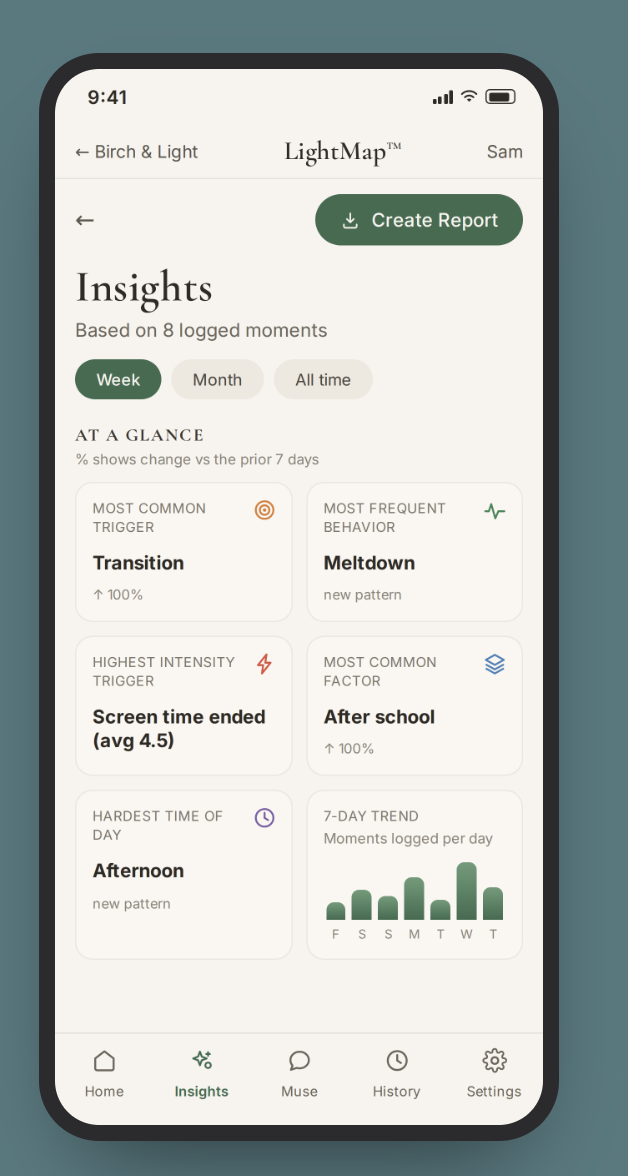

Part of the award-winning Birch & Light Method, honored with the Mom's Choice Gold Award for excellence in family resources.
A story to read together
Sometimes the easiest way in is a story you read side by side.
 Until I Don't
Rosie shines at dance, at school, with neighbors. At home, the smallest thing can tip her over. One quiet hallway moment helps her family finally find language for the part of her nobody else sees.
Read the story The Tower That Looked Fine
A tower in a quiet clearing tries to stay steady through every small thing nobody else seems to notice — until one tiny breath of wind causes her to fall, and a gentle hand begins to gather the blocks back.
Read the story
If today was one of those days
A few more from the library, free to read.
Researched and drafted with AI assistance, reviewed before publication. Editorial standards