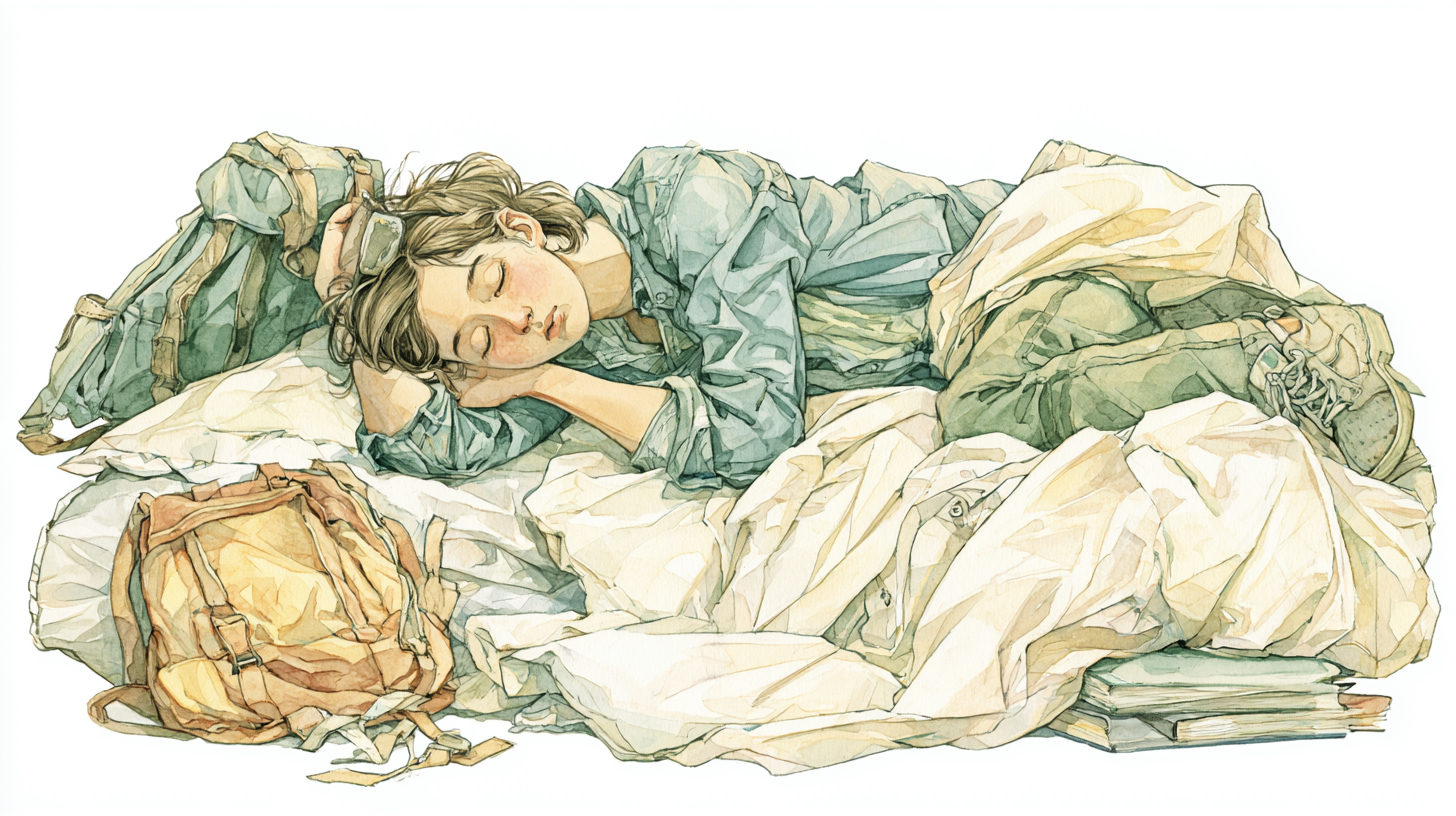
Teenage burnout is a nervous system that has run on high for too long and powered down: exhaustion sleep does not fix, flat mood, lost interest, and a short fuse. It is not laziness. What helps is cutting the load first, protecting sleep, and lowering performance pressure for a while.
The kid who used to bound out of bed is now under the covers at noon. Homework they used to finish doesn't get started. Friends they used to text don't get a reply.
Adults around them call it lazy. Teachers call it disengaged. The honest word is usually a different one: burnt out.
Is it burnout, or is my teen being lazy?
Burnout is what happens when a nervous system has been running on high for so long that it starts to power down to survive. It's not a mood. It's not a choice. It also is not a medical diagnosis: the term comes from research on adults under sustained demand at work, and it describes a pattern rather than a condition a doctor can test for. What it names is real — and adolescence is uniquely set up to produce it.
A teen body is doing more development per day than at almost any other point in life. Stack on academic pressure, social pressure, constant phone input, chronic sleep debt, and the low-grade vigilance of being a teen online, and the system eventually reaches its ceiling. Then it drops.
What teenage burnout can look like
- Exhaustion that sleep doesn't fix
- Flat affect — not sad exactly, just empty
- Loss of interest in things that used to light them up
- Procrastination that looks like defiance
- Irritability or shorter fuses than normal
- Physical complaints — headaches, stomachaches, body aches
- Withdrawing from friends, especially the ones they used to lean on
- "I don't care" as a default response
What's usually driving it
- Chronic sleep debt (teens need 8 to 10 hours a night, and roughly seven in ten US high schoolers get less than eight on school nights)
- Schedules that don't include real, unstructured downtime
- Phones — the input never stops, even at 1am
- Academic pressure, especially when it's stacked with sport or activity pressure
- Friend or social media stress they haven't named out loud
- Identity-level questions running in the background (Who am I? Am I enough?)
What helps a teen who is running on empty?
- Reduce the load before you add anything. The instinct is to add structure, supplements, motivation talks. The thing that works is subtracting. One less activity. One earlier bedtime. One quiet weekend.
- Protect sleep ruthlessly. If only one thing changes, this is the one. Phones out of the bedroom. Lights down earlier than feels reasonable.
- Lower performance demands temporarily. Burnout doesn't recover under pressure. A B in Spanish is not the problem. The burnout is.
- Restore unstructured time. The kind of time where nothing has to happen. The brain restores in boredom, not in scheduled rest.
- Stay close without demanding closeness. Be in the room. Don't require the conversation.
- Name it, lightly. "I think you might be running on empty. We can slow things down for a bit." Letting them hear that you see it is often the first real exhale.
While you're here, take the guide
What's Underneath is free: the three body-state triggers under most meltdowns, what to say in the minute before it tips over, and how to reset afterward.

You'll get the guide instantly, plus five free articles in your inbox every week. Real challenges (meltdowns, school mornings, picky eating, big feelings) and how to actually handle them. Unsubscribe anytime.
How do I know if it is more than burnout?
Burnout usually lifts when the load lifts. If the flatness lasts weeks even after you've reduced demands, comes with hopelessness about the future, big changes in eating or sleeping, or self-harm, it's worth a conversation with a therapist or pediatrician.
A few weeks of LightMap data — what days were hardest, what was on the calendar, how sleep tracked — gives a clinician something concrete to start from instead of vague description.
The reframe most parents need to hear
A burnt-out teen isn't a lazy teen. They're a young person whose system has been carrying too much for too long. The recovery is real, but it starts with permission to do less, not pressure to do more.
Related reading
Frequently asked questions
What is teenage burnout?
Teenage burnout is what happens when a young person's nervous system has been running on high for so long that it starts to power down. It often looks like exhaustion, emotional flatness, dropping motivation, and a sudden inability to do things that used to feel easy.
How is teen burnout different from laziness or depression?
Laziness is a label adults use; burnout describes a system that has been carrying too much for too long. Depression is a clinical condition with overlapping symptoms but a different course. Burnout typically lifts when the load lifts; if it doesn't, it's worth talking to a clinician.
What causes teenage burnout?
Chronic sleep debt, packed schedules, social media saturation, academic pressure, friendship stress, and the constant low-grade vigilance of being a teen online all stack up. Burnout is rarely one cause — it's the accumulation.
Can LightMap help me see if my teen is burning out?
Yes. Logging energy, mood, sleep, and social load for a few weeks often makes the burnout cycle visible — what's draining, what's restoring, and where the floor is starting to drop.
Sources. The recommendation of 8 to 10 hours of sleep for teenagers aged 13 to 18: Paruthi S, Brooks LJ, D'Ambrosio C, et al. Consensus statement of the American Academy of Sleep Medicine on the recommended amount of sleep for healthy children: methodology and discussion. J Clin Sleep Med. 2016;12(11):1549-1561. The share of US high school students sleeping less than eight hours on school nights: Wheaton AG, Jones SE, Cooper AC, Croft JB. Short sleep duration among middle school and high school students, United States, 2015. MMWR Morb Mortal Wkly Rep. 2018;67(3). Delayed circadian timing in adolescence, and why later sleep onset is biological rather than chosen: Carskadon MA. Sleep in adolescents: the perfect storm. Pediatr Clin North Am. 2011;58(3):637-647. Burnout as exhaustion under sustained demand, a construct developed in adults at work rather than in adolescents: Maslach C, Schaufeli WB, Leiter MP. Job burnout. Annu Rev Psychol. 2001;52:397-422. Irritability and withdrawal as recognized presentations of depression in children and adolescents: American Psychiatric Association. Diagnostic and Statistical Manual of Mental Disorders, fifth edition, text revision. 2022.
For education and reflection, not medical advice. Our terms
See what's underneath
See it coming before the shutdown
LightMap reads your hard days together and gives you answers. Start with one moment today.
Start with 3 moments Not sure where to start? Ask me.Message Tara on WhatsApp. It really is me, I read everything and will personally respond.Click here to message Tara →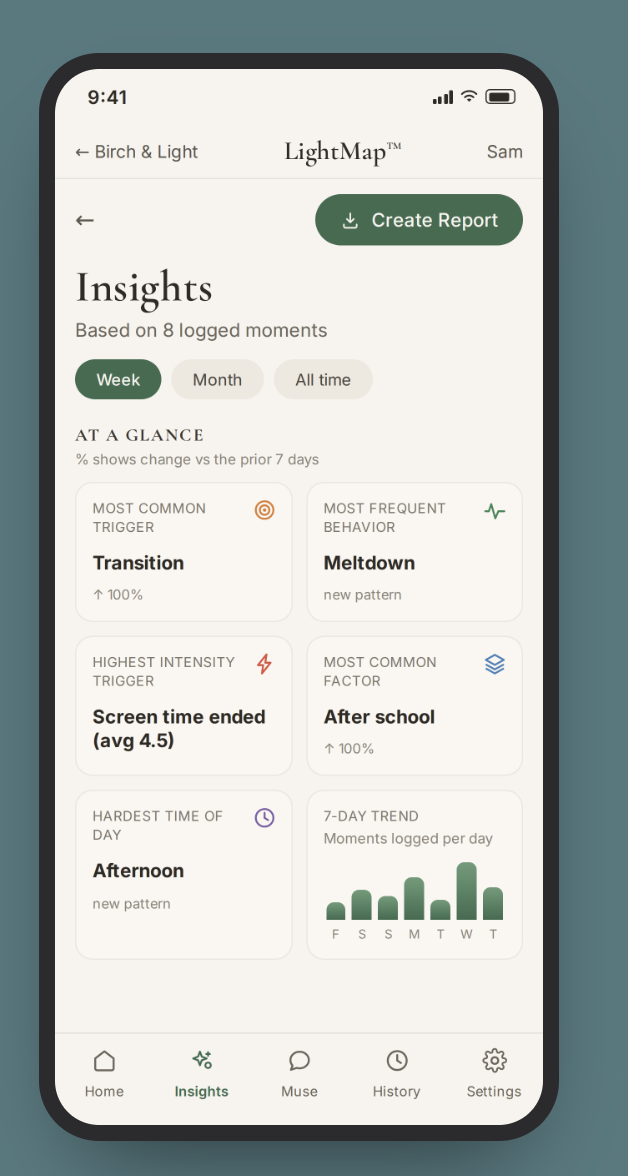

Part of the award-winning Birch & Light Method, honored with the Mom's Choice Gold Award for excellence in family resources.
A story to read together
Sometimes the easiest way in is a story you read side by side.
 Until I Don't
Rosie shines at dance, at school, with neighbors. At home, the smallest thing can tip her over. One quiet hallway moment helps her family finally find language for the part of her nobody else sees.
Read the story The Tower That Looked Fine
A tower in a quiet clearing tries to stay steady through every small thing nobody else seems to notice — until one tiny breath of wind causes her to fall, and a gentle hand begins to gather the blocks back.
Read the story
If today was one of those days
A few more from the library, free to read.
Researched and drafted with AI assistance, reviewed before publication. Editorial standards