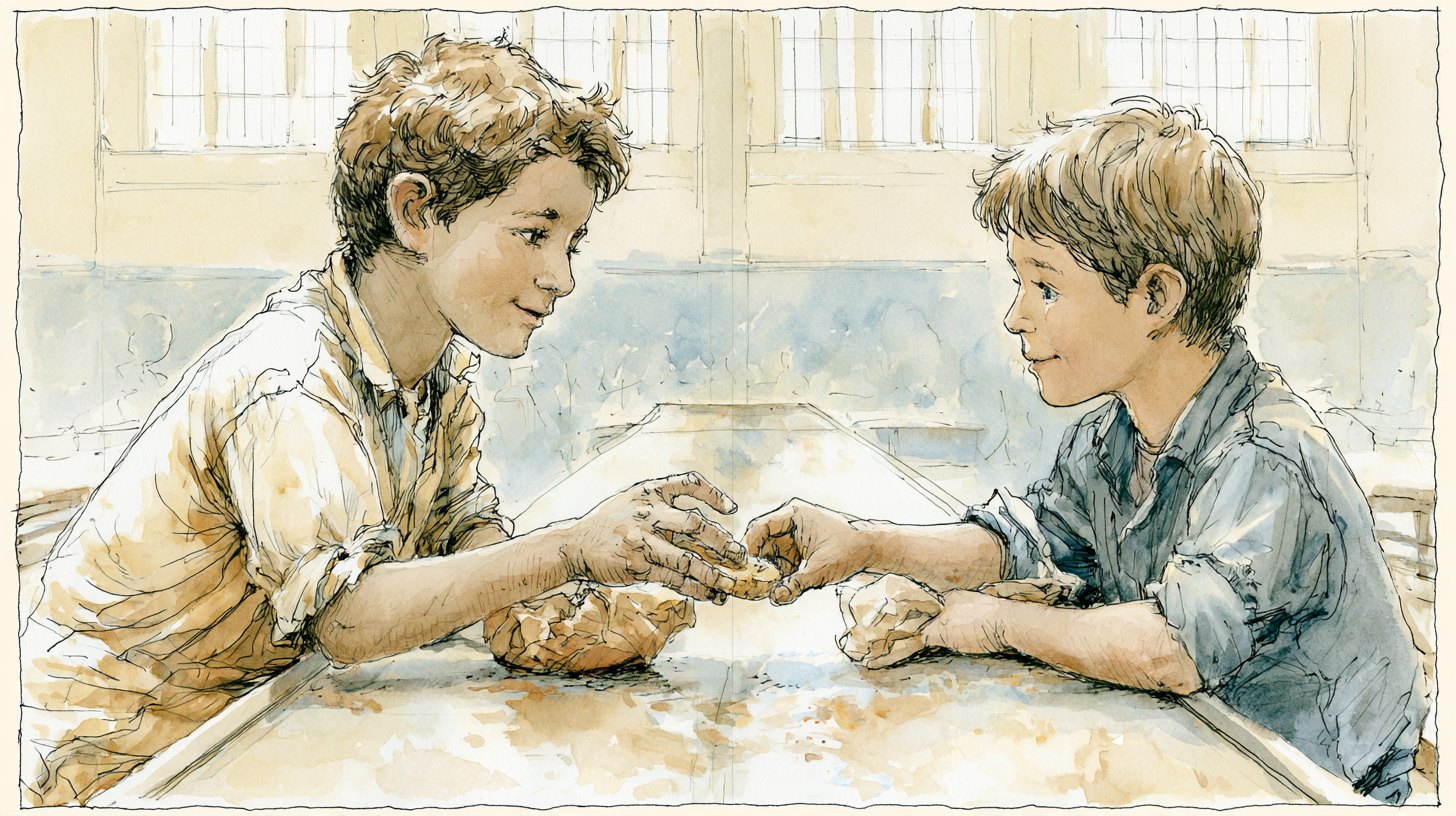
The question comes out sideways. Your child mentions, without much weight on it, that he gave away his snack again. Or that he was the one who got caught. Or that the boy who never talks to him at recess wanted to sit together at lunch, and it turned out there was something he needed.
And you feel the thing you cannot say out loud, which is that you are not sure this is a friend.
Parents ask about bullying because bullying has a name and a script and a form to fill out at the office. This other thing has no name. Nobody is hitting your child. Nobody is calling him anything. He comes home reporting a good day. And you are watching him hand pieces of himself to somebody who would not notice if he stopped showing up.
Why this lands harder on our kids
A child who has struggled to make friends is running a different calculation than a child who has plenty. When friendship is scarce, the cost of losing one feels enormous, and almost any price is payable to keep it. That is not a character flaw. It is arithmetic, and any of us would do the same math.
Add the pieces that often travel with ADHD and autism. Social information arrives late and gets processed after the moment has passed. Tone and intent are read literally, so "you would do it if you were really my friend" registers as information rather than as pressure. Impulsivity means the yes is out of the mouth before the evaluation starts. And a child who has been corrected all day at school has usually learned that other people are right about social things and he is wrong, which is precisely the belief that makes a manipulative kid easy to follow.
None of that means your child is gullible. It means the specific skill of noticing pressure in real time has not been taught, and almost nobody teaches it.
The trap in the obvious approach
The instinct is to warn. That boy is not a good friend. Be careful with him. Do not let people use you.
Three problems with it. First, your child hears it as a criticism of his judgment, and he already suspects his judgment is bad. Second, it names one child, and next month there will be a different one. Third, and this is the one that does real damage, a child who is taught to be suspicious of friendship gets more isolated, not safer. He withdraws from the good ones too, because he cannot tell them apart either.
What actually protects him is not suspicion. It is a small number of concrete tests he can run himself.
What to teach instead
Friendship is measured over time, not in moments. A single fun afternoon proves nothing. The question is what the last ten interactions looked like. Does this person seek him out when there is nothing to be gained? Has he ever done something for your child that cost him anything? A child who wants to know if someone is a friend can count.
Real friends do not need urgency. Pressure lives in the timeline. Right now, quick, before anyone sees, do not tell. A friend asking for something can wait until tomorrow. Anyone who cannot wait is managing him, not asking him. This one is teachable in a sentence, and it catches most of it.
Anything that has to be a secret from you is the signal. Not because secrets are wrong, but because the request to hide it is the tell. Say this without any punishment attached, because the whole value of the rule depends on him being able to bring you the secret without losing anything.
Notice the direction things move. Snacks, money, homework, blame, trouble. If the flow only goes one way over a month, that is the answer, and it does not require him to interpret anybody's intentions. He just has to notice which way things travel.
"Let me think about it" is a complete sentence. This is the single most useful thing you can give an impulsive child. Not no, which is hard and costs him socially. Just a delay, which buys the processing time his brain needs and which almost no manipulative kid will accept quietly. The refusal to allow a delay is itself the information.
While you're here, take the guide
What's Underneath is free: the three body-state triggers under most meltdowns, what to say in the minute before it tips over, and how to reset afterward.

You'll get the guide instantly, plus five free articles in your inbox every week. Real challenges (meltdowns, school mornings, picky eating, big feelings) and how to actually handle them. Unsubscribe anytime.
How to have the conversation
Not as a warning, and not right after an incident, when he is defensive and you are upset. Use somebody else's story. A character in a show, a thing that happened to you at his age, a situation involving a cousin. Kids will analyze a fictional situation with startling clarity while defending their own to the death.
Then ask rather than tell. What do you think she should have done? How do you think he knew it was not okay? What would you have said? You are not delivering a verdict about his friend. You are building the machinery he will use on his own, at school, when you are not there, which is the only place it matters.
And when he does bring you something, respond to the reporting rather than the content. If the first thing he hears is I told you that kid was trouble, he will not bring you the next one.
When it is not this
Sometimes what looks like manipulation is two kids with poor social skills bumping into each other, and neither is running a strategy. Sometimes the child who seems used is happy and getting something real out of it that you cannot see. And sometimes it has crossed into something else. If there is a pattern of coercion, humiliation, physical intimidation, or if he is being made to do things that could get him hurt or in serious trouble, that is not a skills conversation. That is a school conversation, in writing, with dates.
The line is roughly this: if he can still say no and the friendship survives, he needs practice. If saying no is not available to him, he needs an adult to intervene.
The part nobody tells you
You will watch him get it wrong again after you teach him all of this. That is not the teaching failing. Social judgment is built by getting it wrong in survivable ways and having somebody help you look at it afterward, and there is no version where he skips that part.
What you are actually doing is making sure he comes home and tells you. A child who has been shamed for a bad friendship choice stops reporting. A child who has been helped to think about one keeps bringing them, through middle school and high school and the years where the stakes get considerably higher than a snack.
For education and reflection, not medical advice. Our terms
See what's underneath
See which situations cost him the most
LightMap reads your hard days together and gives you answers. Start with one moment today.
Start with 3 moments Not sure where to start? Ask me.Message Tara on WhatsApp. It really is me, I read everything and will personally respond.Click here to message Tara →

Part of the award-winning Birch & Light Method, honored with the Mom's Choice Gold Award for excellence in family resources.
If today was one of those days
A few more from the library, free to read.
Researched and drafted with AI assistance, reviewed before publication. Editorial standards