
It started as blinking. Then a shoulder shrug. Then a small throat sound that the teacher has now mentioned twice, and a suggestion that he is doing it for attention.
The names
Tics are sudden, rapid, repeated movements or sounds. Provisional tic disorder covers tics present for less than a year. Persistent tic disorder covers motor or vocal tics lasting more than a year. Tourette syndrome requires both multiple motor tics and at least one vocal tic, present for more than a year.
Tics are common. Transient tics occur in a substantial minority of children, and typical onset is around five to seven, with intensity often peaking around ten to twelve and reducing through the late teens for many.
Two things everyone gets wrong
Coprolalia is rare. Involuntary swearing appears in a small minority of people with Tourette's, somewhere around one in ten, yet it is what television has taught everyone the condition is.
Tics are not voluntary, but they are briefly suppressible. This is the detail that causes most of the trouble. Most children can hold a tic in for a period, and this is exactly why teachers conclude it is deliberate: he does not do it during the test, so he must be able to control it.
What suppression actually involves is a building premonitory urge, often described as a pressure or an itch that grows until it is released. Holding it in takes continuous effort and does not remove the urge, it stores it.
Which produces the pattern you already know from elsewhere: contained all day at school, and then a wave of tics the moment he gets in the car. That is not proof he was faking. It is the bill arriving.
What makes tics worse
Stress, excitement, fatigue, illness, and anticipation. Also being watched, being talked about, and being told to stop. Tics also naturally wax and wane over weeks regardless of anything anyone does, which means whatever you tried last month will look like it worked and then appear to fail.
What travels with it
ADHD co-occurs in roughly half of children with Tourette's, and OCD in around a third. Anxiety is common. For many families, the co-occurring condition causes more day-to-day difficulty than the tics do, and it is worth having all of it assessed rather than only the visible part.
One important differential: tics that begin abruptly, in a child who was well, alongside other sudden changes such as new obsessive thoughts, urinary frequency, or a marked personality shift over days rather than months, warrant a different conversation and a look at the PANS literature rather than a standard tic pathway. Sudden onset OCD in PANS covers what that abrupt presentation looks like and what to ask for, and PANS testing: which tests to ask for sets out the workup while the window is still open.
While you're here, take the guide
What's Underneath is free: the three body-state triggers under most meltdowns, what to say in the minute before it tips over, and how to reset afterward.

You'll get the guide instantly, plus five free articles in your inbox every week. Real challenges (meltdowns, school mornings, picky eating, big feelings) and how to actually handle them. Unsubscribe anytime.
What helps
The first-line treatment with the strongest evidence is behavioral: comprehensive behavioral intervention for tics, usually shortened to CBIT. It combines awareness training, a competing response performed when the urge arrives, and changes to the situations that reinforce tics. It is not willpower training, and it works.
Medication exists for tics that are painful, injurious, or seriously disabling, and it is a conversation with a neurologist or psychiatrist rather than a first step.
At home: do not comment on tics, do not count them, and do not ask him to stop. Let the tics happen in the house without anyone reacting, because home needs to be the place where suppression is not required.
At school
Ask for: no disciplinary consequences for tics, permission to leave the room to tic without asking, a discreet signal for when he needs that, seating that reduces the audience, extra time on exams and ideally a separate room, and no pressure to read aloud during a bad period.
Ask that staff be told plainly that tics are involuntary and that drawing attention to them increases them. This is the single most useful sentence you can get into a classroom.
Peer education helps when the child wants it and backfires when they do not, so let him decide.
For the after-school collapse, understanding masking in school describes the same mechanism, and after-school meltdowns covers what to do with the hour that follows.
Because tics wax and wane on their own, memory is a poor guide to whether anything is helping. Log frequency roughly, plus sleep, illness, and stress, in LightMap. Over months that shows the actual trend rather than the last bad week.
He is not doing it for attention. He is doing it because not doing it costs more than you can see.
Sources: DSM-5-TR criteria for provisional tic disorder, persistent motor or vocal tic disorder, and Tourette's disorder; American Academy of Neurology practice guideline on the treatment of tics in people with Tourette syndrome and chronic tic disorders; peer-reviewed research on premonitory urges and tic suppression (PMC); trial evidence for comprehensive behavioral intervention for tics (Piacentini et al.; JAMA; PMC); research on the co-occurrence of tic disorders with ADHD and OCD (PMC); PANS Research Consortium guidance on abrupt-onset neuropsychiatric symptoms.
For education and reflection, not medical advice. Our terms
See what's underneath
Understand the why, not just the what
LightMap reads your hard days together and gives you answers. Start with one moment today.
Start with 3 moments Not sure where to start? Ask me.Message Tara on WhatsApp. It really is me, I read everything and will personally respond.Click here to message Tara →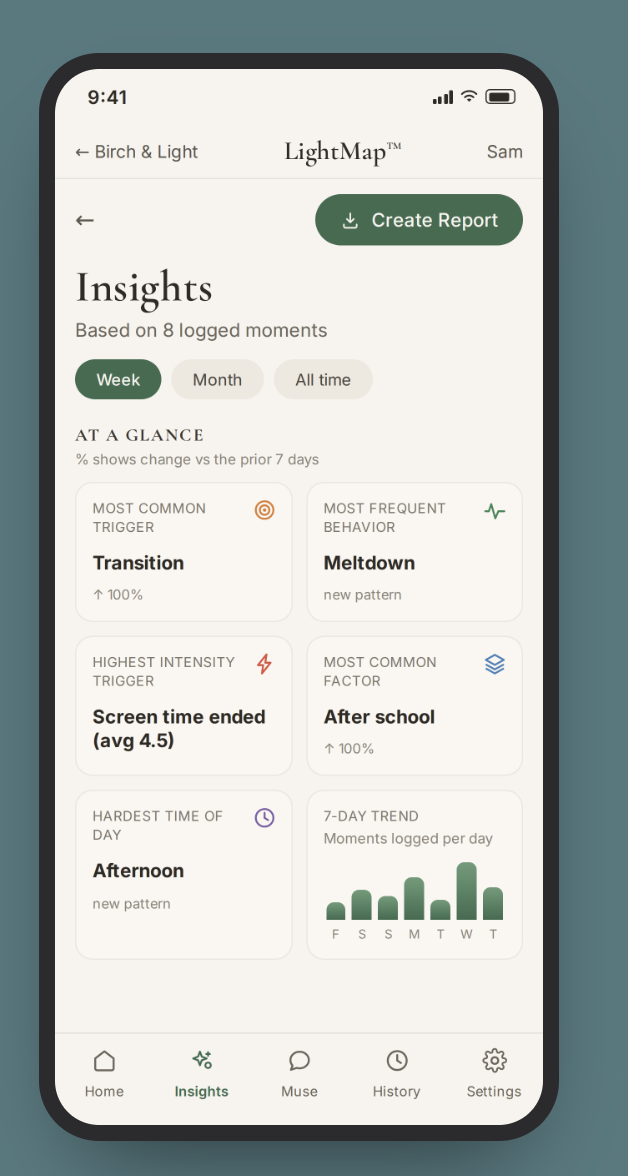

Part of the award-winning Birch & Light Method, honored with the Mom's Choice Gold Award for excellence in family resources.
A story to read together
Sometimes the easiest way in is a story you read side by side.
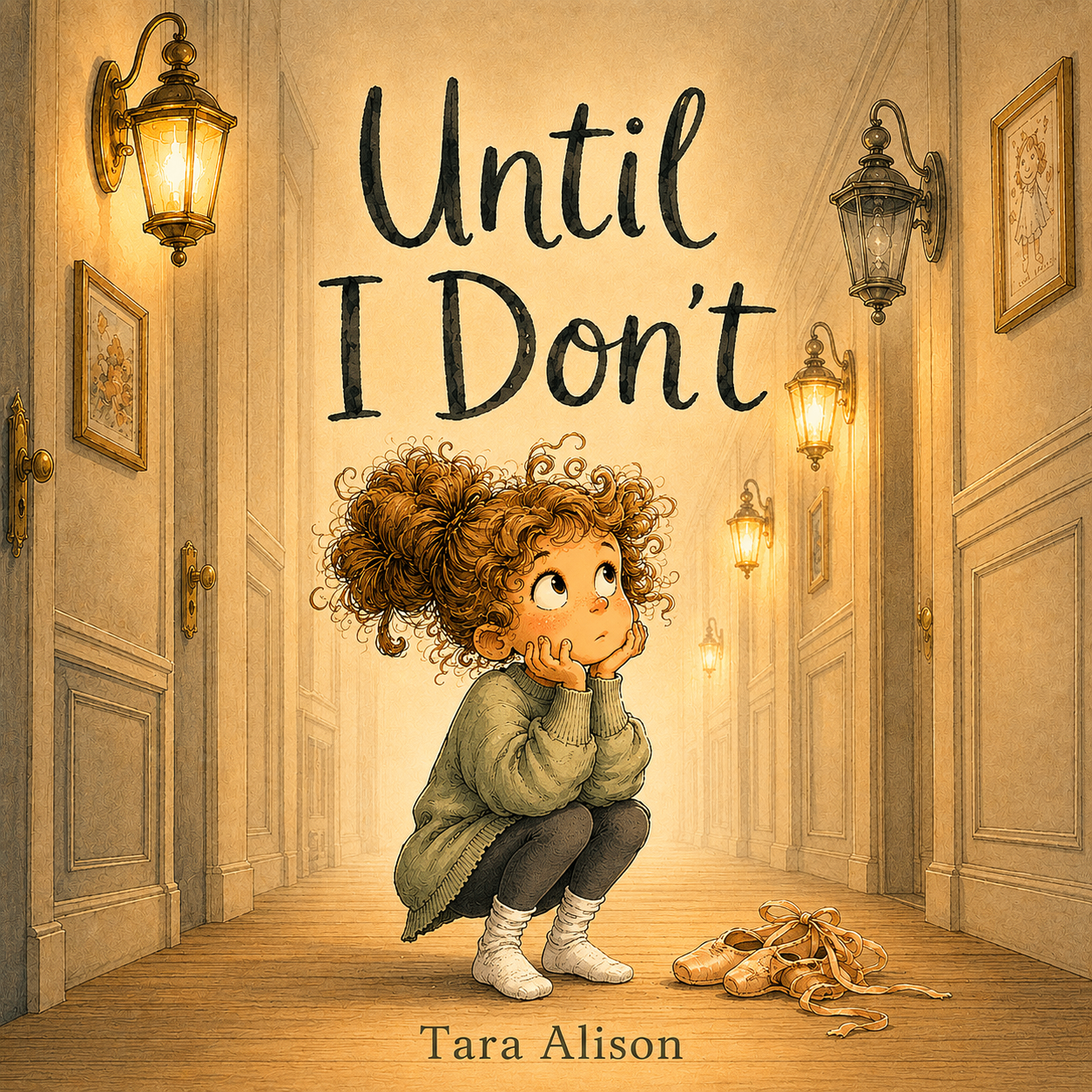 Until I Don't
Rosie shines at dance, at school, with neighbors. At home, the smallest thing can tip her over. One quiet hallway moment helps her family finally find language for the part of her nobody else sees.
Read the story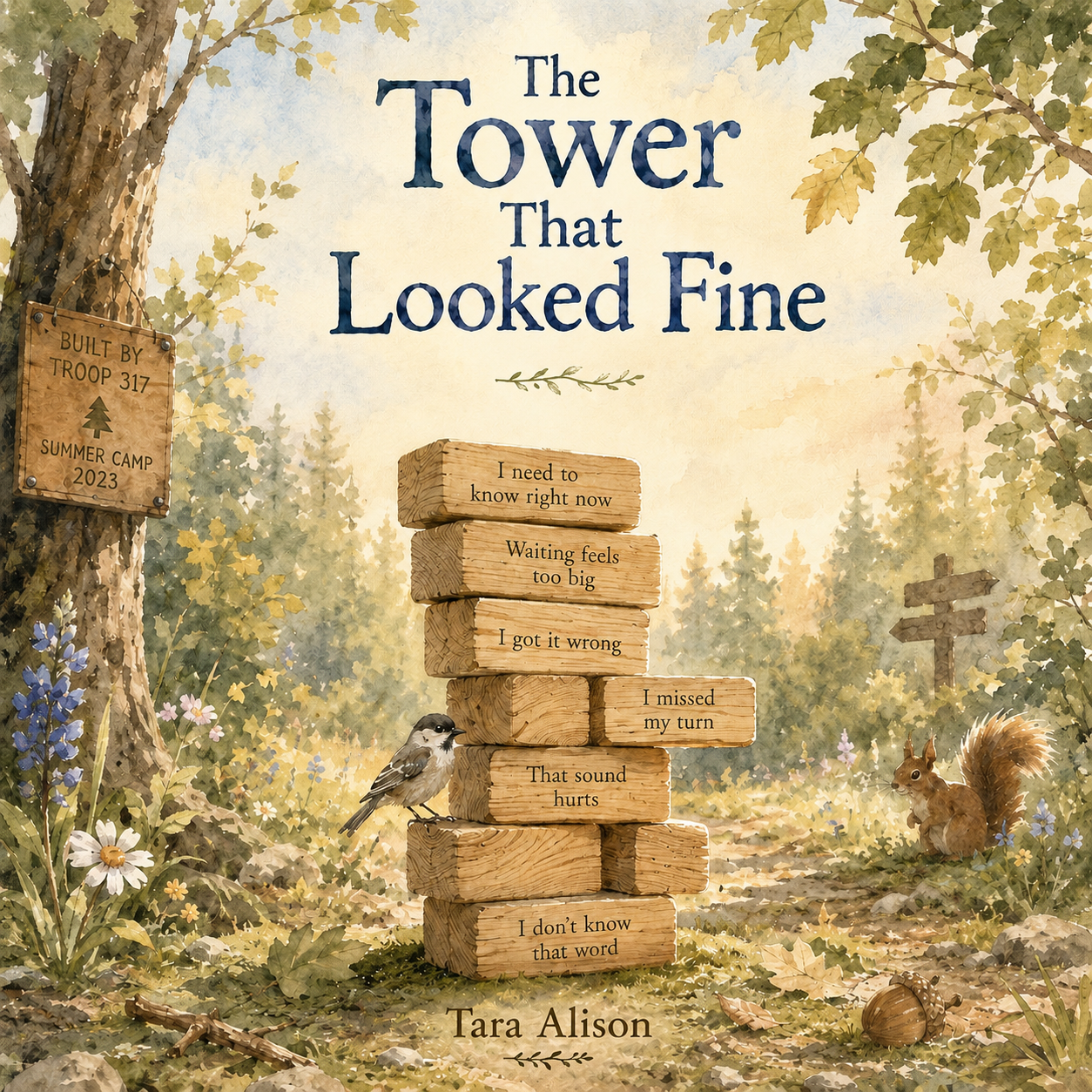 The Tower That Looked Fine
A tower in a quiet clearing tries to stay steady through every small thing nobody else seems to notice — until one tiny breath of wind causes her to fall, and a gentle hand begins to gather the blocks back.
Read the story
If today was one of those days
A few more from the library, free to read.
Researched and drafted with AI assistance, reviewed before publication. Editorial standards