
You have a diagnosis. You have tried occupational therapy, and talk therapy, and both helped a little in a narrow way. You still cannot answer the question you actually have, which is what is driving this, and why the things that work for other children do not work for yours.
The word that comes up next in most of these conversations is neuropsych. It is expensive, the waitlists are long, and parents are rarely told what it does or does not deliver before they commit.
This is general information, not medical advice, and it reflects our best reading of published sources at the time of writing. What any particular evaluation includes, and what your insurance will cover, varies by clinician, plan and state.
What it actually is
A neuropsychological evaluation is not a single test. It is a records review, a long clinical interview, a battery of standardized tests, measures of social and emotional functioning, behavioral observation, and then the part that matters most, someone integrating all of it into an account of how your child works.
The cognitive side is organized into domains: intelligence, attention and concentration, learning and memory, language, visuospatial and perceptual function, executive function, psychomotor speed and sensory-motor function. Many evaluations add academic achievement and adaptive functioning.
The value is in the relationships between those, not in any one score. A child whose reasoning is strong and whose working memory sits well below it looks lazy or inconsistent to everyone around her, and that gap is precisely what a battery is built to expose.
What it adds beyond the diagnosis you already have
A diagnostic appointment answers whether a label fits. An evaluation answers where the floor is, where the ceiling is, and which of several plausible explanations the pattern actually supports.
That matters most in three situations. When the story does not hold together, a bright child failing at something that should be easy. When several explanations are live at once, ADHD or anxiety or a language disorder or all three, and the treatment for one is wrong for another. And when what has been tried has not worked, because the plan was built on the wrong mechanism.
The medical versus educational wall
Here is the part that catches families out, and it is worth understanding before you call anyone.
Insurers routinely treat testing done to establish an educational diagnosis, a learning disability for instance, as the school district's responsibility rather than a medical benefit. Some go further. One large insurer's published medical policy states outright that neuropsychological testing for the routine diagnosis of ADHD is not medically necessary, and sets the typical course of testing, scoring and interpretation at ten hours.
Which means the referral question determines the coverage. Testing to work out whether your child qualifies for school services reads as educational. Testing to clarify how a medical or neurological condition, a seizure disorder, a head injury, a genetic condition, a complex psychiatric picture, relates to the difficulties is a medical question. Both may involve the same child and overlapping tests.
Practical steps before you book:
- Ask the practice to tell you the referral question in writing and check it against your plan's policy, which is usually published online
- Ask whether they bill insurance or provide a superbill for you to submit
- Ask for the estimate in hours, since this is billed in timed units rather than as a flat package, and hours are what drive the number
- Ask whether prior authorization is required, and who submits it
While you're here, take the guide
What's Underneath is free: the three body-state triggers under most meltdowns, what to say in the minute before it tips over, and how to reset afterward.

You'll get the guide instantly, plus five free articles in your inbox every week. Real challenges (meltdowns, school mornings, picky eating, big feelings) and how to actually handle them. Unsubscribe anytime.
The school evaluation is a different thing, and it is free
A district evaluation and a private neuropsych evaluation are built for different purposes. The school's is aimed at whether your child qualifies for services and how the difficulty affects access to education. It is at no cost to you. A neuropsych evaluation is broader, is not bound to eligibility categories, and answers questions the school has no reason to ask.
Running both is common and reasonable. If money is the constraint, request the school evaluation first, in writing, because it costs nothing and it may answer enough.
One thing to know about bringing a private report to the school. Under IDEA, an evaluation you obtain at your own expense must be considered by the team. Under Section 504 the obligation is softer: it is one source of information among several. Considered does not mean adopted, and a district is not bound to implement what the report recommends.
What to ask before you hand over the money
- Who administers the tests, and who interprets them. In some practices those are different people, and the interpreter is who you are paying for
- How long until the written report, and is there a feedback session included
- Will the recommendations be specific enough for a teacher to act on, or general. Ask to see a sample report with the identifying details removed
- Does the evaluator have experience with the particular question you are bringing
- What happens if the results are inconclusive, which does happen
What it will not do
It will not produce services. It names what is going on and recommends; the district decides eligibility on its own process, and insurers decide coverage on theirs.
It will not tell you who your child is. A report describes performance on standardized tasks in a quiet room on one or two days. That is genuinely useful information and it is not the whole child, which is why the interview and your own account carry real weight in a good evaluation.
And it does not expire neatly. Children change, and a profile taken at seven answers questions about a seven-year-old. Many families end up repeating some of it at a transition point, which is worth knowing when you are weighing the cost of doing it now versus later.
Sources, tied to the claims they support. That a neuropsychological evaluation comprises records review, clinical interview, standardized testing, measures of social-emotional functioning and personality, adaptive functioning, estimates of premorbid functioning, behavioral observation and integration of those components, and that cognitive functions are organized into domains including intelligence, attention and concentration, learning and memory, language, visuospatial and perceptual functions, executive functions, psychomotor speed and sensory-motor functions: Schaefer LA, et al., "Neuropsychological Assessment," StatPearls [Internet], Treasure Island (FL), StatPearls Publishing, NCBI Bookshelf ID NBK513310, PMID 30020682, last updated September 13, 2026. That at least one major insurer's published medical policy states that neuropsychological testing for the routine diagnosis of ADHD is not medically necessary, and describes a typical course of testing, administration, scoring and interpretation as completed in ten hours: Blue Cross Blue Shield of Massachusetts Medical Policy 151, "Neuropsychological and Psychological Testing." That insurers commonly deny coverage for assessment used to establish an educational diagnosis on the basis that it is the school's responsibility, while often covering testing where the question concerns the relationship between the academic problem and another medical problem or treatment: patient guidance published by The Center for Neuropsychology and Counseling, cited here as a description of common practice rather than as an authority on any individual plan. Consideration of parent-obtained evaluations: 34 CFR 300.502(c) under IDEA, and the narrower requirement under Section 504 that such information be among the sources considered.
For education and reflection, not medical advice. Our terms
See what's underneath
Bring more than memory to the intake
LightMap holds the pattern you would otherwise have to reconstruct in a two-hour interview.
Start with 3 moments Not sure where to start? Ask me.Message Tara on WhatsApp. It really is me, I read everything and will personally respond.Click here to message Tara →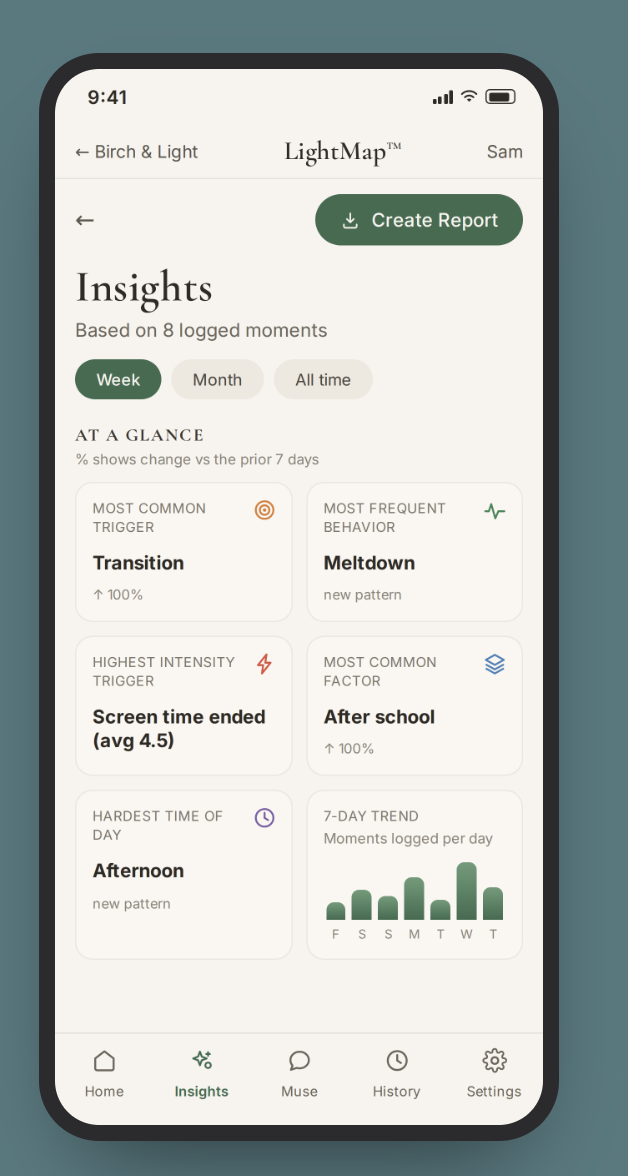

Part of the award-winning Birch & Light Method, honored with the Mom's Choice Gold Award for excellence in family resources.
Researched and drafted with AI assistance, reviewed before publication. Editorial standards