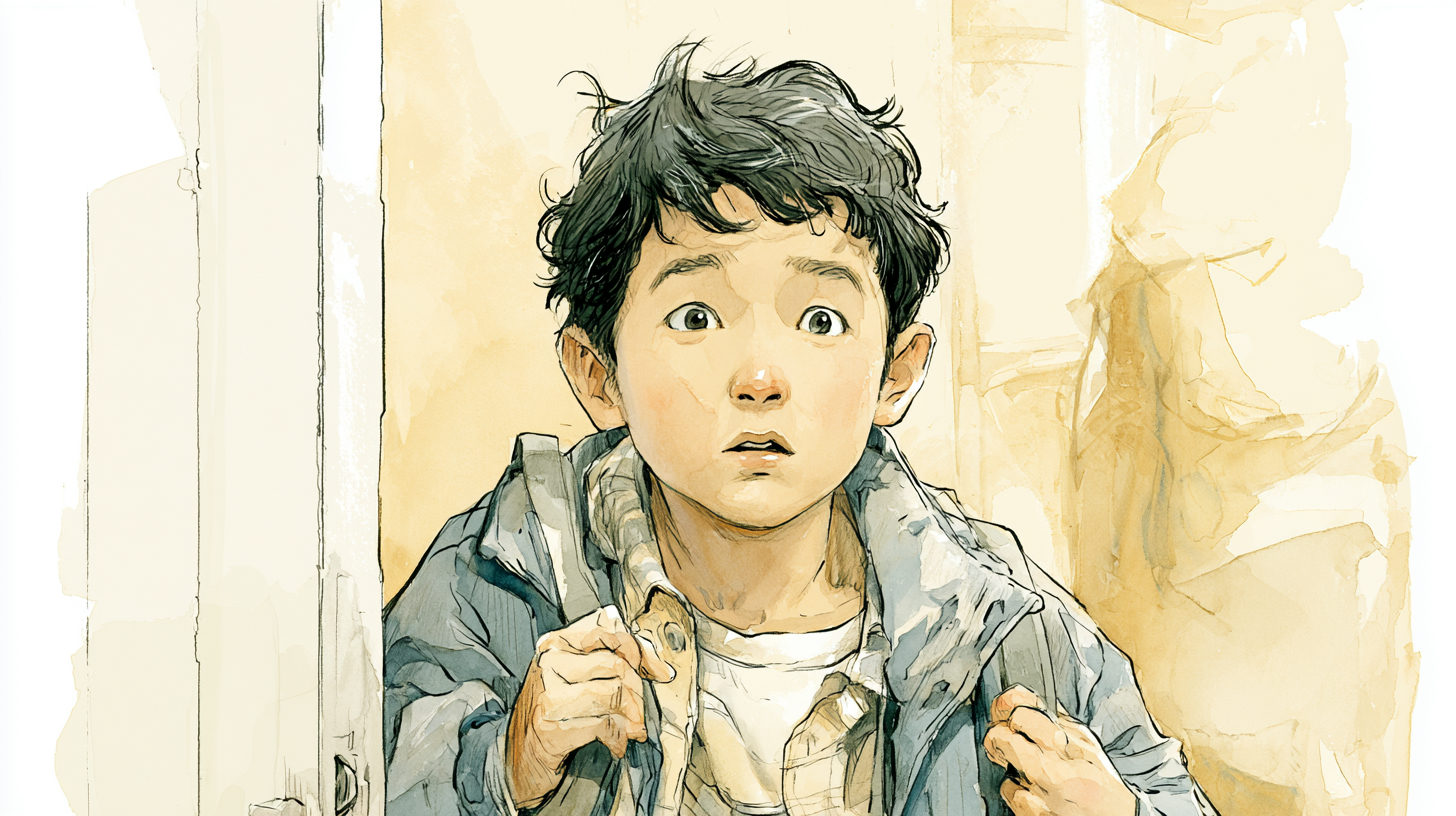
It starts in an ordinary week. Your four-year-old pinches the same patch of skin until it bruises. She scratches her arms until they are raw. The meltdown that used to run ten minutes runs an hour, and the room stops being safe, because the dresser moves and anything on a shelf becomes something to throw.
Parents arrive at this with the same sentence: this is not her. Hold onto that sentence. It is the most useful piece of information you have, and it points somewhere specific.
This is information, not medical advice. It reflects our best reading of the research and guidance at the time of writing and is not guaranteed. Nothing here can tell you what is happening with your child. Injuries, new symptoms and anything involving medication belong with her doctor.
What self-injury is in a young child
Self-injurious behavior is the clinical term for behavior a child directs at her own body that causes physical harm: head banging, hitting, biting, scratching, pinching, hair pulling, pressing on the eyes. It is common in autism. In the largest population study done in the United States, covering 8,065 eight-year-olds identified through the CDC monitoring network, self-injury showed up in the records of about 28 percent of autistic children. The authors thought the real number was probably higher, since milder self-injury often never makes it into a record at all.
This is not the same behavior as self-harm in an older child or a teenager, which has different drivers and needs a different response. In a preschooler, self-injury is usually one of three things: pain she cannot locate or describe, a nervous system past its limit, or a message with no other route out. Often all three at once.
It is also not manipulation. A child who pinches herself through a screaming hour alone in her room, with nobody getting anything out of it, is not running a strategy.
When it is new, start with the body
The important word in your situation is "new." A behavior that has been building for a year is a different question from one that arrived on Tuesday and has come every day since.
The American Academy of Pediatrics consensus panel on gastrointestinal problems in autism put the principle in a single line: a care provider should know that problem behavior in an autistic patient may be the first or the only symptom of a medical condition sitting underneath it. The panel was writing about the gut. The logic is not limited to the gut.
There is an old assumption that gets in the way here, which is that autistic children feel pain less than other children. That is not safe to treat as a rule. In one study of 51 young children being evaluated for autism and other developmental disabilities, the children who self-injured showed more pain-related behavior during everyday routines, not less. Pain may be expressed differently in an autistic child. Different is not the same as absent.
The things that most often turn out to be underneath a sudden change in a small child are ordinary: constipation, an ear infection, a tooth, reflux, a urinary infection, a headache, skin that itches, an injury nobody saw happen. Add anything that changed in the same window. A new medication or a dose change. An illness starting. A run of broken sleep. A house that has been louder than usual.
None of that is a diagnosis and you are not expected to produce one. The ask at the appointment is simply that someone look before the behavior gets filed as behavior.
What makes the appointment useful
A pediatrician makes decisions in a fifteen-minute window, largely on what a parent can recall under pressure. "She has been awful for a week" is true and it goes nowhere. A pattern goes somewhere.
The details that change what a doctor does with this:
- The date it started, as close as you can get it, and whether it has been every day since
- Where on her body, and whether it is the same place each time
- What time of day the episodes cluster
- What was happening in the ten minutes before, including the boring things
- Sleep and appetite over the same stretch
- Bowel pattern, which parents often leave out and which matters more than almost anything else on this list at this age
- Anything that changed in the same window: illness, medication, a move, a new room, a new setting
LightMap is built for this part. You log the episode after it has passed, with the physical state attached, and what comes back is the shape of the week rather than your memory of the worst hour of it.
A meltdown and a tantrum are different events
This distinction matters because the standard advice is written for the other one. A tantrum runs toward a goal and stops when the goal is met or clearly abandoned. A meltdown has no goal. It is a nervous system that has gone past capacity and is discharging, and it ends when it is finished rather than when it is answered.
Which is why "do not give in" lands so strangely. There is nothing to give in to. And why she resists you at the height of it while wanting you most of the time: during the discharge, being approached, held and spoken to is more input on a system that already has too much.
While you're here, take the guide
What's Underneath is free: the three body-state triggers under most meltdowns, what to say in the minute before it tips over, and how to reset afterward.

You'll get the guide instantly, plus five free articles in your inbox every week. Real challenges (meltdowns, school mornings, picky eating, big feelings) and how to actually handle them. Unsubscribe anytime.
Getting through the hour without anyone getting hurt
Safety work happens before the episode, not during it. In the middle of an hour like that, there are no clever moves left, and that is not a failure of your parenting.
- Make the space survivable in advance. Anchor or remove the furniture that moves. Take down what comes off walls. Leave soft things in and take hard things out, on a calm afternoon rather than at 6pm
- Cut the words. One short sentence, then quiet. Language is load, and during a meltdown it is load she cannot process
- Stay near without looming. In the doorway, or just outside it where she can find you, is closer than it feels
- Do not block or hold her unless someone is about to be seriously hurt. Physical restraint tends to lengthen the episode, and any plan that involves it should be written with her clinicians rather than improvised in the moment
- Protect your own body. Standing inside range of a child who is throwing and hitting is not the same as supervising her
- Afterward, skip the debrief. No consequence for the episode itself, no review of what she did. Water, food, dark, quiet. What follows a meltdown is physical recovery, and a lesson cannot land on it
When the strategies stop working
If you have run everything the behavior team gave you and none of it is touching this, that is information and it should go back to them rather than into your own list of failures.
A behavior plan is built around an assumed function: the child is escaping something, seeking something, or communicating something. Plans work when the assumed function is the real one. A plan built around escape will do nothing at all to a behavior driven by an earache, because the plan is answering a question the child is not asking.
The questions to put to the team: has anything medical been ruled out since this started, what does your data show about what happens in the minutes before, and does the function this plan was built on still fit what you are seeing now.
When it is not a wait-and-see
Some of this needs a call rather than the next available appointment:
- Blows to the head, or anything directed at the eyes
- Injuries that break the skin repeatedly, or any injury that needs treatment
- Escalation day over day rather than a hard stretch holding steady
- Self-injury alongside other sudden changes: speech going backward, new rituals or fears, changes in urination, a child who stops eating, or a change that followed an illness
- Any point at which you cannot keep her safe, or cannot keep yourself safe
That last line is not a failure to plan. A four-year-old who spends an hour trying to hurt herself is a medical situation, and treating it as one is the correct response.
You noticed a change and you believed your own eyes about it. That is the part nobody else can do, and it is the part that gets this looked at properly.
Sources, tied to the claims they support. The prevalence of self-injurious behavior among autistic children, the 8,065-child sample drawn from the Autism and Developmental Disabilities Monitoring Network across the 2000, 2006 and 2008 surveillance years, the 27.7 percent average figure, and the authors own note that record-based counting likely understates milder self-injury: Soke GN, Rosenberg SA, Hamman RF, Fingerlin T, Robinson C, Carpenter L, Giarelli E, Lee LC, Wiggins LD, Durkin MS, DiGuiseppi C, "Brief Report: Prevalence of Self-injurious Behaviors among Children with Autism Spectrum Disorder: A Population-Based Study," Journal of Autism and Developmental Disorders, 2016;46(11):3607-3614. The statement that problem behavior may be the primary or sole symptom of an underlying medical condition in an autistic patient: Buie T, Campbell DB, Fuchs GJ, Furuta GT, Levy J, Van de Water J, et al., "Evaluation, Diagnosis, and Treatment of Gastrointestinal Disorders in Individuals With ASDs: A Consensus Report," Pediatrics, 2010;125(Supplement 1):S1-S18. The finding that young children who self-injure showed more pain-related behavior rather than less, measured with the Non-Communicating Children Pain Checklist across everyday routines in 51 children: Courtemanche AB, Black WR, Reese RM, "The Relationship Between Pain, Self-Injury, and Other Problem Behaviors in Young Children With Autism and Other Developmental Disabilities," American Journal on Intellectual and Developmental Disabilities, 2016;121(3):194-203. Co-occurring medical conditions in autism and the role of the primary care clinician in evaluating them: Hyman SL, Levy SE, Myers SM, Council on Children with Disabilities, Section on Developmental and Behavioral Pediatrics, "Identification, Evaluation, and Management of Children With Autism Spectrum Disorder," Pediatrics, 2020;145(1):e20193447, reaffirmed October 2025.
For education and reflection, not medical advice. Our terms
See what's underneath
Walk into the appointment with something to show
LightMap turns what you saw into something a doctor can read. Start with one moment.
Start with 3 moments Not sure where to start? Ask me.Message Tara on WhatsApp. It really is me, I read everything and will personally respond.Click here to message Tara →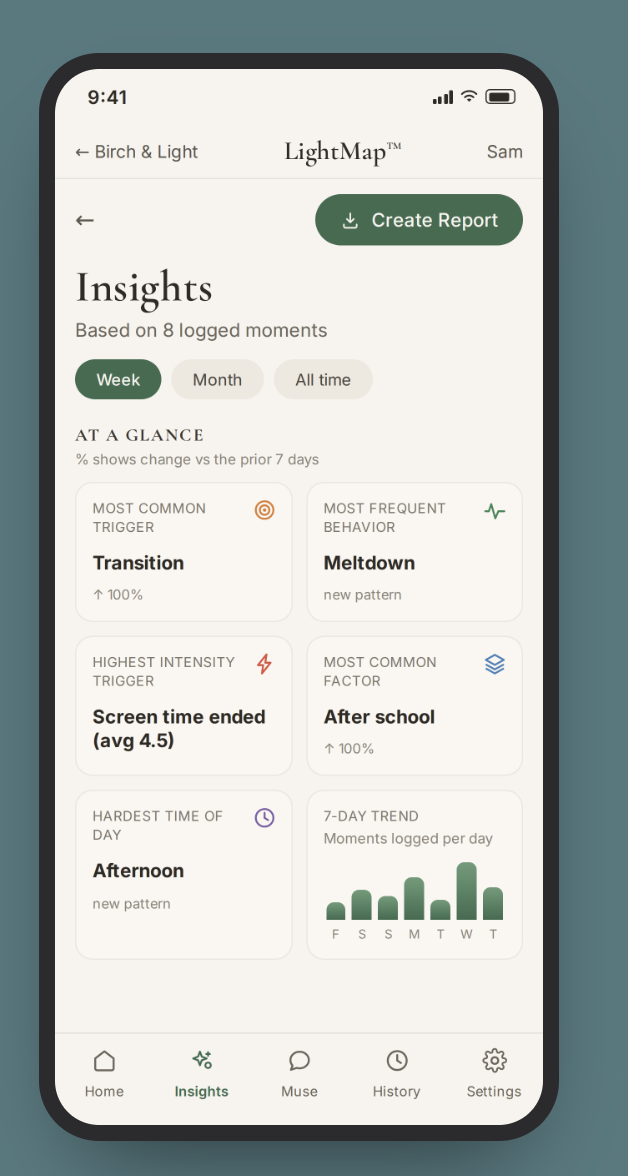

Part of the award-winning Birch & Light Method, honored with the Mom's Choice Gold Award for excellence in family resources.
Researched and drafted with AI assistance, reviewed before publication. Editorial standards