
If you're raising a neurodivergent child — autistic, ADHD, or otherwise wired differently — you've probably collected a quiet catalog of the things people get wrong. The well-meant advice that misses entirely. The assumptions about what your child is doing and why. The judgments, sometimes from strangers and sometimes from people who love your child, that reveal how deeply the misunderstandings run.
Most of these misunderstandings share a single root: the assumption that a neurodivergent child is a neurotypical child who is either misbehaving or failing. Once you see that root, the specific myths start to fall apart. Here are some of the biggest, and what's actually true instead.
'They're Just Being Difficult'
Perhaps the most common and damaging misreading is that a neurodivergent child's hard behavior is willful — defiance, manipulation, attention-seeking, a child choosing to make things hard. In reality, challenging behavior is almost always a sign of a child who is struggling, not scheming. It's a response to being overwhelmed, to unmet needs, to demands that exceed current capacity, to a world that isn't built for how they're wired.
As psychologist Dr. Ross Greene has long taught, kids do well if they can. When a neurodivergent child isn't doing well, the useful question isn't how to make them comply, but what's getting in the way. The behavior is communication about a struggle, not a strategy to cause trouble.
'They Could Do It If They Wanted To'
Because neurodivergent children can often do something brilliantly one day and not at all the next, people conclude the inconsistency must be about motivation — they did it before, so the failure to do it now must be a choice. But neurodivergent capacity is genuinely variable. It fluctuates with regulation, energy, sensory load, anxiety, and a dozen other factors. The same task can be easy on a calm day and genuinely impossible on an overwhelmed one.
This is the difference between 'won't' and 'can't.' Inconsistent ability isn't evidence of a child choosing not to. It's the normal, fluctuating reality of a nervous system whose capacity rises and falls. Punishing the hard-day 'can't' as if it were a good-day 'won't' is one of the most common and harmful mistakes.
Doing something one day and not the next isn't a motivation problem. Neurodivergent capacity genuinely fluctuates — the same task can be easy or impossible depending on the day.
'A Happy, Compliant Child Is Doing Fine'
It's easy to assume the neurodivergent child who causes the least trouble — quiet, agreeable, holding it together at school — is the one doing best. But sometimes the child who looks fine is masking: working enormously hard to suppress their natural responses and appear 'normal,' at significant internal cost. The calm exterior can hide real exhaustion and distress, often unloaded later at home where it's safe.
Looking fine and being fine aren't the same thing for a neurodivergent child. The effort of appearing okay can be its own source of harm, and the children who mask most successfully are sometimes the ones struggling most underneath.
While you're here, take the guide
What's Underneath is free: the three body-state triggers under most meltdowns, what to say in the minute before it tips over, and how to reset afterward.

You'll get the guide instantly, plus five free articles in your inbox every week. Real challenges (meltdowns, school mornings, picky eating, big feelings) and how to actually handle them. Unsubscribe anytime.
'The Goal Is to Make Them Normal'
A lot of advice, and a lot of older approaches, aim implicitly at making the neurodivergent child indistinguishable from neurotypical peers — to suppress the stimming, eliminate the differences, train them to pass. But the goal of supporting a neurodivergent child isn't to erase how they're wired. It's to help them thrive as who they are.
Many neurodivergent traits aren't deficits to be fixed; they're differences, and often strengths. The stimming that soothes, the intense focus on an interest, the different way of seeing — these aren't problems to eliminate. Support means accommodating real challenges and building on real strengths, not manufacturing a neurotypical-looking child at the expense of the actual one.
'If You Just Disciplined Them More, They'd Be Fine'
The assumption that neurodivergent struggles are really parenting failures — that more consistency, more consequences, more firmness would resolve them — is both common and wrong. Standard behavioral approaches built for neurotypical children often don't work for neurodivergent ones, and can actively backfire, because they target the behavior while ignoring the neurological reality underneath.
More pressure on a struggling neurodivergent child usually produces more struggle, not more compliance. What helps isn't harder discipline; it's understanding, accommodation, and approaches matched to how the child is actually wired.
The Shift Worth Making
Nearly every misunderstanding about neurodivergent children comes from the same place: judging them by neurotypical assumptions, as though their differences were choices, failures, or flaws. Difficult behavior gets read as defiance, variable capacity as laziness, masking as wellness, difference as deficit, and neurological reality as a discipline problem.
The shift that changes everything is to start from a different assumption — that your child is wired differently, doing their best with the nervous system they have, and struggling when the world asks more than that system can give. From there, the right responses follow: not correction and pressure, but understanding, accommodation, and a focus on helping your child thrive as exactly who they are.
Every behavior is a clue.
If you're working to understand how your neurodivergent child is actually wired, LightMap can help you track their patterns — what overwhelms them, what helps, where they thrive — so the pattern beneath it becomes easier to see. Explore LightMap at birchandlight.com/lightmap.
For your child: Oliver Octopus Used Arm Number Three is about an octopus who draws beautifully with the wrong arm and is told at school that everyone uses arm one.
Sources: Milton's double empathy problem (Disability and Society; PMC); Ross Greene, Collaborative and Proactive Solutions; Hull and Lai on camouflaging (Autism; PMC); neurodiversity paradigm literature (PMC).
For education and reflection, not medical advice. Our terms
See what's underneath
Understand the why, not just the what
LightMap reads your hard days together and gives you answers. Start with one moment today.
Start with 3 moments Not sure where to start? Ask me.Message Tara on WhatsApp. It really is me, I read everything and will personally respond.Click here to message Tara →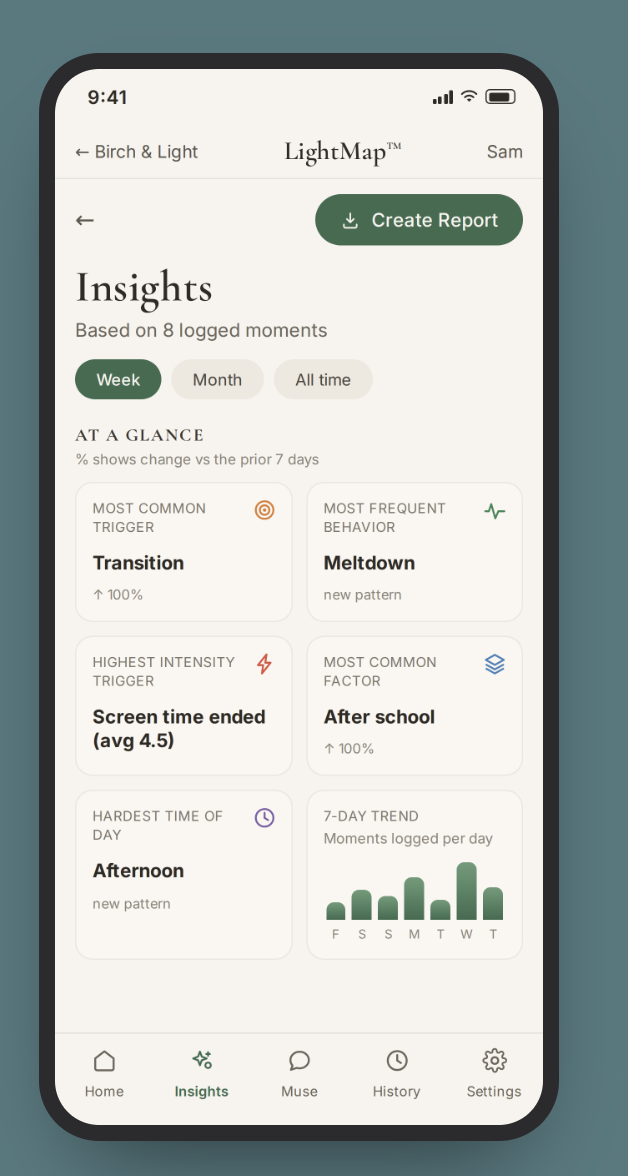

Part of the award-winning Birch & Light Method, honored with the Mom's Choice Gold Award for excellence in family resources.
A story to read together
Sometimes the easiest way in is a story you read side by side.
 The Mosquito Who Thought He Was a Dragonfly
Raised by dragonflies after a summer storm, Miro learns one night that the world sometimes sees him differently than the family who loves him — and that being misunderstood isn’t the same as being bad.
Read the story Otto Filled Everything
Otto can't stop filling things with water. His family doesn't understand — until Grandma Willow helps them listen to what his body is actually asking for.
Read the story
If today was one of those days
A few more from the library, free to read.
Researched and drafted with AI assistance, reviewed before publication. Editorial standards