

Most parents arrive at this question the same way. Something is clearly wrong with your child, someone has mentioned PANS or PANDAS, and the next appointment consists of a rapid strep test that comes back negative and a shrug.
So it helps to know what a real workup involves, and to be able to ask for specific things by name. Not because you should be running your child's medical care, but because a parent who asks for a perianal swab by name gets a different conversation than one who asks whether it could be PANDAS.
Start here: nothing on this list diagnoses PANS
Worth saying up front, because it saves a lot of heartbreak. PANS and PANDAS are clinical diagnoses. They're made from the story: what appeared, how fast, and what came with it. There's no blood test that confirms it and no blood test that rules it out.
What testing does is different but still valuable. It looks for a treatable infection driving the picture, it builds documentation, and it can support a diagnosis that's already being considered clinically. A doctor who says the labs were normal so it isn't PANS has misunderstood the framework.
Why the throat swab keeps missing it
The single most useful thing to understand is that the strep behind these cases is usually quiet. It doesn't produce the sore throat and fever everyone is watching for. Children get it, carry it, and pass it around while looking perfectly well from the neck up.
Two consequences follow. First, a rapid strep test is less sensitive than a culture, so a negative rapid test means considerably less than people assume. If it's negative and suspicion is real, ask for a throat culture, held the full 24 to 48 hours.
Second, and this is the one that changes cases: the throat is not the only place strep lives.
The sites that get missed
Perianal. The most commonly missed reservoir by a distance, and specifically recommended in PANS workups. Perianal streptococcal dermatitis shows up as a bright red, moist, sharply bordered rash around the anus, and it's routinely mistaken for irritation or thrush. Children rarely complain about it and nobody finds it without looking, so it needs a direct examination and a swab. There are documented cases of children whose neuropsychiatric symptoms tracked a perianal infection nobody had found.
Vulvovaginal. Same principle in girls, same tendency to be attributed to something else.
Skin. Impetigo is a strep or staph infection of the skin, and strep impetigo counts as a trigger the same way strep throat does. Any weeping, crusted, or repeatedly flaring patch is worth swabbing while it's open rather than after it settles.
Sinuses. Chronic congestion or a lingering cough that never quite resolves is worth raising, particularly when flares seem to follow colds.
The rest of the household. Reinfection from a sibling or parent who has no symptoms is often raised as a reason a child improves on antibiotics and slides back the moment they stop. Know before you ask that this one is genuinely contested: mainstream infectious disease guidance recommends against routinely testing or treating symptom-free household contacts, since carriage is common and treating it has limited proven benefit. Some PANS clinicians do pursue household swabbing in recurrent cases anyway. So it is reasonable to raise if flares keep returning, but a doctor who declines is following standard guidance rather than dismissing you, and it is worth asking for their reasoning rather than reading a no as a brush-off.
Titers: ASO and anti-DNase B, and why you want both
These measure your child's antibody response to strep, which is how a recent infection can be detected after the bacteria themselves are gone.
Ask for both, because they behave differently. ASO rises faster and falls off sooner. Anti-DNase B rises later and stays elevated longer, so it catches infections that ASO has already missed.
Here's the detail worth carrying into the appointment, especially if a skin infection is part of the story: the ASO response after strep infections of the skin is often poor, while anti-DNase B still rises. So a child whose trigger was impetigo can have a normal ASO and a meaningfully raised anti-DNase B. Running ASO alone, in that situation, produces a false reassurance.

There's a story for this exact struggle
The Princess and the Witch Inside
Esme is loved, but a fast protective part keeps rushing in before she gets a turn. A quiet visitor helps her meet the witch inside — not as an enemy, but as a worried protector — and find her way back to the people she wanted to be with all along.
Free to read. You'll also get five free articles a week. Unsubscribe anytime.
Before you go, grab the free guide
The 3 body-state triggers under most meltdowns, a script for the 30 seconds before it tips over, and a reset for after. Free.

You'll get the guide instantly, plus five free articles in your inbox every week. Real challenges (meltdowns, school mornings, picky eating, big feelings) and how to actually handle them. Unsubscribe anytime.
Why one titer result tells you very little
This causes more confusion than anything else in the workup.
Reference ranges are built from populations, not from your child. A result inside the normal range can still represent a large rise from where that particular child sits, and a result above the range can simply be where they've always been.
What's informative is the trend. Two measurements a few weeks apart, ideally one during a flare and one when things are settled, say far more than a single number. If you can get a value while your child is well, that becomes their baseline and every future result means something.
So the question to ask isn't whether the titer is normal. It's whether it's changed.
The carrier argument
At some point someone will say a positive throat culture just means your child is a carrier, and carriers don't need treating.
The distinction is real. Carriage means the bacteria are present without the immune system reacting to them. But the reasoning behind treating these children is that their symptoms track an immune response rather than the bacteria themselves, which is why the neuropsychiatric picture and the antibody picture tend to move together. This remains genuinely debated among clinicians, so it's worth knowing the argument exists rather than being blindsided by it.
It isn't always strep
PANDAS specifically requires strep. PANS is broader and doesn't require any identified trigger at all, though one is often found.
Other triggers reported often enough to ask about: mycoplasma pneumoniae, particularly where there's been a lingering cough, influenza, Epstein Barr, and Lyme and other tick borne infections in areas where those are common. Which of these gets tested should follow your child's history rather than a standard panel.
The wider bloods
Beyond infection, most thorough workups include inflammatory markers, a full blood count, thyroid function, vitamin D, and ferritin. These aren't looking for PANS. They're looking for the other things that produce overlapping symptoms, and they're worth having ruled out properly.
You'll also encounter the Cunningham Panel, which is commercially available and widely discussed in parent groups. Be aware that it isn't accepted as a diagnostic test, that its validation is contested, and that it's expensive and rarely covered. Some PANS clinicians use it as one input among many. It cannot confirm or exclude the diagnosis, and any clinician presenting it as definitive in either direction is overstating what it does.
How to ask
Specific requests land better than general worry. Something like: I'd like a throat culture rather than only the rapid test, plus ASO and anti-DNase B together, and I'd like her examined for perianal strep. That sentence signals you know what you're asking for.
Bring a written timeline. When symptoms appeared, how quickly, what infections came before them, and what the pattern has been since. In a ten minute appointment, a page that shows a flare following an illness three times over two years does more than any description you can give out loud.
If you're told the rapid test was negative so there's nothing more to do, the useful reply is to ask what would need to be true for further testing to be worthwhile. It moves the conversation from a closed door to a criterion.
What testing can't fix
Honestly: a meaningful number of families never get a clean positive. Infections come and go, titers get checked at the wrong moment, and the trigger has often cleared long before anyone thought to look.
That's not a failure and it doesn't mean you were wrong. The diagnosis was always clinical, and treatment decisions in the real world get made on the whole picture rather than on a single confirming result. Testing is worth doing thoroughly, and it's worth not letting the absence of a positive convince you that what you've watched happen didn't happen.
If you're piecing together a history that goes back years, wondering about PANS years later covers how to build that timeline. And if your child is starting antibiotics, telling a flare from a drug reaction is the next thing worth reading.
Which infections came when, what symptoms followed, and how long the gap was: log it in LightMap as it happens, and the timeline your doctor needs is already written when you walk in.
This is general information for parents, not medical advice. Testing and treatment decisions belong with your child's clinician.
Sources: Mayo Clinic Laboratories, PANS Research Consortium diagnostic guidelines (Journal of Child and Adolescent Psychopharmacology, 2015), Medscape.
For education and reflection, not medical advice. Our terms
Before the next flare
Bring your doctor a timeline, not a memory
LightMap turns scattered hard days into a pattern you can see. Start by logging one moment tonight.
Log today's hard moment, no account needed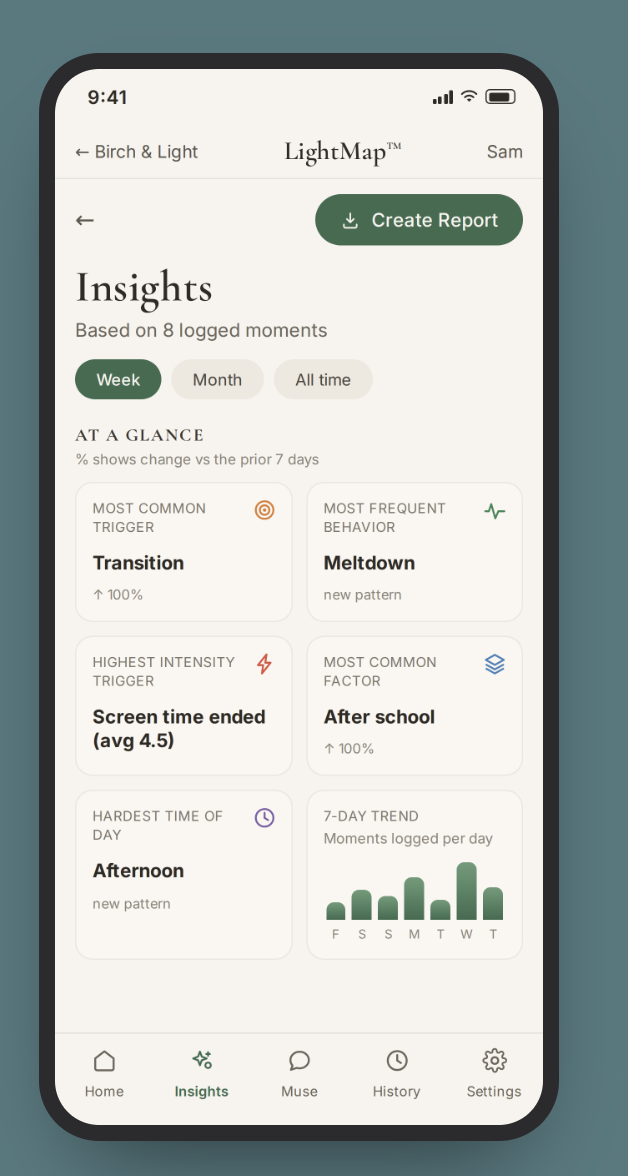

Part of the award-winning Birch & Light Method, honored with the Mom's Choice Gold Award for excellence in family resources.
A story to read together
Sometimes the easiest way in is a story you read side by side.
- The Princess and the Witch Inside
Esme is loved, but a fast protective part keeps rushing in before she gets a turn. A quiet visitor helps her meet the witch inside — not as an enemy, but as a worried protector — and find her way back to the people she wanted to be with all along.
Read the story  The Tower That Looked Fine
A tower in a quiet clearing tries to stay steady through every small thing nobody else seems to notice — until one tiny breath of wind causes her to fall, and a gentle hand begins to gather the blocks back.
Read the story
Researched and drafted with AI assistance, reviewed before publication. Editorial standards