

Three days into a new antibiotic your child is worse, and you have no way to tell whether that means the treatment is working, the treatment is hurting her, or the illness is simply doing what it does. Every group you ask will give you both answers confidently.
This distinction is worth learning to make, because the two situations call for opposite responses. One is usually something to support your child through. The other is a reason to pick up the phone today.
The single most useful question
Ask this first: are these her symptoms getting louder, or are these new symptoms in her body?
A flare, or what many parents call a Herx reaction, tends to be an intensification of what she already had. The obsessions get more insistent. The tics increase. The rage comes faster and lasts longer. Handwriting deteriorates again. Separation anxiety returns. Urinary frequency picks up. Sleep falls apart. Nothing on that list is new to her, it is all turned up.
A drug reaction usually introduces something that was not part of her picture at all. Vomiting. Diarrhea. A rash. Headache. Stomach pain. Appetite gone. Those are the body objecting to a medication rather than the illness getting noisier.
It is not a perfect rule, because a miserable gut will make any child more dysregulated, and a genuinely sick child eats less. But it sorts the majority of cases, and it gives you something specific to tell a prescriber.
What is actually known about Herx reactions
Worth being straight about this, because the term gets used far more loosely than the evidence supports.
The original Jarisch Herxheimer reaction is real and well documented, in the treatment of syphilis and a few other specific infections, where killing large numbers of organisms quickly releases material that provokes a short intense inflammatory response. It is recognized, it has a described time course, and it resolves.
Extending that concept to weeks or months of treatment for chronic infections is much less established, and mainstream infectious disease medicine is generally skeptical of it. That does not mean parents are imagining what they see, since symptom spikes after starting treatment are reported consistently enough to take seriously. It does mean that treating every worsening as a Herx, and therefore as evidence that treatment is working, is a habit that can keep a child on something that is harming her.
The practical position: a short early spike in her existing symptoms that settles is worth reporting and often worth sitting with under medical guidance. A worsening that keeps building, or that brings new physical symptoms, deserves to be treated as a possible drug problem until someone rules it out.
Timing tells you a great deal
A flare pattern usually appears within the first several days of starting or increasing a dose, peaks, and then eases over days to a couple of weeks.
A drug reaction is often tied tightly to a single medication. Symptoms starting on day one of a particular drug, especially when a different antibiotic was tolerated fine the week before, points strongly at that drug rather than at the illness.
This is the reason clinicians stagger new antibiotics rather than starting several at once. If three drugs begin together and something goes wrong, nobody can say which one did it, and you may end up abandoning a medication that was never the problem. If your prescriber has spaced them out, the spacing is the diagnostic tool. Use it by writing down what started when.

There's a story for this exact struggle
The Princess and the Witch Inside
Esme is loved, but a fast protective part keeps rushing in before she gets a turn. A quiet visitor helps her meet the witch inside — not as an enemy, but as a worried protector — and find her way back to the people she wanted to be with all along.
Free to read. You'll also get five free articles a week. Unsubscribe anytime.
Side effects worth knowing by drug
Not a complete list, and never a substitute for the pharmacy leaflet, but these are the ones parents most often mistake for something else.
Azithromycin. Nausea, stomach pain, and diarrhea are the common ones. It can affect heart rhythm, which matters if your child is on other medications that do the same or has a known cardiac issue.
Cefdinir. Diarrhea is common. Two specific things: it is among the antibiotics more associated with C. difficile, so watery diarrhea that keeps going rather than settling needs evaluating, and taken alongside iron it can turn stools a startling reddish color that is harmless but alarming if nobody warned you.
Amoxicillin and amoxicillin with clavulanate. Diarrhea, more so with the combination. A late appearing flat rash is common and usually benign, but any rash should still be looked at rather than assumed.
Rifampin. Turns urine, sweat, and tears orange, which is expected and will stain contact lenses permanently. It affects the liver and interacts with a very long list of other medications, including some psychiatric ones, so every prescriber and the pharmacist need the full list.
Doxycycline. Serious sun sensitivity, so a sunburn on a cloudy day is the medication rather than bad luck. It can irritate the esophagus, which is why it goes down with plenty of water and not at bedtime.
Any of them. Yeast overgrowth, appetite change, and a generally unsettled gut are common across the class, and worth asking about rather than enduring.
Before you go, grab the free guide
The 3 body-state triggers under most meltdowns, a script for the 30 seconds before it tips over, and a reset for after. Free.

You'll get the guide instantly, plus five free articles in your inbox every week. Real challenges (meltdowns, school mornings, picky eating, big feelings) and how to actually handle them. Unsubscribe anytime.
The signs that mean call today
Regardless of which explanation seems more likely, these are not worth waiting on:
Watery diarrhea that continues rather than settling, particularly with fever or stomach pain. Any sign of dehydration, meaning very little urine, a dry mouth, no tears, unusual sleepiness, or difficulty rousing her. Blood or mucus in the stool. A rash with fever, blistering, or any involvement of the mouth, eyes, or genitals. Swelling of the face, lips, or tongue, or any difficulty breathing. Yellowing of the eyes or skin, or dark urine. Severe or unusual headache, or a change in vision.
And one that belongs on every list for this population: new or worsening thoughts of self harm, or a change that looks like a break from reality. Those are urgent regardless of cause, and they do not wait for the next appointment.
What to write down
The prescriber cannot make this call without a timeline, and a timeline is nearly impossible to reconstruct from memory once three medications are in play.
Keep it simple. Each drug, the date it started, and the dose. Then each day, a line on how she was: her existing symptoms on a one to five scale, plus anything new in her body. Note what she ate and drank on the bad days, because appetite and fluids are the first thing anyone will ask about.
Two weeks of that is worth more than an hour of describing it, and it turns a conversation about impressions into a conversation about a pattern.
What to ask
Whether this looks like a reaction to a specific drug or an expected early flare. Whether to hold, reduce, or continue, and for how long before you should expect it to settle. What specifically would make them want to hear from you sooner. Whether anything is worth testing, particularly if diarrhea persists. And whether the sequence of introduction should change, so the next drug goes in with a clean baseline behind it.
The thing not to do is decide alone. Stopping an antibiotic partway has its own consequences, and pushing through something that is genuinely harming her has worse ones. This is a phone call, and prescribers who work with these children expect these calls.
If the wetting, urinary frequency, or a sudden change in her symptoms is what brought you here, the medical reality of PANDAS and PANS covers the wider picture, and finding a doctor who actually understands PANS is worth reading if the prescriber you have is not the one you want managing this.
Which drug started when, what changed on which day, and whether it was her symptoms or her body: log it in LightMap as it happens, and the answer your prescriber needs is already written down when you call.
This is general information for parents, not medical advice. Never start, stop, or change a prescribed medication without speaking to the prescriber, and seek urgent care for any of the warning signs above.
Sources: FDA prescribing information, StatPearls (NCBI Bookshelf), American Board of Family Medicine.
For education and reflection, not medical advice. Our terms
Before the next flare
Bring your doctor a timeline, not a memory
LightMap turns scattered hard days into a pattern you can see. Start by logging one moment tonight.
Log today's hard moment, no account needed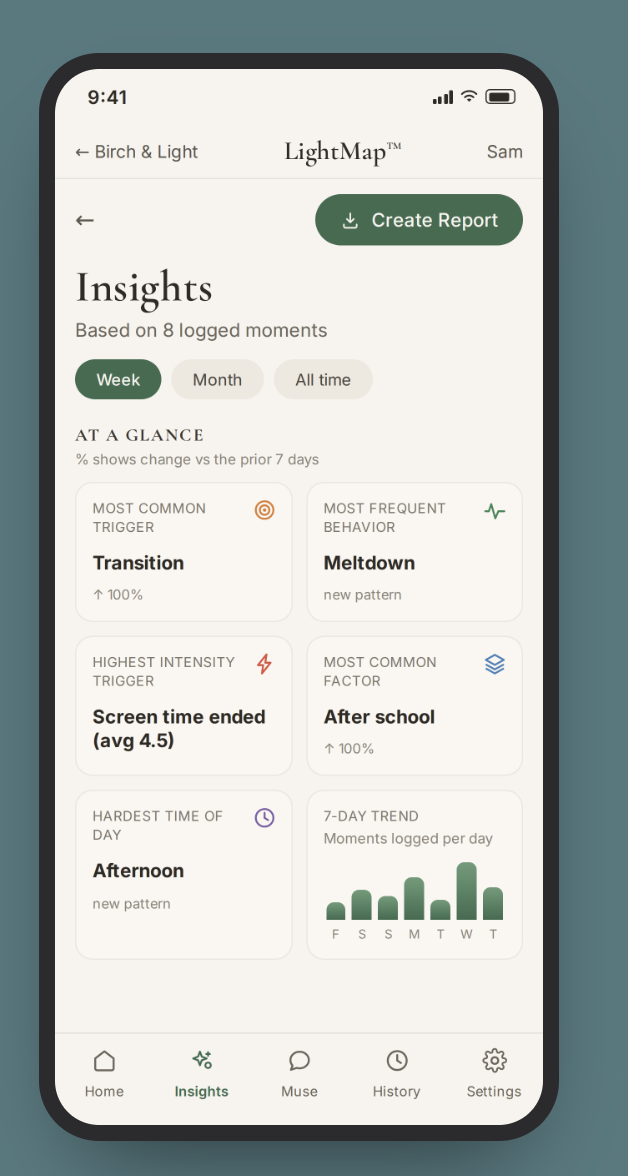

Part of the award-winning Birch & Light Method, honored with the Mom's Choice Gold Award for excellence in family resources.
A story to read together
Sometimes the easiest way in is a story you read side by side.
- The Princess and the Witch Inside
Esme is loved, but a fast protective part keeps rushing in before she gets a turn. A quiet visitor helps her meet the witch inside — not as an enemy, but as a worried protector — and find her way back to the people she wanted to be with all along.
Read the story  The Tower That Looked Fine
A tower in a quiet clearing tries to stay steady through every small thing nobody else seems to notice — until one tiny breath of wind causes her to fall, and a gentle hand begins to gather the blocks back.
Read the story
Researched and drafted with AI assistance, reviewed before publication. Editorial standards