
Headache and abdominal pain are common IVIG side effects, and they often arrive two to four days after the infusion, not during it. Most are manageable by changing rate, hydration, or product. A severe headache with a stiff neck, light sensitivity, or vomiting is an emergency.
The treatment is working. The rages settled, the tics quieted, school became possible again, and you got your child back in a way you had stopped expecting. And now, somewhere in year two or year three, there is a headache that never fully goes away and a stomach that hurts badly enough to have put you in an emergency department more than once.
The obvious infection tests come back clean. Nobody has an answer. And almost nobody in the room has asked the obvious question, because the treatment has been running so long that it stopped being a variable in anyone's mind years ago.
It is still a variable.
This is a map, not medical advice. It reflects our best reading of the research at the time of writing and is offered without guarantee. Nothing here is a reason to stop or change a treatment, and every decision in it belongs to you and your child's doctor.
Start with the calendar, not the symptom
The single most useful thing you can do costs nothing and takes a month.
Get a calendar. Mark every infusion day. Then mark, every day, whether there was a headache and whether there was stomach pain, and roughly how bad each was on a scale of zero to ten. Do it for two full cycles.
You are looking for one of two answers. Either the symptoms cluster in the days following infusion, or they are spread evenly and have no relationship to the cycle at all. Those two answers send you to two different doctors and two different conversations, and until you have one of them everybody involved is guessing.
This matters more than it sounds, because of a fact about how these reactions behave.
Why do IVIG side effects show up days later?
Parents are told what to watch for during an infusion. Flushing, chills, chest tightness, a change in breathing or blood pressure. The nurse is in the room, everyone is alert, and if something happens the rate gets slowed or the infusion gets stopped.
What is far less often explained is that a second category exists. Delayed reactions arrive anywhere from about eight hours to ten days after the infusion, long after everyone has gone home and stopped connecting the two things.
One retrospective study of 104 children receiving their first course of IVIG found reactions in 37.5% of them, arriving a median of three days after the course began and most often between days two and four. Among the children who did react, fever, headache and rash were the most common, with vomiting, nausea and abdominal pain also on the list. Those children were younger than yours and most were treated for epilepsy rather than for this, so read the ranking rather than the rates.
Read that list against your calendar. Headache and abdominal pain are not exotic reactions. Both sit on the standard list, and they land in a window where nobody is watching for them.
Headache, and the one that is an emergency
Headache is consistently near the top of every list of immunoglobulin adverse effects. Most of it is unremarkable, responds to the ordinary things, and passes.
There is one version that does not, and every parent whose child receives regular infusions should be able to recognize it.
Aseptic meningitis is a reaction where the membranes around the brain become irritated. It is not an infection, it is generally reversible, and it is treatable, but it looks and feels serious because it is. It is also uncommon: as of April 2022, forty-four cases had been described in the English-language medical literature. It is in this article because it is treatable and because it does not look like an ordinary post-infusion headache. The presentation is a severe headache that ordinary pain relief does not touch, together with a stiff or painful neck, real sensitivity to light, and often vomiting. It can begin during an infusion or in the days after one.
That combination is an emergency department visit rather than a phone call in the morning. Say plainly at the desk that your child receives immunoglobulin infusions and when the last one was, because it changes what the team is thinking about from the first minute.
Two things raise the odds. Higher doses, which is relevant because the doses used for this condition are not small. And a personal or family history of headaches or migraine, which is one of the risk factors identified in the literature and one that a parent can flag without any testing at all. If migraines run in your family, that is information your infusion team should have.
Is the stomach pain from the infusion?
Nausea, vomiting and abdominal pain all appear on the adverse effect lists, so a stomach that hurts in the days after an infusion has a plausible explanation sitting right there.
Two cautions in opposite directions.
Do not assume it is the infusion and cancel the gastroenterology appointment. Children with this condition have a high rate of genuine gut problems, constipation is extremely common and hides well, and abdominal pain that is anxiety-driven is real pain rather than imagined pain. A pattern that tracks the infusion cycle does not rule out a second thing happening underneath it. Keep the appointment.
And do not assume the gastroenterologist will ask about the infusions. They may not know the schedule, they may not know the dose, and they are being handed a child with abdominal pain and a complicated history. Bring the calendar. It reframes the entire consultation in about thirty seconds.
The one most families have never heard of
Immunoglobulin products can carry antibodies against blood group antigens, and in some recipients those antibodies attack the child's own red blood cells. The result is hemolysis, meaning red cells breaking down faster than they should.
This is not common. Reported rates run at roughly one hemolytic episode per thousand treatment episodes, and most are mild enough to show up only on a blood test. Occasionally it is significant enough to cause real anemia.
The risk is not evenly spread, and the pattern is well described. It occurs almost entirely in people who do not have blood group O, with the highest risk in group AB. High cumulative doses over a short period raise it, and so does having an underlying inflammatory or immune-mediated condition, which describes every child receiving these infusions for this reason.
What it looks like at home: unusual fatigue or pallor in the days after an infusion, breathlessness on stairs a child normally manages fine, dark or tea-colored urine, or a yellow tint to the eyes or skin.
The question to ask your team is simple. Do you know my child's blood group, and is hemoglobin checked after infusions? For a child on this treatment long term, that is a reasonable thing to have an answer to.
While you're here, take the guide
What's Underneath is free: the three body-state triggers under most meltdowns, what to say in the minute before it tips over, and how to reset afterward.

You'll get the guide instantly, plus five free articles in your inbox every week. Real challenges (meltdowns, school mornings, picky eating, big feelings) and how to actually handle them. Unsubscribe anytime.
The rarer ones, briefly
Kidney strain and clotting events are both on the label and both are rare. They matter mainly because the preventive measures for them are the same measures that reduce the common reactions, which makes this section short and practical rather than frightening.
Hydration is the main one. Well hydrated in the day before, during, and for several days after. Dehydration makes almost every category of reaction more likely, and it is the one variable a family controls directly.
What can your infusion team change?
This is the part that turns a complaint into a plan. If the calendar shows the symptoms tracking the infusion cycle, there are several levers, and none of them involve abandoning a treatment that is working.
Infusion rate. Slower is the single most reliable adjustment. Many reactions are rate-related, and a longer, slower infusion produces fewer of them.
Hydration protocol. Oral fluids in the day before, intravenous fluids alongside the infusion, and a deliberate push on fluids for several days afterward rather than only on the day.
Premedication. Guidelines describe premedicating patients who have had previous rate-related reactions, using combinations that may include a fever reducer, an antihistamine, an antiemetic, or a steroid. What is appropriate is a decision for the prescriber, and the trigger for the conversation is you reporting the pattern.
How the dose is divided. The same total dose spread across more days is a different physiological event than the same dose delivered fast.
The product itself. Different immunoglobulin preparations differ in concentration, in what they are stabilized with, and in how well individual patients tolerate them. Switching products is a real option that gets considered less often than it should.
Notice that all five sit with the infusion team, and none of them can be considered if nobody has told the team there is a pattern. Three years of tolerating something quietly reads, from their side, as three years of no problems.
What to bring, and what to say
Bring the calendar. Two cycles is enough.
Then say it in the form that gets acted on: her headaches cluster in the two to four days after each infusion and rate around a seven, her stomach pain does the same and has taken us to the emergency department twice, and I want to know whether we can adjust the rate, the hydration or the premedication before the next one.
That sentence contains a pattern, a severity, a consequence and a request. It is a different object from saying she gets a lot of headaches, and it tends to produce a different meeting.
Ask these as well. What is her exact dose and how does it compare to when we started, given that dosing is by weight and children grow. What is her blood group and is her hemoglobin checked after infusions. What product is she on and have we ever tried a different one. Over how many hours is the infusion currently run and can it be run slower.
Get help now, rather than at the next appointment, if
- A severe headache comes with a stiff or painful neck, light hurting the eyes, or vomiting
- There is unusual pallor or breathlessness, dark urine, or yellowing of the eyes or skin
- There is a significant drop in how much she is urinating
- There is chest pain, breathing difficulty, or new swelling or pain in one leg
- Abdominal pain is severe, localized, or comes with a fever
The thing to keep hold of
None of this is an argument against a treatment that gave your child her life back. Side effects are a management problem, and the great majority of them are managed by adjusting how the treatment is delivered rather than by stopping it.
What makes it manageable is somebody noticing the pattern, and the only person positioned to notice it is the one who is there on day three.
Researched and written in 2026. This reflects our best reading of the clinical literature at that time and is offered without any guarantee of accuracy or outcome. It is not medical advice and it is not a diagnosis. Do not change, delay or stop any treatment based on it. Talk to the team that manages your child's infusions.
Sources, tied to the claims they support.
The retrospective cohort of 104 children receiving a first course of IVIG, the 37.5% reaction rate, onset at a median of three days from the start of the course with an interquartile range of two to four days, the ranking of fever, headache, rash, vomiting, nausea and abdominal pain among the children who reacted, and the definition of delayed reactions as those arriving from about eight hours to ten days after administration begins: Kubota J, Hamano S, Daida A, Hiwatari E, Ikemoto S, Hirata Y, Matsuura R, Hirano D. Predictive factors of first dosage intravenous immunoglobulin-related adverse effects in children. PLoS ONE. 2020;15(1):e0227796. Those children were treated in a pediatric neurology unit, most of them for epilepsy, at a median age of 8.5 months, and the authors note that the results may not generalize to other conditions.
Pre-infusion hydration, the slowest tolerated infusion rate, premedication for patients with previous rate-related reactions, and reducing the rate when post-infusion headache occurs: ASCIA Guidelines for standardised IVIg infusion rates for immunoglobulin replacement therapy. Australasian Society of Clinical Immunology and Allergy, 2024. These guidelines are written for immunoglobulin replacement therapy in immune deficiency, and ASCIA states that patients receiving IVIg for immunomodulation should follow local protocols or the product information, so read them as a description of the available levers rather than as a protocol for this condition.
Aseptic meningitis, its presentation, the count of reported cases, and a personal or family history of headache as a factor warranting closer monitoring and premedication: Kretowska-Grunwald A, Krawczuk-Rybak M, Sawicka-Zukowska M. Intravenous immunoglobulin-induced aseptic meningitis: a narrative review of the diagnostic process, pathogenesis, preventative measures and treatment. J Clin Med. 2022;11(13):3571. Frequency and risk factors in high-dose therapy: Sekul EA, Cupler EJ, Dalakas MC. Aseptic meningitis associated with high-dose intravenous immunoglobulin therapy: frequency and risk factors. Ann Intern Med. 1994;121(4):259-262. Adverse effect categories and safe administration: Orbach H, Katz U, Sherer Y, Shoenfeld Y. Intravenous immunoglobulin: adverse effects and safe administration. Clin Rev Allergy Immunol. 2005;29(3):173-184.
Hemolysis occurring almost entirely in non-O blood group recipients with the highest risk in group AB, and its association with high cumulative dose over a short period and with underlying inflammatory or immune-mediated disorders: Bruggeman CW, Nagelkerke SQ, Lau W, Manlhiot C, de Haas M, van Bruggen R, McCrindle BW, Yeung RSM, Kuijpers TW. Treatment-associated hemolysis in Kawasaki disease: association with blood-group antibody titers in IVIG products. Blood Adv. 2020;4(14):3416-3426. The approximate rate of one hemolytic episode per thousand treatment episodes, the observation that most are unnoticed or self-limiting, and hemoglobin monitoring after infusion: Mohamed M. Intravenous immunoglobulin-associated hemolysis: risk factors, challenges, and solutions. Int J Clin Transfus Med. 2016;4:121-131.
For education and reflection, not medical advice. Our terms
Before the next flare
Bring your doctor a timeline, not a memory
LightMap reads your hard days together and gives you answers. Start with one moment today.
Start with 3 moments Not sure where to start? Ask me.Message Tara on WhatsApp. It really is me, I read everything and will personally respond.Click here to message Tara →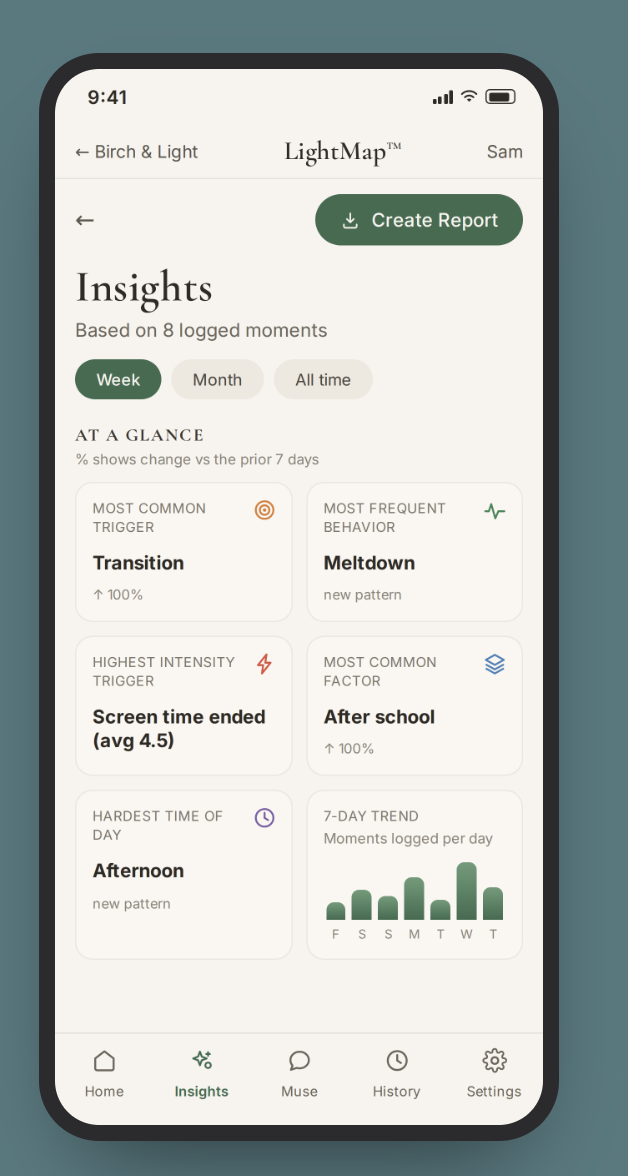

Part of the award-winning Birch & Light Method, honored with the Mom's Choice Gold Award for excellence in family resources.
If today was one of those days
A few more from the library, free to read.
Researched and drafted with AI assistance, reviewed before publication. Editorial standards