Somebody you care about has a child with PANS or PANDAS, and they sent you this because explaining it out loud has not been working.
That is not their fault and it is not yours. The condition does not fit any category you already have, and every time they try to describe it, the words land in the wrong bin. So here it is from the outside, written for you.
Start with what it is not
It is not a behavior problem. It is not a discipline issue. It is not something a firmer hand or a calmer household would have prevented. It is not anxiety in the ordinary sense, and it is not a phase, and it is not the parents being dramatic about a difficult kid.
If you have been quietly wondering whether the parenting is the problem, you are not a bad person for having wondered. Almost everyone does, including the parents, who have spent more hours than you can imagine wondering the same thing about themselves.
What it actually is
PANS and PANDAS are neuroimmune conditions. An infection, most often strep, triggers an immune response, and in these children that response reaches the brain. The result is inflammation in the parts of the brain that handle fear, impulse, and repetitive thought.
The child does not gradually develop symptoms. They arrive. Parents can often name the week. Sometimes the day.
A child who was fine on a Tuesday cannot use a bathroom by Friday. A nine year old who could read chapter books is writing like a five year old. A kid who ate everything now believes food is contaminated and is losing weight. Rage that has no relationship to the child you knew. Tics. Handwriting that falls apart. Separation panic in a child who used to sleep at your house.
This is not fringe medicine. Stanford runs a dedicated clinic for it. The research base has grown substantially over the last decade. The problem was never that these families were imagining things. The problem is how long it has taken the rest of the medical world to catch up, which is why so many of them spent a year or two being told it was behavioral before anyone looked at the immune system.
The part that makes it hardest to explain
It comes and goes.
Symptoms flare, then recede. A family can get their child back for six weeks. Long enough to breathe, to plan something, to start believing it is over. Then a cold goes through the house and it all returns.
This is why what you see may not match what you have been told. You might visit and find a completely normal child, funny and easy and fine, and privately conclude that things must not be as bad as described. What you saw was real. So was the version they lived with in March. Both are the same child.
It is also why these parents seem to brace during ordinary events. A birthday party going around the neighborhood is not a party to them. It is an exposure.
While you're here, take the guide
What's Underneath is free: the three body-state triggers under most meltdowns, what to say in the minute before it tips over, and how to reset afterward.
You'll get the guide instantly, plus five free articles in your inbox every week. Real challenges (meltdowns, school mornings, picky eating, big feelings) and how to actually handle them. Unsubscribe anytime.
What is happening to the parents
They are managing a medical condition, a psychiatric presentation, a school that may or may not believe them, and often a marriage under enormous strain, with no visible injury to point at. There is no cast. Nobody brings a casserole for this.
Most of them have been disbelieved by at least one doctor. Many have been told they were anxious parents. Some have been reported to school authorities or child protective services by people who thought they were helping. That history is why they may be guarded with you, and why the offer of advice, however kindly meant, can land badly.
What actually helps
Believe the description without needing to see it. This is the entire thing. More than any practical help you could offer.
Do not suggest treatments. They have read more about this than you will. If you send an article, send it once and let it go.
Do not compare it to something ordinary. "My kid does that too" is meant as solidarity and lands as dismissal. Your child having a tantrum and their child in a rage that lasts ninety minutes and ends with holes in a wall are not the same event.
Ask about the child, not about the illness. They rarely get to talk about their kid as a person anymore. Ask what he is into right now. Ask what made her laugh this week.
Keep inviting them. They will cancel. Often. Cancelling is not rejection, it is triage, and the invitations are what tell them they still exist to somebody.
Offer something specific. Not "let me know if you need anything," which puts the work on them. Try: I am at the store, what do you need. I can take your other kid Saturday morning. I can sit in your driveway on my laptop while you go to the appointment.
Remember the siblings. There is usually another child in that house whose entire year has been organized around a crisis that is not theirs. An adult who shows up for that kid specifically is doing something almost nobody does.
If you take one thing from this
The hardest part of this illness, for a lot of these families, is not the symptoms. It is being alone inside it while people they love quietly conclude they are exaggerating.
You do not have to understand the immunology. You do not have to have an opinion about treatment. You just have to be a person who believed them, and stayed, and kept calling.
That is not a small thing. For most of these families it is the rarest thing there is.
For education and reflection, not medical advice. Our terms
Before the next flare
Turn a hard year into something you can show someone
LightMap reads your hard days together and gives you answers. Start with one moment today.
Start with 3 moments Not sure where to start? Ask me.Message Tara on WhatsApp. It really is me, I read everything and will personally respond.Click here to message Tara →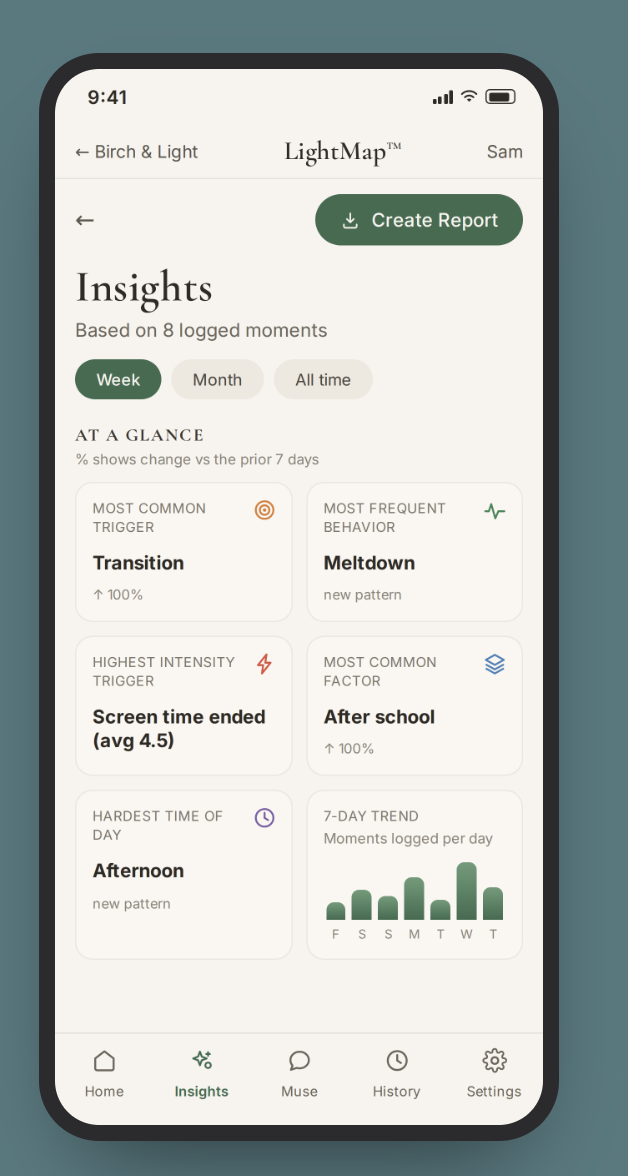

Part of the award-winning Birch & Light Method, honored with the Mom's Choice Gold Award for excellence in family resources.
If today was one of those days
A few more from the library, free to read.
Researched and drafted with AI assistance, reviewed before publication. Editorial standards