
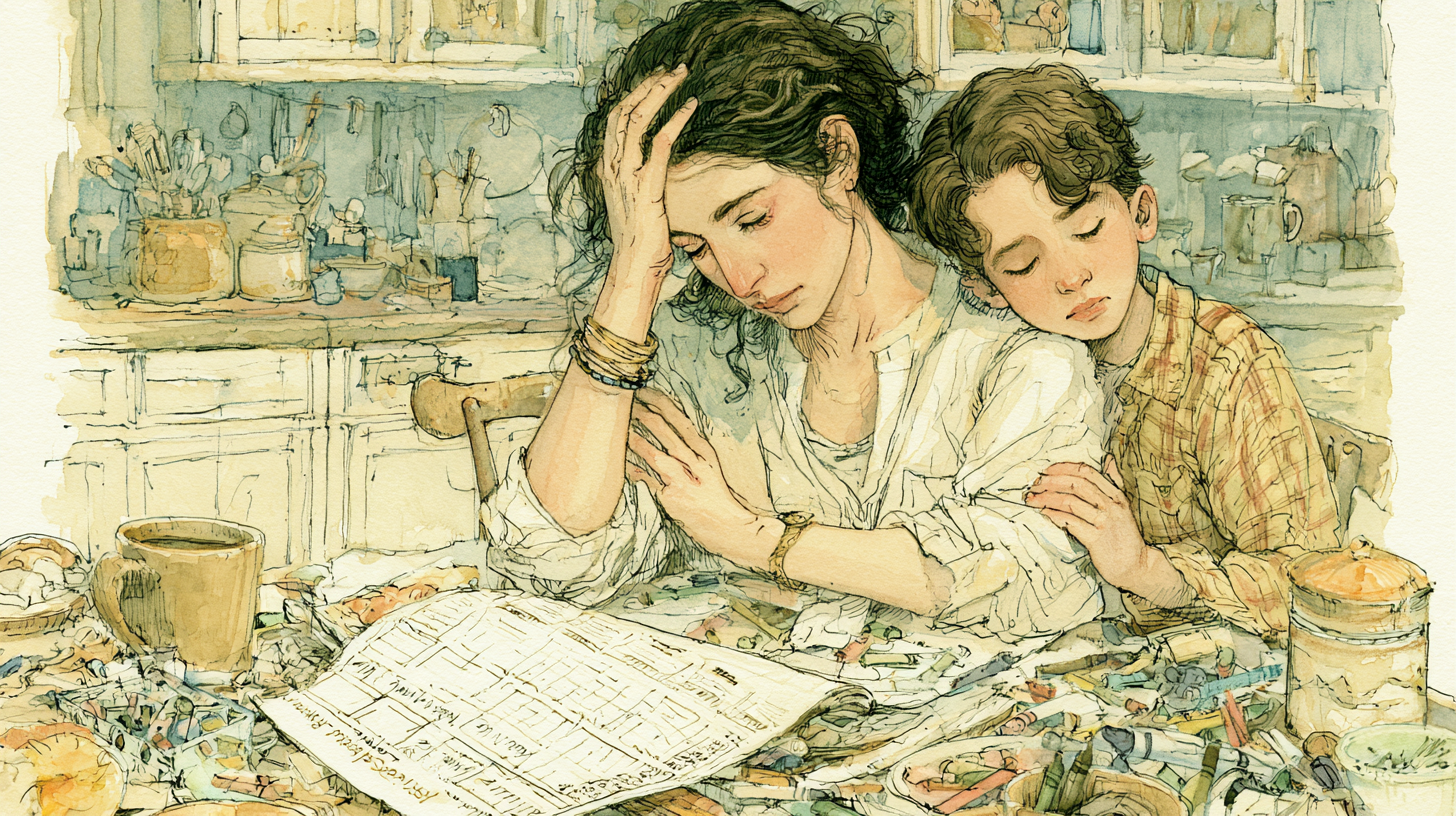
You started strong. There was a plan, possibly a laminated one. Six weeks later the plan is somewhere under a pile, you have no idea what you covered last Thursday, and you are lying awake wondering whether you have quietly ruined your child's education.
Almost every conversation about homeschooling assumes the difficulty is the child. For a large number of families it is not. It is that running a school day requires precisely the skills that cost the parent the most, and nobody says so out loud.
What homeschooling actually asks of you
Look at what the job is made of. Planning ahead. Sequencing. Tracking progress across weeks. Starting something on time when nothing external forces it. Transitioning between activities. Sustaining attention on things that do not interest you. Remembering what you decided a month ago.
That is a list of executive functions. If yours are unreliable, and they may be for reasons you have known about for years or reasons you have never named, then the difficulty you are having is structural rather than a matter of trying harder.
It also explains the specific shape of the problem. Not that you cannot teach, since the teaching is often the easy part and frequently brilliant. It is the administration of the thing that collapses.
Build the structure to hold you
Most homeschool advice is about scaffolding the child. If you are the bottleneck, scaffold yourself first.
One fixed start time. Not a schedule. A single anchor. Everything else can float, but the day starting at the same time removes the daily decision about when to begin, and that decision is where a lot of days are lost.
The plan lives where you both see it. Not in your head, not in an app you will stop opening. A whiteboard on the wall, a list on the fridge. External and visible, because internal and remembered is the thing that fails.
Short blocks with movement between them. Better for the child, and essential for you, since a long block requires you to sustain attention on one thing for an hour and that is the thing you cannot reliably do.
Same order every day, not same times. Sequence is much easier to hold than a timetable, and it gives the day a shape without requiring clock management.
Decide once, not daily. Pick the curriculum, pick the sequence, and stop revisiting. Reopening the decision every few weeks feels like diligence and is usually avoidance with a respectable coat on.
The two traps
The elaborate system. Building a beautiful planner is enormously satisfying and it is the same impulse that produced the last four systems. Elaborate systems fail because maintaining them is another executive function task. Aim for something so simple it survives a bad week, because bad weeks are what it has to survive.
The rebuild. When it falls apart, the instinct is to start over with a new approach. What works better is picking it back up mid week with the thing you already had. Nothing needs to be re-founded on a Monday.

There's a story for this exact struggle
Until I Don't
Rosie shines at dance, at school, with neighbors. At home, the smallest thing can tip her over. One quiet hallway moment helps her family finally find language for the part of her nobody else sees.
Free to read. You'll also get five free articles a week. Unsubscribe anytime.
The guilt is the bigger problem
Almost every parent in this position is carrying two beliefs at once: that they are failing their child, and that they cannot say so because they chose this.
Worth naming a few things.
Your child is getting one to one attention from someone who knows them, which is an extraordinary ratio. A patchy homeschool with that ratio still delivers a great deal of teaching time compared to a classroom of thirty.
A week you consider lost was almost never lost. Reading, conversation, cooking, being outside, and answering questions all count, and they are frequently the parts that matter most at the ages when parents panic hardest.
And the comparison in your head is not real. You are comparing your actual Tuesday to somebody else's photograph.
Before you go, grab the free guide
The 3 body-state triggers under most meltdowns, a script for the 30 seconds before it tips over, and a reset for after. Free.

You'll get the guide instantly, plus five free articles in your inbox every week. Real challenges (meltdowns, school mornings, picky eating, big feelings) and how to actually handle them. Unsubscribe anytime.
Your own diagnosis, if it applies
Many parents work out something about themselves during their child's assessment, and then do nothing with it because the child is the priority.
If that is you, treating your own attention or executive function is not self indulgence in this context, it is a direct intervention in your child's education, since you are the school. A medication conversation, a coach, or simply understanding the mechanism will do more for the homeschool than another curriculum will.
The other thing worth knowing is that two similar brains in one house all day means the input never drops. Protecting your own capacity, with a genuine block of solitude in the day and whatever reduces sensory load, is part of the work rather than a reward for finishing it.
What to keep when everything else goes
On the weeks it falls apart, hold three things and let the rest go.
Read aloud. Talk with them. Get outside.
If the reading aloud is the part that keeps slipping because choosing something is its own decision, the story library is built for that. Short, already chosen, and each one lands on something your child is likely dealing with anyway, so a bad week still does real work.
A term of only that would not damage a child. Believing you are failing them, and letting them watch you believe it, does considerably more harm than a missed math book.
If the difficulty sits with your child as well as the day itself, starting to homeschool a child with ADHD and anxiety covers deschooling and pacing. And if you recognized yourself during their assessment, being diagnosed alongside your child is about what to do with that.
Which days worked, what time you actually started, and what you were carrying that week: logged in LightMap, that turns a vague sense of failing into a pattern you can change.
Sources: Barkley on executive function and ADHD; peer-reviewed research on parental executive function and household routine consistency (PMC); research on adult ADHD and difficulties with task initiation, planning, and time management (PMC).
For education and reflection, not medical advice. Our terms
See what's underneath
Bring the school evidence, not impressions
LightMap turns scattered hard days into a pattern you can see. Start by logging one moment tonight.
Log today's hard moment, no account needed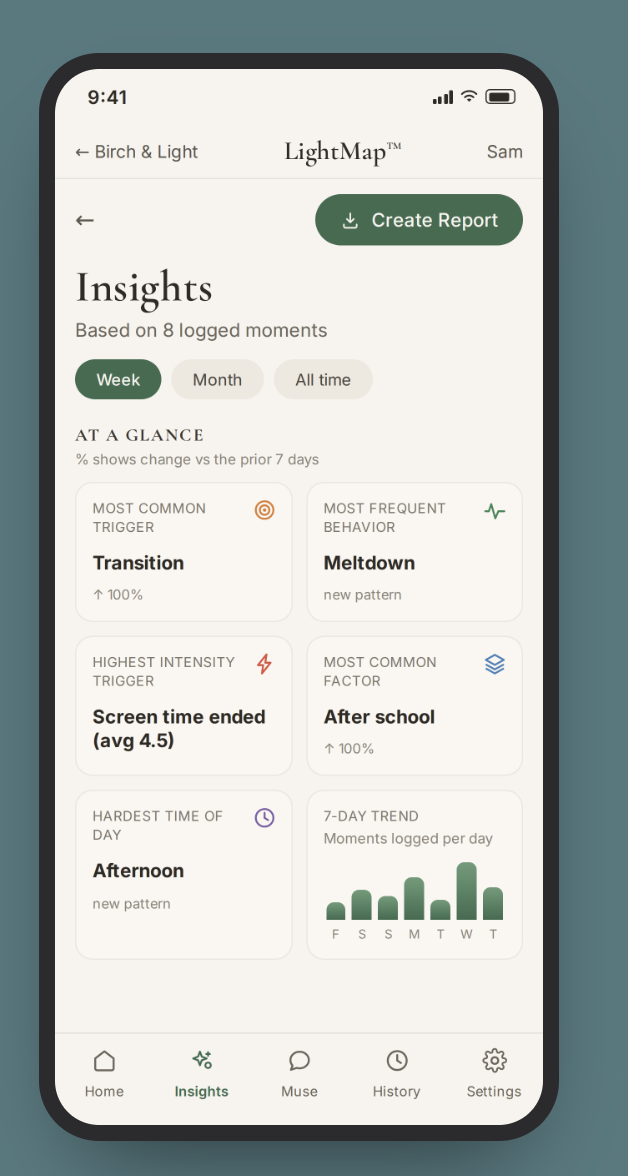

Part of the award-winning Birch & Light Method, honored with the Mom's Choice Gold Award for excellence in family resources.
A story to read together
Sometimes the easiest way in is a story you read side by side.
- Until I Don't
Rosie shines at dance, at school, with neighbors. At home, the smallest thing can tip her over. One quiet hallway moment helps her family finally find language for the part of her nobody else sees.
Read the story  Theo's Invisible Backpack
Theo carries every hurtful word as a stone in an invisible backpack — until the day his mama really sees how heavy it has become, and they begin sorting the stones together.
Read the story
Researched and drafted with AI assistance, reviewed before publication. Editorial standards