
The IEP was written for something else. Speech, or reading, or occupational therapy. It is doing its job in that lane. Meanwhile the behavior is getting worse, the teacher is meeting you at pickup with a new incident three days running, and she keeps asking you what she should do about it.
You are in a different position from a parent whose child has no plan at all, and the difference works in your favor. The file is already open. What you need is to get a question added to it, and there is a specific way to do that.
This is general information about the federal special education rules in the United States, not legal advice, and it reflects our best reading at the time of writing. States and districts add their own requirements, and a question about your child specifically belongs with someone who can read the file.
Start with what the school is and is not required to do
Parents are often told to "ask for an FBA," a functional behavioral assessment, as though requesting one obliges the school to produce it. That is not how the regulation reads, and walking in believing it tends to end badly.
Under IDEA, an FBA is required in specific disciplinary situations: when a child is removed for disciplinary reasons and the behavior is determined to be a manifestation of the disability, the team must conduct one unless it already has, and must implement a behavior intervention plan. The same duty attaches during certain removals. Outside those situations, the regulations do not oblige a district to run an FBA on request.
There is a general duty that applies in your situation, and it is worth quoting to the team because it is often forgotten. Where a child's behavior impedes that child's learning or the learning of others, the IEP team must consider the use of positive behavioral interventions and supports, and other strategies, to address the behavior. Must consider. The team cannot treat behavior as somebody else's department once it is interfering with school.
The request that actually has teeth
The lever you have is the reevaluation. The regulation states that a public agency must ensure a reevaluation is conducted if the child's parent or teacher requests one.
Two limits sit alongside it. A reevaluation may not happen more than once a year unless you and the district agree otherwise, and it must happen at least every three years unless you both agree it is unnecessary. So if your child was fully evaluated four months ago, this route is narrower.
Being honest about what "must" means here: a district that declines your request is obliged to give you prior written notice explaining why it refused and what information it relied on, and your recourse from there runs through mediation, a state complaint or due process. The request does not conjure an assessment by itself. What it does is force a written, dated decision from people who would otherwise keep saying they will look into it.
How to word it
Email, not a conversation at pickup. Short. The ingredients that matter:
- State that you are requesting a reevaluation under IDEA, naming behavior as the area you want assessed
- Say what changed, with dates. Three incidents this week beats "things have gotten bad"
- Ask specifically for a functional behavioral assessment as part of it
- Ask for the team to be reconvened to review the current IEP in light of the behavior
- Ask for a written response, and note that you understand a refusal comes with prior written notice
That last line is not a threat and does not need to read as one. It tells an administrator that you know the process, which tends to shorten it.
While you're here, take the guide
What's Underneath is free: the three body-state triggers under most meltdowns, what to say in the minute before it tips over, and how to reset afterward.

You'll get the guide instantly, plus five free articles in your inbox every week. Real challenges (meltdowns, school mornings, picky eating, big feelings) and how to actually handle them. Unsubscribe anytime.
What you are actually asking the assessment to find
An FBA is not a tally of how many times your child threw something. It looks at what happens immediately before a behavior and what the behavior achieves, so the plan that follows addresses the driver rather than the outburst.
When you ask for one, ask about the conditions rather than the counts:
- What is happening in the five minutes before. The transition, the demand, the noise, the particular peer
- Where. Behavior logs built only from classroom incidents routinely miss the bus, the hallway, lunch and recess, which is where supervision thins out
- When. A pattern that clusters at the same time each day is telling you something different from one scattered across the week
- What follows. Whether the behavior reliably ends a demand, or produces attention, or gets the child out of the room
If your child also has a communication or learning goal on the existing IEP, say so in the request. Behavior that spikes around the exact skill a child struggles with is a common pattern, and a team looking at the two separately can miss it.
Who does the assessment
Parents often assume a board certified behavior analyst has to conduct the FBA. Federal guidance says otherwise: there is no Part B requirement that a BCBA conduct one unless state law imposes it. In practice a school psychologist or a district behavior specialist frequently does.
That is worth knowing before the meeting, because "we do not have a BCBA" is sometimes offered as a reason nothing can happen, and federally it is not one. Your state may set its own rule, so it is reasonable to ask what your state requires.
The discipline route, and why it matters even if you are nowhere near it
If removals start accumulating, a different set of protections switches on. Once a disciplinary removal amounts to a change of placement, the team must decide whether the behavior was a manifestation of the disability, and if it was, the FBA requirement becomes mandatory rather than discretionary.
You do not want to get there. The reason to know it exists is that the same behavior, addressed six weeks earlier through a reevaluation request, is a far better conversation than the one that happens after a suspension.
If the answer is no
Get the refusal in writing, which you are entitled to. Read what it says the district relied on, because that is frequently where the disagreement actually lives: they looked at grades, you are looking at a child who cannot get through a morning.
From there the options are the district's own dispute process, mediation, a state complaint to your department of education, or a due process complaint. Each has its own deadlines, and state complaint timelines and due process timelines are not the same, so check your state's procedural safeguards notice, which the district has to give you.
None of that is where most of these end up. Most end with a meeting that happens because someone had to put a decision in writing, which is the whole reason to start with an email rather than another conversation in the parking lot.
Sources, tied to the claims they support. That an FBA is required when a disciplinary removal constitutes a change of placement and the behavior is determined to be a manifestation of the child's disability, that the team must then implement or review a behavior intervention plan, and that an FBA must be provided as appropriate during certain removals: 34 CFR 300.530(f)(1)(i) and 34 CFR 300.530(d)(1)(ii), confirmed via eCFR and the U.S. Department of Education's IDEA regulations site. That the regulations otherwise require behavior to be addressed with an FBA only in those disciplinary situations, and that where a child's behavior impedes his or her learning or that of others the IEP team must consider positive behavioral interventions and supports and other strategies: 34 CFR 300.324(a)(2), as quoted in the Arizona Department of Education's FAQ on Functional Behavioral Assessment and Behavioral Intervention Plans, which also cites the Department's 2006 analysis of comments at 71 Fed. Reg. 46721. That there is no Part B requirement for a Board Certified Behavior Analyst to conduct an FBA unless state law imposes one: Letter to Janssen, 51 IDELR 253 (OSERS 2008), quoted in the same FAQ. That a reevaluation must be conducted if the child's parent or teacher requests one, that it may occur not more than once a year unless the parent and public agency agree otherwise, and that it must occur at least once every three years unless both agree it is unnecessary: 34 CFR 300.303(a)(2) and 300.303(b), confirmed via eCFR and Cornell Legal Information Institute. Prior written notice requirements: 34 CFR 300.503.
For education and reflection, not medical advice. Our terms
See what's underneath
Walk into the meeting with something on paper
LightMap turns what you saw at home into the pattern the team keeps asking you to describe.
Start with 3 moments Not sure where to start? Ask me.Message Tara on WhatsApp. It really is me, I read everything and will personally respond.Click here to message Tara →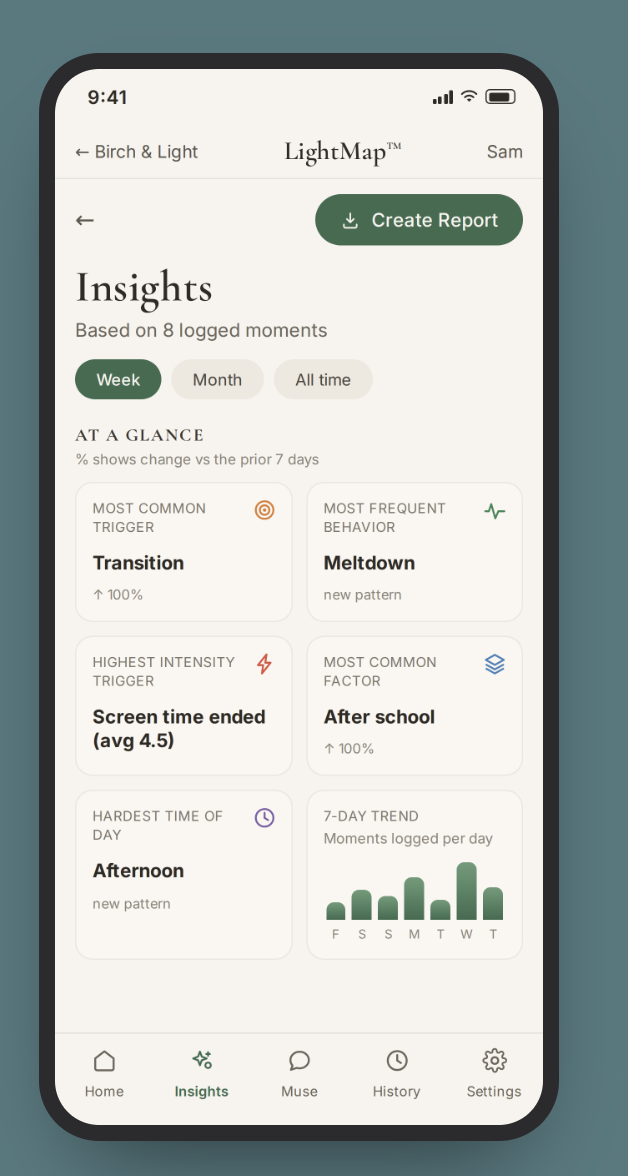

Part of the award-winning Birch & Light Method, honored with the Mom's Choice Gold Award for excellence in family resources.
Researched and drafted with AI assistance, reviewed before publication. Editorial standards