
He ate a full dinner twenty minutes ago. He is standing in front of the open fridge asking what there is to eat, and he is not being cheeky, he means it.
You have started counting snacks. You have started dreading the question. And somewhere underneath is a worry you have not said out loud, about whether you are handling this wrong in a way that will matter later.
Start here: this is a medical question first
Persistent hunger that food does not settle is worth a GP or pediatrician appointment, not because something is necessarily wrong, but because a handful of real medical causes are easy to check and worth ruling out. Ask for that appointment before you redesign your meals around it.
It is also the route to a pediatric dietitian, who can give you the specific guidance that nobody on the internet can give you safely, because portions depend on growth, activity, and what is actually happening in a particular child's body.
Everything below is context to bring to that conversation, not a substitute for it.
Interoception, and why the signal may not be arriving
Interoception is the sense that reports what is happening inside the body: hunger, fullness, thirst, temperature, needing the bathroom, the early edge of anger.
In many neurodivergent children that channel runs unreliably. The signals arrive faint, late, or not at all, and fullness is one of the most commonly affected. Which produces two opposite-looking patterns from the same underlying difficulty:
- Children who cannot tell they are hungry, forget to eat, and run on empty until they fall apart
- Children who cannot tell they are full, and so keep looking for food long after they have eaten enough
The same child sometimes does both, on different days. If your child genuinely reports being hungry after a full meal, they are not being greedy and they are not lying to you. The stop signal is not arriving clearly.
When food is not about hunger
Eating provides real sensory input: chewing, crunch, temperature, taste, the deep pressure of a full stomach. For a child who seeks input, food is one of the most available regulation tools in the house, and it works.
Which is why food seeking so often clusters at particular times rather than spreading evenly through the day. Watch for whether it spikes when they are bored and under-stimulated, in the wind-down before bed, in the after-school window when everything held together at school comes apart, or when the stimulant medication is wearing off and appetite comes roaring back all at once.
Those spikes are worth noticing, because they respond to different things than hunger does.
Why restriction tends to backfire
The instinct to cap snacks is completely reasonable, and it usually produces more preoccupation with food rather than less.
Restriction increases the salience of the restricted thing. A child who knows there are two snacks available spends the day thinking about snacks, negotiating for snacks, and eating quickly when the opportunity comes. For an impulsive child, adding scarcity to something already hard to regulate is a difficult combination.
The research on children and food restriction is fairly consistent on this: controlling approaches are associated with more eating in the absence of hunger, not less. That does not mean the answer is no structure at all, it means the structure works better when it is about predictability than about limits.
While you're here, take the guide
What's Underneath is free: the three body-state triggers under most meltdowns, what to say in the minute before it tips over, and how to reset afterward.

You'll get the guide instantly, plus five free articles in your inbox every week. Real challenges (meltdowns, school mornings, picky eating, big feelings) and how to actually handle them. Unsubscribe anytime.
What tends to help
Predictable timing. Eating opportunities at reliable points in the day, so a child never has to wonder whether food is available or negotiate for the next one. Predictability lowers the preoccupation that scarcity creates.
Meals that stay with them. Protein, fat, and fibre slow the return of hunger considerably more than fast carbohydrates do. Your dietitian can be specific about this in a way I should not be.
A pause between the plate and the question. Fullness signals lag behind eating, and for a child with weak interoception the lag is longer. A drink of water and ten minutes of something absorbing before the second helping is not a delaying tactic, it is giving the signal time to arrive.
Building interoception directly. This is teachable, slowly. Body-check questions asked with genuine curiosity rather than as a test: is your tummy quiet or loud, does it feel like a little hungry or a big hungry, what does full feel like in your body. The aim is not to catch them out, it is to build vocabulary for something they currently cannot name.
Offer a different input when the pattern is regulation. If food seeking clusters at the same time every day, and that time is boredom or wind-down rather than a real gap since eating, something else with a similar sensory profile sometimes does the job: something cold to drink through a straw, something crunchy, movement, deep pressure.
Separate the medication conversation. If your child is on stimulant medication, appetite suppression during the day followed by a large rebound in the evening is a known and common pattern, and it is a prescriber conversation rather than a discipline one.
The thing to protect above everything
Keep the conversation about energy, growth, and feeling good in your body. Never about size, never about being good or bad with food.
Children absorb the framing adults use about their bodies remarkably young and hold onto it remarkably long, and a child who learns that wanting food is something to feel ashamed of carries that into adolescence. The interoception difficulty is real and manageable. The shame is the part that does lasting damage.
If this sits alongside sensory sensitivity in the other direction, ARFID covers the mirror-image problem, food hoarding and night eating in ADHD covers the medication rebound pattern in more depth, and sensory overload covers the regulation piece.
Note the clock, not the quantity. What time the asking starts, what happened in the hour before, whether it lands after school or before bed or when medication wears off. Logged in LightMap for a couple of weeks, the shape of it usually becomes obvious, and it is also the single most useful thing to hand a dietitian or a doctor.
He is not eating to be difficult, and you are not failing by finding this hard. A signal that should be arriving is not arriving, and that is a thing with explanations and with help.
Sources: peer-reviewed research on interoception and interoceptive accuracy in autistic and ADHD populations (PMC); Mahler and colleagues on interoception-focused intervention approaches; research on eating in the absence of hunger and its relationship to parental restriction (Birch et al.; PMC; American Journal of Clinical Nutrition); research on sensory seeking and oral sensory input in children (American Journal of Occupational Therapy; PMC); FDA prescribing information for stimulant medications on appetite suppression and rebound; American Academy of Pediatrics guidance on growth monitoring and on avoiding weight-focused language with children.
For education and reflection, not medical advice. Our terms
See what's underneath
Find the input before it becomes a meltdown
LightMap reads your hard days together and gives you answers. Start with one moment today.
Start with 3 moments Not sure where to start? Ask me.Message Tara on WhatsApp. It really is me, I read everything and will personally respond.Click here to message Tara →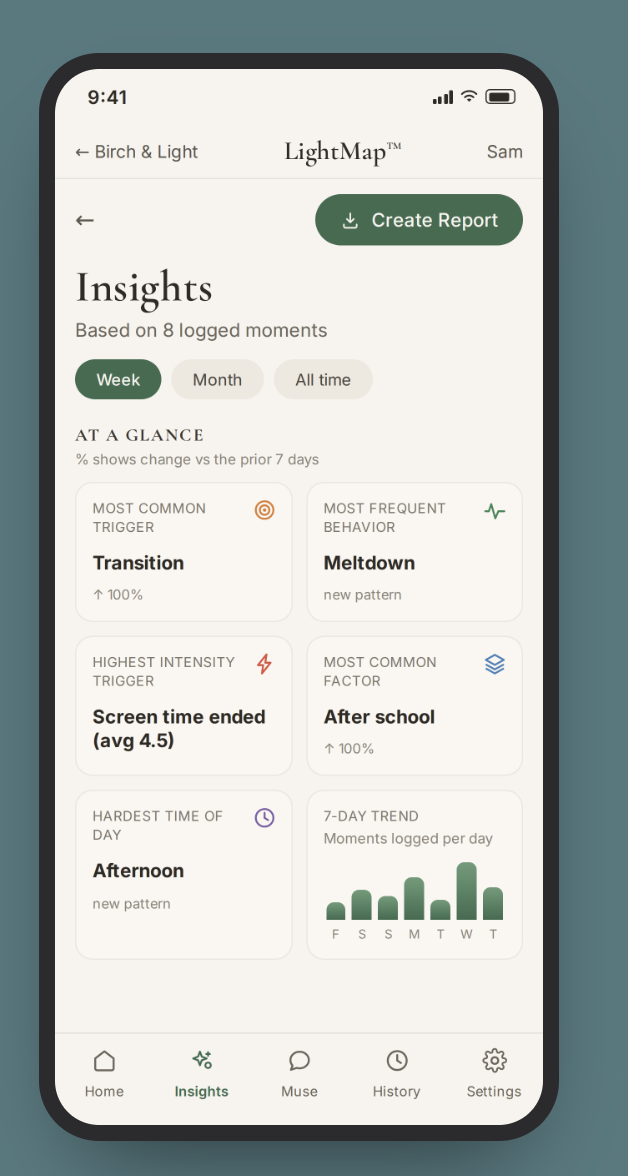

Part of the award-winning Birch & Light Method, honored with the Mom's Choice Gold Award for excellence in family resources.
A story to read together
Sometimes the easiest way in is a story you read side by side.
 Taste Bud 17
Taste Bud 17 feels everything more — and learns that big sensory feelings deserve the same care as everyone else’s.
Read the story The Tower That Looked Fine
A tower in a quiet clearing tries to stay steady through every small thing nobody else seems to notice — until one tiny breath of wind causes her to fall, and a gentle hand begins to gather the blocks back.
Read the story
If today was one of those days
A few more from the library, free to read.
Researched and drafted with AI assistance, reviewed before publication. Editorial standards