
ARFID is not picky eating when the list of foods a child accepts keeps shrinking and the restriction starts to affect growth, nutrition, or daily life, without any concern about body shape. Sensory aversion, low interest in food, and fear of choking or vomiting drive it, and pressure at the table makes it worse.
Everyone tells you she will grow out of it. Everyone tells you she will eat when she is hungry enough.
She is eight. The list of foods she will eat has been getting shorter, not longer, for three years. And she has now gone a whole day without eating rather than accept something that was not on it.
What ARFID is
Avoidant Restrictive Food Intake Disorder is a recognized eating disorder in the DSM-5-TR. It describes eating that is restricted enough to interfere with nutrition, growth, or daily life, and it is defined by what it is not driven by: body image. A child with ARFID is not avoiding food to change their shape or weight. That distinction is the whole point of the diagnosis, and it is why standard eating disorder treatment aimed at body image is the wrong fit.
It occurs at much higher rates in autistic children and in children with ADHD, and it frequently sits alongside sensory processing differences and anxiety.
The three things that drive it
Most children with ARFID have one dominant driver, and many have more than one.
Sensory. The food is genuinely intolerable. Texture usually first, then smell, then appearance. This is not a preference expressed strongly, it is closer to how most adults respond to a food that has gone off. Mixed textures are often the hardest, which is why a child may eat plain pasta and plain sauce and refuse the two combined.
Low interest. Little appetite, no hunger signal, food is boring rather than frightening. These children forget to eat, fill up almost immediately, and eating feels like a chore imposed from outside.
Fear of consequences. Usually traceable to an event: choking, a bad vomiting episode, a painful swallow. After that, whole categories get ruled out, and the fear often generalizes well beyond the original food.
Is it ARFID or picky eating?
Picky eating is common, waxes and wanes, and the range of accepted foods slowly widens with age. ARFID tends to go the other direction: foods drop off the list and are not replaced, sometimes permanently after a single bad experience.
Other markers that separate it: real distress rather than resistance, rigidity about brand, packaging, and preparation, refusal to eat at other people's houses or at school, physical consequences such as faltering growth or nutritional problems, and a social life that is starting to shrink around it.
When should you call the doctor right away?
Talk to a doctor without waiting if there is weight loss or a flattening growth curve, ongoing fatigue, changes in hair, skin, or teeth, or if a child is running on liquid supplements. Nutritional deficiencies from long-term restriction do happen in children and some of them cause lasting harm, so this is a medical question and not only a behavioral one.
While you're here, take the guide
What's Underneath is free: the three body-state triggers under most meltdowns, what to say in the minute before it tips over, and how to reset afterward.

You'll get the guide instantly, plus five free articles in your inbox every week. Real challenges (meltdowns, school mornings, picky eating, big feelings) and how to actually handle them. Unsubscribe anytime.
What does not work
The advice families receive most often is the advice most likely to make this worse.
Waiting them out. The premise is that hunger will win. In ARFID it frequently does not, and the attempt teaches a child that mealtimes are a contest.
The one bite rule. Requiring a taste turns the table into a demand, and for a sensory-driven child it can produce gagging or vomiting, which then adds a fear driver on top of the sensory one.
Hiding foods. Blending vegetables into a sauce works exactly once, and the cost is that a safe food becomes unsafe and trust in what you serve is damaged.
Rewards and consequences. They add pressure to something already loaded, and pressure is the reliable predictor of a shrinking food list.
What actually helps
Take the pressure out first. Serving a safe food alongside everything else, with no expectation attached to the rest, is not giving up. It is what makes exposure possible later.
Then build outward in very small steps from foods she already accepts, changing one property at a time: same food different brand, then same food slightly different shape, then a closely related food. This is usually called food chaining, and it works because the steps are small enough not to trigger the alarm.
Let food be handled without being eaten. Touching, smelling, playing, serving, and cooking are all real progress, and for many children the route to eating a food runs through weeks of contact with it first.
Get a team where you can. A feeding-experienced speech and language therapist or occupational therapist, a registered dietitian, and a pediatrician who is tracking growth. Ask specifically whether they have worked with ARFID, because generic eating disorder services and generic fussy eating advice are both poor fits.
If sensory drivers dominate, this piece on sensory eating covers the texture side, and sensory overload covers why capacity at the table drops as the day goes on.
Track the list rather than the meals: which foods are in, which dropped and when, what happened just before one disappeared. In LightMap, that history is what tells a clinician whether this is sensory, low interest, fear, or some of each, which is what determines the treatment.
She is not being difficult, and you did not cause this by giving in. The list got short because something about eating became genuinely hard, and the work is finding out which something.
Sources: DSM-5-TR criteria for avoidant restrictive food intake disorder; peer-reviewed research on ARFID presentations and driver subtypes (Thomas and Eddy; PMC; International Journal of Eating Disorders); research on the elevated prevalence of ARFID in autistic children and children with ADHD (PMC); Ellyn Satter Institute on feeding roles and the limits of responsibility-based approaches in clinical feeding disorders; American Academy of Pediatrics guidance on growth monitoring and nutritional deficiency in restrictive eating; research on food chaining and systematic desensitization in pediatric feeding intervention (PMC).
Primary sources: Thomas JJ and colleagues, "Avoidant/restrictive food intake disorder: a three-dimensional model of neurobiology with implications for etiology and treatment," Current Psychiatry Reports, 2017, 19. Bourne L, Bryant-Waugh R, Cook J, Mandy W, "Avoidant/restrictive food intake disorder: A systematic scoping review of the current literature," Psychiatry Research, 2020, 288, 112961.
For education and reflection, not medical advice. Our terms
See what's underneath
Understand the why, not just the what
LightMap reads your hard days together and gives you answers. Start with one moment today.
Start with 3 moments Not sure where to start? Ask me.Message Tara on WhatsApp. It really is me, I read everything and will personally respond.Click here to message Tara →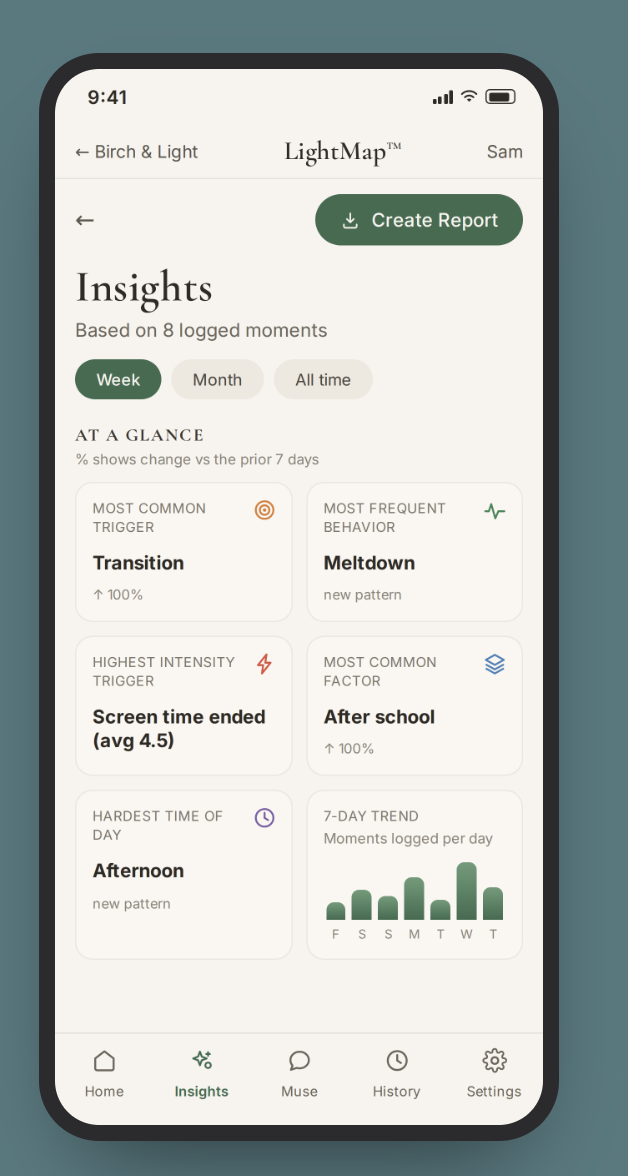

Part of the award-winning Birch & Light Method, honored with the Mom's Choice Gold Award for excellence in family resources.
A story to read together
Sometimes the easiest way in is a story you read side by side.
 Taste Bud 17
Taste Bud 17 feels everything more — and learns that big sensory feelings deserve the same care as everyone else’s.
Read the story Otto Filled Everything
Otto can't stop filling things with water. His family doesn't understand — until Grandma Willow helps them listen to what his body is actually asking for.
Read the story
If today was one of those days
A few more from the library, free to read.
Researched and drafted with AI assistance, reviewed before publication. Editorial standards