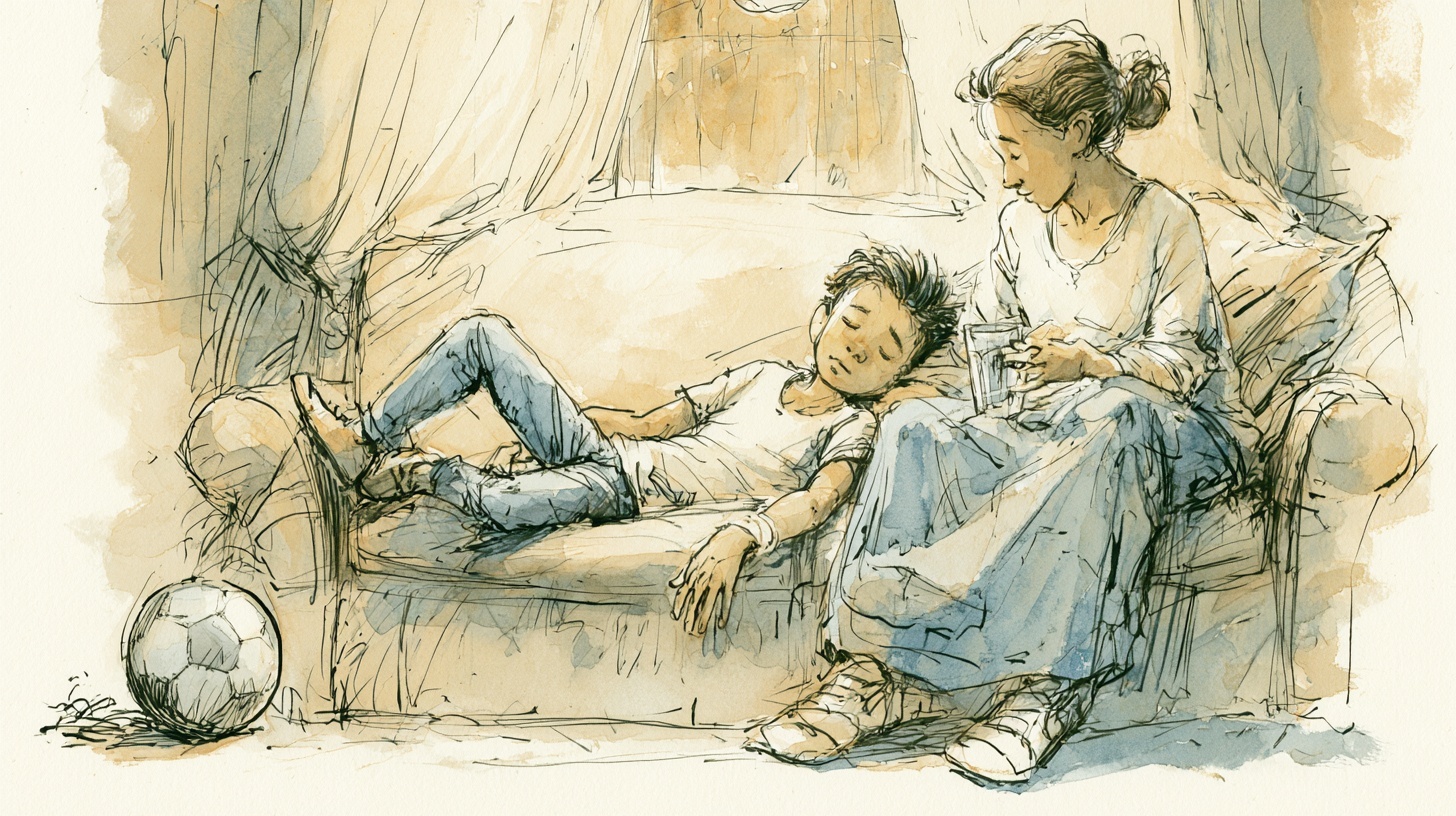
He got knocked over at football in October. He was fine. He got up, he finished the game, nobody even filled in a form.
Since then he has been a slightly different child. Shorter fuse, tired all the time, homework taking twice as long, headaches he mentions and then does not. Someone has suggested ADHD. Someone else has suggested he is being difficult about school.
Nobody has connected it to October.
Why this gets missed
A concussion is a mild traumatic brain injury. It does not require losing consciousness, and most children who have one do not. It does not require a dramatic impact. And crucially, the symptoms that persist are usually not the ones people associate with head injury.
What families report weeks later is behavioral and cognitive: irritability, emotional swings, slowed thinking, poor attention, memory lapses, light and noise sensitivity, sleep that has changed, and fatigue that is out of proportion to everything.
That list is close to identical to ADHD, to anxiety, and to a child who has decided to stop trying at school. Which is exactly what gets diagnosed when nobody asks about the head injury.
Signs that need urgent medical attention
In the hours and days after any head injury, get emergency care for a headache that keeps worsening, repeated vomiting, a seizure, unequal pupils, weakness or numbness, slurred speech, unusual drowsiness or difficulty waking, or increasing confusion. Any loss of consciousness should be assessed.
Beyond that window, see a doctor if symptoms are not steadily improving over a couple of weeks, or if they are getting worse rather than better.
What recovery actually looks like
Most children recover within about a month. A meaningful minority take longer, and that longer group is where families end up feeling gaslit, because by then everyone else has forgotten there was an injury.
Two things predict a longer course: a previous concussion, and pre-existing ADHD, anxiety, depression, migraine, or learning difficulty. So the children in your audience are disproportionately the ones who take longer, and disproportionately the ones whose new symptoms get attributed to their existing diagnosis.
The advice on rest has changed, and it is worth knowing. A short period of relative rest in the first day or two is standard, but prolonged strict rest in a dark room is no longer recommended and is associated with slower recovery. Current guidance favors a gradual, symptom-guided return to light activity.
Return to learn comes before return to play, and returning to sport requires clearance, because a second impact before recovery is complete is the scenario everyone is trying to avoid.
While you're here, take the guide
What's Underneath is free: the three body-state triggers under most meltdowns, what to say in the minute before it tips over, and how to reset afterward.

You'll get the guide instantly, plus five free articles in your inbox every week. Real challenges (meltdowns, school mornings, picky eating, big feelings) and how to actually handle them. Unsubscribe anytime.
The school piece almost nobody knows
In the American system, traumatic brain injury is its own eligibility category under IDEA. It sits alongside specific learning disability and other health impairment, and it is separate from both. Most families have never heard this, and a fair number of school staff have not either.
That matters because a child with lingering post-concussion difficulty does not need to be squeezed into an ADHD or anxiety framing to get support. Ask about it by name.
Supports worth requesting during recovery: reduced workload rather than the same load with extra time, breaks in a quiet low-light space, screen limits, no timed tests, copies of notes, postponed rather than accumulated missed work, and a staged return to full days.
Say the word concussion in writing to the school, with the date of injury. A behavior change with an unexplained start date gets managed. A behavior change with a documented head injury gets accommodated.
If it has been months
Persistent symptoms are treatable, and the route is usually a pediatrician who takes it seriously, and where needed a referral for neuropsychological assessment, vestibular or vision therapy, or a specialist concussion clinic. Headache, dizziness, and visual symptoms each have their own treatment pathways.
Bring the timeline. What he was like before, the date of the injury, and what changed after, is the single most persuasive thing you can put in front of a clinician.
If the picture is being attributed to attention rather than injury, how ADHD is properly assessed is worth reading, because a good evaluation should establish that difficulties predate any injury, and why a child is fine one minute and explosive the next covers the fatigue-driven fuse.
The before-and-after is the case. Log what changed and when, how long homework takes now, when the headaches come, what the last hour of the school day looks like, in LightMap. A dated record starting at the injury is far more persuasive than a parent trying to recall six months backwards.
Behavior that changes suddenly usually has a cause. Sometimes the cause was in October.
Sources: Centers for Disease Control and Prevention pediatric mild traumatic brain injury guideline; Amsterdam and Berlin international consensus statements on concussion in sport; Individuals with Disabilities Education Act eligibility category for traumatic brain injury; peer-reviewed research on persistent post-concussive symptoms and predictors of prolonged recovery in children, including prior concussion and pre-existing ADHD, anxiety, and migraine (JAMA Pediatrics; PMC); research on early gradual return to activity versus strict rest following concussion (PMC); return-to-learn and return-to-play protocol literature (PMC).
For education and reflection, not medical advice. Our terms
See what's underneath
Understand the why, not just the what
LightMap reads your hard days together and gives you answers. Start with one moment today.
Start with 3 moments Not sure where to start? Ask me.Message Tara on WhatsApp. It really is me, I read everything and will personally respond.Click here to message Tara →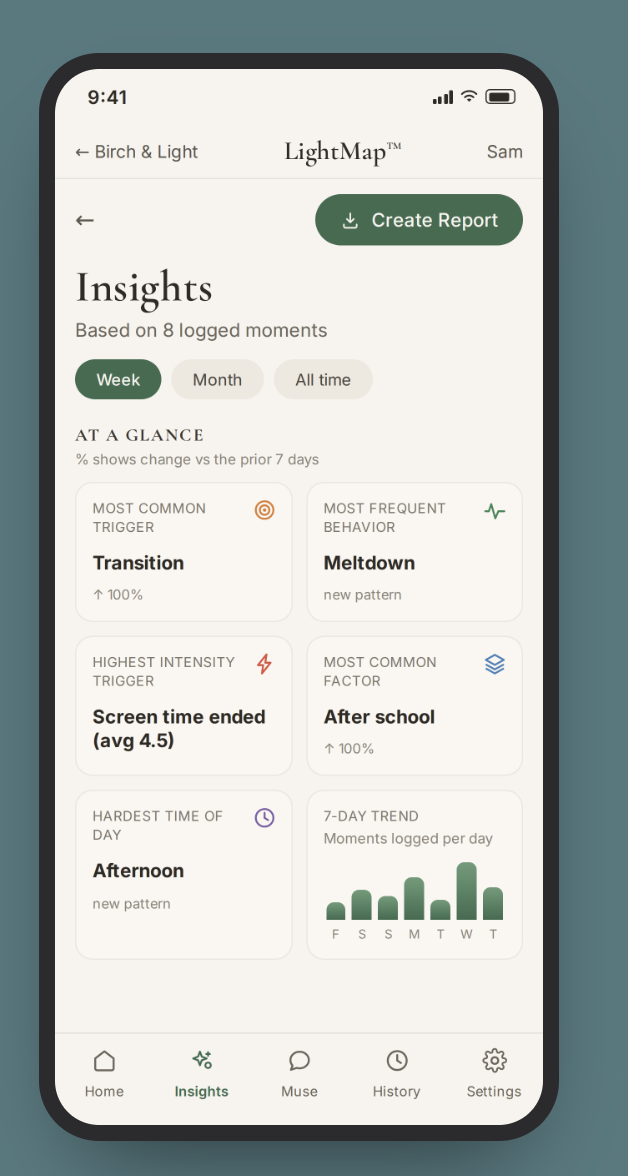

Part of the award-winning Birch & Light Method, honored with the Mom's Choice Gold Award for excellence in family resources.
A story to read together
Sometimes the easiest way in is a story you read side by side.
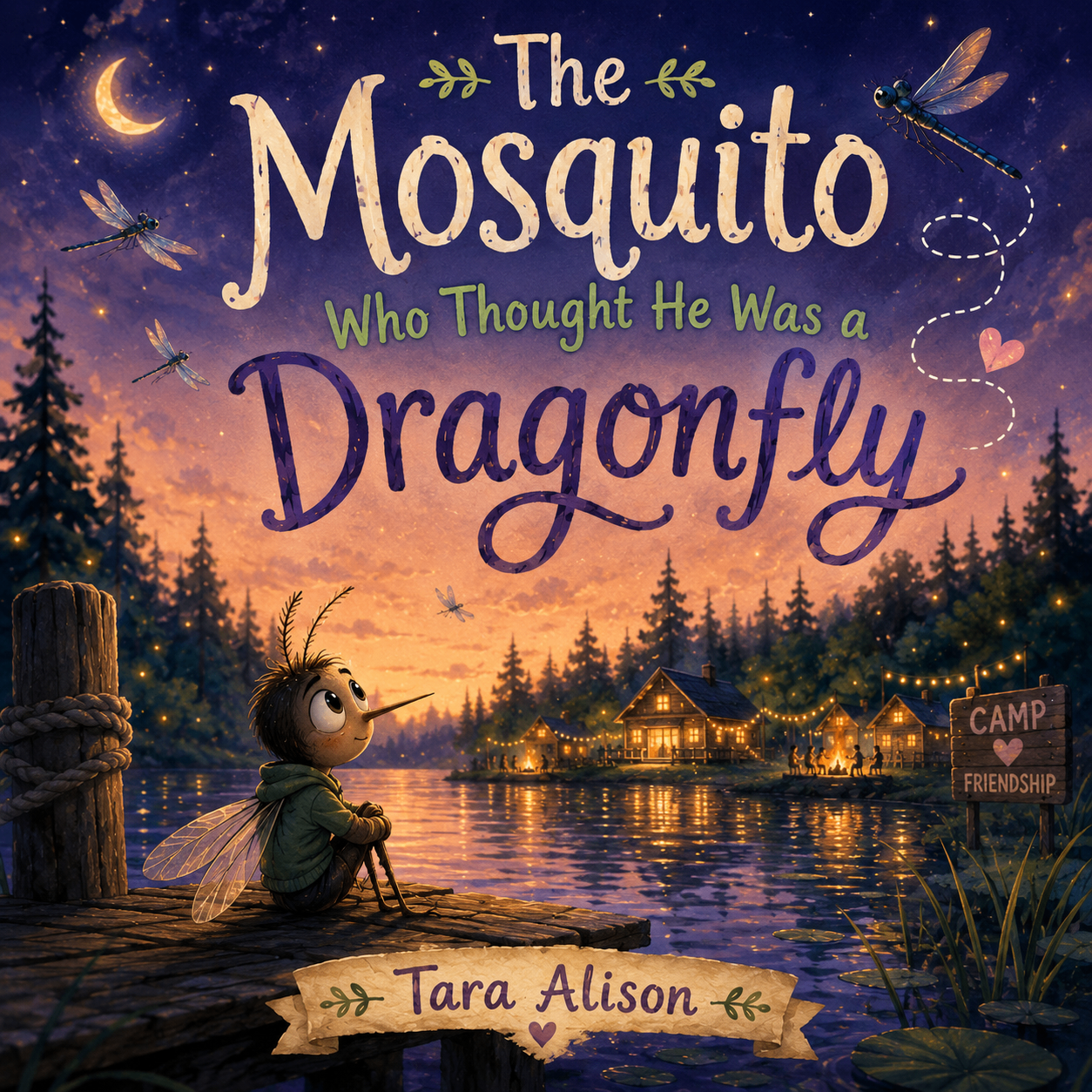 The Mosquito Who Thought He Was a Dragonfly
Raised by dragonflies after a summer storm, Miro learns one night that the world sometimes sees him differently than the family who loves him — and that being misunderstood isn’t the same as being bad.
Read the story Otto Filled Everything
Otto can't stop filling things with water. His family doesn't understand — until Grandma Willow helps them listen to what his body is actually asking for.
Read the story
If today was one of those days
A few more from the library, free to read.
Researched and drafted with AI assistance, reviewed before publication. Editorial standards