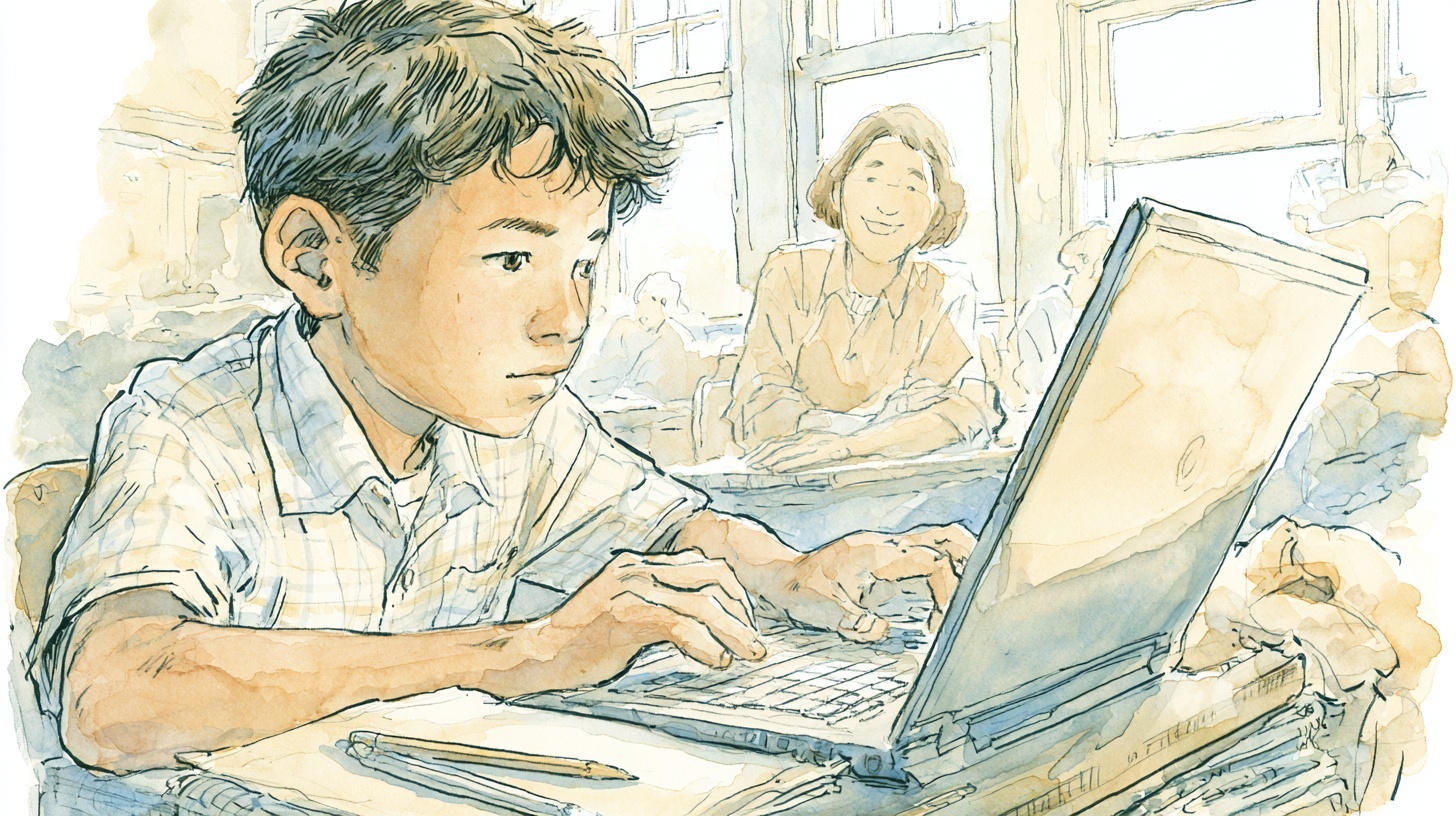
Ask him about the book and you get five minutes of detail, opinions, a theory about why the ending was wrong.
Ask him to write a paragraph about the book and you get one sentence, produced over forty minutes, with tears at the end of it.
Two different problems wearing one name
Dysgraphia is the common term, and it covers two things that often occur together but are not the same.
Transcription. The physical act. Letter formation, grip, speed, spacing, staying on the line. Handwriting that is slow, effortful, painful, or illegible even when the child is trying.
Composition. Getting ideas into written language. Organizing thoughts into sentences and sentences into order, spelling, punctuation, and holding an idea in mind long enough to write it down.
In the DSM-5-TR the relevant diagnosis is Specific Learning Disorder with impairment in written expression, covering spelling accuracy, grammar and punctuation accuracy, and clarity or organization of written expression. Where the difficulty is primarily motor, developmental coordination disorder may be the better fit, and an occupational therapy assessment is the right route.
What it looks like
- An enormous gap between what he can say and what he can write
- Writing that is slow enough that he never finishes, or so effortful that he stops caring what it says
- Awkward or white-knuckled pencil grip, hand pain or cramping, frequent breaks
- Inconsistent letter size, spacing, and case, sometimes within one word
- Mixing print and cursive, letters formed from odd starting points
- Spelling that varies for the same word within a page
- Avoidance out of proportion to everything else at school
The diagnostic tell is that mismatch between oral and written output. A child who cannot explain the idea has a comprehension problem. A child who explains it well and then writes three words has a transcription or composition problem.
Why it gets missed
Messy handwriting is treated as a character issue in a way no other academic difficulty is. Children get told to slow down, take more care, do it again neatly. And recopying is the standard consequence, which means the child does the hardest possible task twice as punishment for finding it hard.
It also hides behind ADHD. If a child already has an attention diagnosis, incomplete written work is attributed to that and the writing difficulty underneath never gets assessed on its own.
Getting it assessed
Two routes, often both. An occupational therapy evaluation for the motor and handwriting side, including handwriting speed and legibility measures rather than a general fine motor screen. A psychoeducational evaluation for written expression, spelling, and the composition side.
Ask specifically that written output be measured under timed conditions and compared with his oral output on the same task. That comparison is the whole diagnosis, and a report that only lists a written expression score misses it.
While you're here, take the guide
What's Underneath is free: the three body-state triggers under most meltdowns, what to say in the minute before it tips over, and how to reset afterward.
You'll get the guide instantly, plus five free articles in your inbox every week. Real challenges (meltdowns, school mornings, picky eating, big feelings) and how to actually handle them. Unsubscribe anytime.
What actually helps
Separate the ideas from the transcription. Let him talk the answer first, or record it, then transcribe. Graphic organizers, bullet points, and dictated first drafts remove the bottleneck without removing the thinking.
Move to keyboarding, deliberately and early. For many children this is the single largest intervention available. Explicit typing instruction is worth more than another year of handwriting practice once handwriting has clearly failed to become automatic.
Speech-to-text. Now good enough to be genuinely usable, and it lets a child with strong ideas produce work that reflects them.
Explicit handwriting instruction while it is still worth pursuing. In the early years, direct teaching of letter formation with consistent starting points, plus a slant board and a grip that works for him, can help. What does not help is more volume of the same unsupported practice.
Grade content and mechanics separately. A history answer marked down for spelling tells him nothing about history.
Accommodations worth requesting
- Laptop or tablet for any extended writing
- Speech-to-text and a scribe for longer assessments
- Copies of notes rather than copying from the board
- Reduced writing volume rather than extra time on the same volume
- Oral assessment as an alternative where the point is the knowledge
- No recopying as a correction or a consequence
- Fill-in-the-blank or word bank formats instead of full sentences where possible
The part that is not about handwriting
Writing is how school asks children to show what they know. A child who cannot get it onto the page appears, day after day, to know less than he does, to his teachers and eventually to himself.
Refusal, tearing up work, and rage at the kitchen table are usually about that gap rather than about defiance. When your young child refuses schoolwork at home covers what to do in the moment, and executive dysfunction isn't laziness covers the planning load that sits underneath composition. If math is also difficult, dyscalculia is the companion piece.
Time it. How many minutes for how many sentences, what he said out loud versus what reached the page, when the hand pain starts. Logged in LightMap, that turns "he refuses to write" into the specific evidence an evaluator can act on.
He is not careless. He is spending on the letters what everyone else spends on the ideas.
Sources: DSM-5-TR criteria for Specific Learning Disorder with impairment in written expression and for developmental coordination disorder; peer-reviewed research on transcription versus composition demands in children's writing (Berninger; PMC; Journal of Educational Psychology); American Occupational Therapy Association guidance on handwriting assessment and intervention; research on keyboarding and assistive technology outcomes for students with writing difficulty (PMC); Individuals with Disabilities Education Act provisions on Specific Learning Disability in written expression; International Dyslexia Association guidance on dysgraphia.
For education and reflection, not medical advice. Our terms
See what's underneath
Understand the why, not just the what
LightMap reads your hard days together and gives you answers. Start with one moment today.
Start with 3 moments Not sure where to start? Ask me.Message Tara on WhatsApp. It really is me, I read everything and will personally respond.Click here to message Tara →

Part of the award-winning Birch & Light Method, honored with the Mom's Choice Gold Award for excellence in family resources.
A story to read together
Sometimes the easiest way in is a story you read side by side.
 The Mosquito Who Thought He Was a Dragonfly
Raised by dragonflies after a summer storm, Miro learns one night that the world sometimes sees him differently than the family who loves him — and that being misunderstood isn’t the same as being bad.
Read the story Otto Filled Everything
Otto can't stop filling things with water. His family doesn't understand — until Grandma Willow helps them listen to what his body is actually asking for.
Read the story
If today was one of those days
A few more from the library, free to read.
Researched and drafted with AI assistance, reviewed before publication. Editorial standards