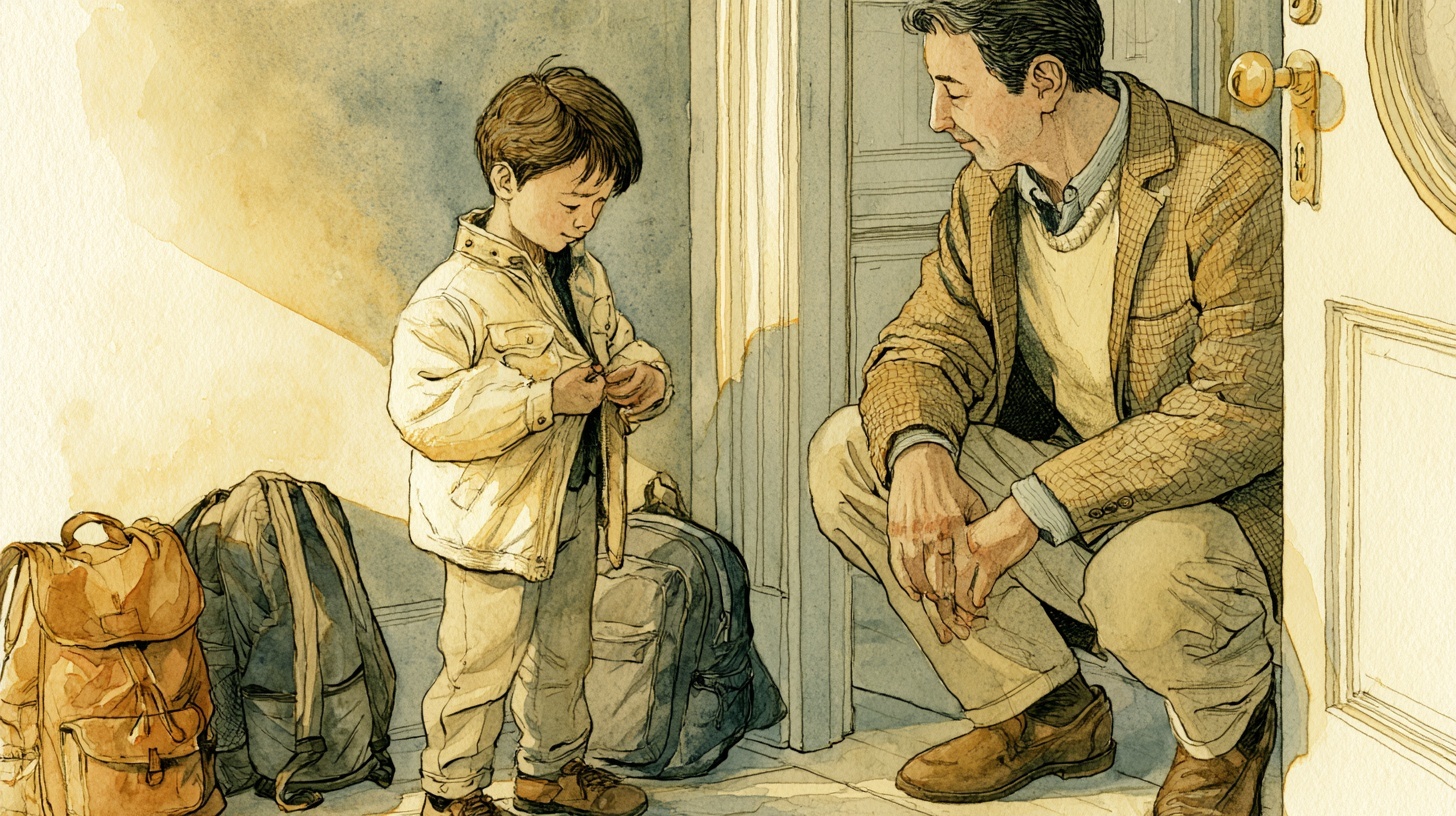
He knows how to tie the lace. He can tell you the steps. He has watched you do it four hundred times.
His hands will not do it.
What it is
Developmental coordination disorder is the formal diagnosis. Dyspraxia is the term most families and many therapists use. It describes motor coordination substantially below what you would expect for a child's age, present from early development, and significant enough to interfere with daily life or schoolwork.
It affects roughly five to six percent of children, which makes it about as common as ADHD, and it is one of the least recognized conditions in this whole category.
The core difficulty is motor planning: organizing and sequencing a movement, and then executing it smoothly. Knowing what to do is intact. Getting the body to carry it out is not.
What it looks like
- Late or unusual milestones, sometimes skipping crawling
- Bumping into furniture, dropping things, spills that seem constant
- Dressing: buttons, zips, laces, getting clothes the right way round
- Cutlery, and eating that stays messy long past the age of peers
- Handwriting that is slow, effortful, and tiring
- Ball skills, catching, riding a bike, swimming
- Avoiding PE, playgrounds, and anything performed in front of others
- Exhaustion, because nothing is automatic and everything is being consciously steered
That last point explains a lot of the behavior that gets attributed to attitude. When walking across a room and holding a tray both require conscious effort, there is very little left over for the rest of the day.
What it is not
It is not lack of practice. Most of these children have practiced far more than their peers and made far less progress per hour.
It is not low intelligence, and it is not a vision problem.
It is not something they will simply outgrow. Coordination improves with the right intervention, but the underlying difficulty commonly persists into adulthood, which is an argument for teaching workarounds rather than waiting.
Overlap
Co-occurrence with ADHD is high, often cited at around half of children with DCD. Overlap with dysgraphia is substantial, since handwriting is a motor task, and overlap with developmental language disorder is common too. If one has been identified and the others have not been looked at, they are worth raising.
Getting it assessed
An occupational therapist is the usual assessor, sometimes with a pediatrician or pediatric physiotherapist. Ask for a standardized motor assessment rather than an informal observation, and ask that both fine motor and gross motor be covered, since a child can look adequate on one and be well below expectation on the other.
Bring examples: how long dressing actually takes, what handwriting looks like after ten minutes rather than after one line, what happens at PE.
While you're here, take the guide
What's Underneath is free: the three body-state triggers under most meltdowns, what to say in the minute before it tips over, and how to reset afterward.

You'll get the guide instantly, plus five free articles in your inbox every week. Real challenges (meltdowns, school mornings, picky eating, big feelings) and how to actually handle them. Unsubscribe anytime.
What actually helps
The evidence favors teaching the specific task rather than trying to build a general underlying capacity. Approaches that break a real-world skill into steps and coach the child through problem-solving it, such as the CO-OP approach, have better support than programs aimed at improving coordination in the abstract.
In practice that means: pick the skills that matter to him, teach those directly, and adapt everything else.
Adaptations worth making without guilt: elastic laces or velcro, clothing without small fasteners, a sloped writing board, chunky or weighted cutlery, a water bottle that does not spill, keyboarding instead of extended handwriting, and a seat where his feet reach the floor.
At school, ask for extra time, reduced handwriting volume, help with equipment changes for PE rather than exclusion from PE, and permission to leave class a minute early so corridors are not a collision course.
The part that is not about coordination
Motor skill is the most visible thing a child does. Being picked last, dropping the tray in front of everyone, and being the only one who cannot do up their own coat happen in public, repeatedly, and they add up.
Rates of anxiety and low self-esteem are meaningfully higher in children with DCD, and much of the avoidance that looks like refusal is protection. Why your child only participates when they know they will succeed covers that directly. For the writing side, dysgraphia is the companion piece.
Note how long the ordinary things take and how much is left afterwards: dressing, the walk to school, the first ten minutes of writing. Logged in LightMap, that shows the effort cost that a single motor assessment in a quiet room will never capture.
He is not being careless. Everything you do without thinking, he is thinking about.
Sources: DSM-5-TR criteria for developmental coordination disorder; European Academy of Childhood Disability international clinical practice recommendations on DCD; peer-reviewed research on DCD prevalence and persistence into adolescence and adulthood (PMC; Developmental Medicine and Child Neurology); research on the co-occurrence of DCD with ADHD and with specific learning disorders (PMC); evidence reviews comparing task-oriented approaches such as CO-OP with process-oriented motor interventions (PMC); American Occupational Therapy Association practice guidance.
For education and reflection, not medical advice. Our terms
See what's underneath
Understand the why, not just the what
LightMap reads your hard days together and gives you answers. Start with one moment today.
Start with 3 moments Not sure where to start? Ask me.Message Tara on WhatsApp. It really is me, I read everything and will personally respond.Click here to message Tara →

Part of the award-winning Birch & Light Method, honored with the Mom's Choice Gold Award for excellence in family resources.
A story to read together
Sometimes the easiest way in is a story you read side by side.
 The Mosquito Who Thought He Was a Dragonfly
Raised by dragonflies after a summer storm, Miro learns one night that the world sometimes sees him differently than the family who loves him — and that being misunderstood isn’t the same as being bad.
Read the story Otto Filled Everything
Otto can't stop filling things with water. His family doesn't understand — until Grandma Willow helps them listen to what his body is actually asking for.
Read the story
If today was one of those days
A few more from the library, free to read.
Researched and drafted with AI assistance, reviewed before publication. Editorial standards