.jpg)
The laundry was sorted. All she had to do was put it in the machine. She got halfway — half a load actually in the drum — and then it became too much, and she walked away and left it there.
If you're parenting a child with ADHD, you have your own version of this scene. Maybe it's the math lesson that takes ninety minutes of fighting for twenty minutes of work. Maybe it's the backpack packed except for the one thing that mattered. And you're left holding a genuinely confusing question: she has done this task before, easily, so why not today? Is she being lazy? Manipulative? Regressing? Should I lower my expectations, or am I failing her by not holding the line?
Here's the reframe that changes everything: the inconsistency isn't evidence against her struggle. It IS the struggle. Start from psychologist Dr. Ross Greene's premise that kids do well if they can — that when she stalls, it's because something is genuinely hard in that moment, not because she's choosing to make your life difficult. That single assumption changes what you do next.
What executive function actually is
Executive function is the brain's management layer — the systems that start a task, hold the steps in mind, resist the pull of everything more interesting, push through the boring middle, and finish. In ADHD, the machinery for knowing what to do is fine; the machinery for doing it on demand is unreliable. Researchers sometimes describe ADHD as a performance problem, not a knowledge problem: the gap isn't between your child and understanding. It's between understanding and execution.
That's why the half-finished laundry is so diagnostic. Walking away halfway through isn't avoidance of the task — she started it. It's the executive system running out of fuel mid-task: the steps stopped being holdable, the effort cost spiked, and the brain did what ADHD brains do under that condition, which is exit.
Why "she did it fine last week" is a trap
ADHD execution runs on conditions, not character. Interest, novelty, urgency, someone nearby, a good night's sleep, the right time of day — when those line up, the same child performs beautifully, and it looks like proof of what she "can do." Then the conditions shift and she can't, and it looks like regression or defiance.
But the good days aren't her real capacity with the bad days as failures of will. Both are her real capacity — under different conditions. This is the single hardest thing for loving parents to internalize, because everything in us says "I've seen you do it." The more useful frame: you've seen her do it under certain conditions. The job isn't to demand the good days by force of expectation. It's to figure out what the good days have in common and build more of it.
The false choice: lower the bar or push harder
Most parents feel trapped between two bad options — expect less (and quietly grieve it) or hold firm (and turn the house into a battlefield). There's a third option, and it's the one that actually matches the problem: keep the expectation, change the support. The word for it is scaffolding.
Scaffolding isn't doing it for her, and it isn't letting her off. It's lending her your executive system while hers develops — the same way you once held the back of the bike. Concretely, for an eleven-year-old:
- Shrink the visible task. "Put on the laundry" is one instruction to you and eleven working-memory items to her. Externalize the steps — a card on the machine, three lines, not eleven. The steps she can see don't have to be held in her head.
- Body double. Presence is fuel. You don't supervise, you exist nearby — fold towels, make tea. Task completion rates for ADHD kids (and adults) jump dramatically with another calm body in the room. It's not dependence; it's the best-documented free scaffold there is.
- Anchor tasks to ritual, not willpower. "Math happens after breakfast, at the kitchen table" beats "do your math" every time. Starting is the hardest executive act, so tie it to something that already happens daily and the start becomes automatic instead of chosen.
- Shorter blocks, real endings. Ninety minutes of struggle for twenty minutes of math is a terrible trade. Twenty focused minutes with a guaranteed stop is more math, less damage — and the guaranteed stop is what makes starting possible.
- Praise the middle, not the finish. The hardest moment for her isn't completing — it's minute six, the boring middle where the exit pull peaks. Catch her there, while she's still standing at the machine before the walk-away, and name exactly what she's doing: "You're still here, still working the boring part — that's the hard thing and you're doing it." Recognizing the effort in the moment it's happening, rather than waiting for a finished result to reward, is what builds the skill.
While you're here, take the guide
What's Underneath is free: the three body-state triggers under most meltdowns, what to say in the minute before it tips over, and how to reset afterward.

You'll get the guide instantly, plus five free articles in your inbox every week. Real challenges (meltdowns, school mornings, picky eating, big feelings) and how to actually handle them. Unsubscribe anytime.
What to say when she stalls
"You're capable of this, I've seen you do it" — meant as encouragement, lands as accusation, because she can't explain the gap either. Try instead: "Looks like your brain hit the wall on this one. What's the next single step?" It names the stall without shame, keeps the task alive, and shrinks the ask to one item. Kids who hear their stalls described as mechanics rather than character grow up to be adults who build systems instead of hiding failures.
And when a task dies halfway, resist the autopsy. Finish the laundry together, one step each. Completion with help teaches more than abandonment followed by a lecture.
Lower expectations, or the right ones?
Here's the honest answer to the question you're actually asking. You don't need to lower your expectations of who she'll become — kids with ADHD become surgeons, founders, artists, and organized-enough adults, usually via systems rather than willpower. You do need to adjust your expectations of unsupported, on-demand execution at eleven, because executive function in ADHD develops on a delayed curve — commonly a few years behind peers, with maturation continuing well into the twenties. Expecting her to perform like a neurotypical eleven-year-old isn't high standards; it's the wrong yardstick. Expecting her to perform like herself, with the right scaffolds, on a curve that's still climbing — that's the version of high standards that builds her instead of grinding you both down.
Where LightMap helps
Everything above turns on one question you can't answer from memory: what do her good days have in common? Tracking the stalls and the successes — time of day, subject, what was eaten, who was nearby, what the task looked like — surfaces the conditions that make execution possible for your specific child. Two weeks of pattern beats two years of arguing about capability. And on the hard days, the record is also for you: proof that the regression you're afraid of is actually a wave, not a slide.
Every behavior is a clue.
If you're trying to figure out what your child's good days have in common, LightMap can find the pattern with you. Explore LightMap at birchandlight.com/lightmap.
Frequently asked questions
How do I know it's executive function and not laziness or manipulation?
Laziness is consistent — it avoids effort everywhere, including on preferred activities. Executive dysfunction is wildly inconsistent and effort-expensive: the same child who can't finish loading a machine will hyperfocus for three hours on something interesting, and often feels genuine shame about the gap. Starting a task and stalling midway, like the half-loaded laundry, is especially telling — avoidance doesn't start.
Should I punish unfinished tasks?
Consequences work on motivation problems, and this mostly isn't one — punishing a working-memory stall teaches shame, not follow-through. Keep accountability but aim it at the system: the task still gets finished (with help if needed), and together you adjust the scaffold so next time stalls later or not at all.
Will she ever do these things independently?
Very likely yes — on her curve, and via externalized systems that gradually become her own. The teens who fare best aren't the ones forced to white-knuckle independence early; they're the ones who learned that lists, timers, rituals, and body doubling are tools smart people use, and kept using them. Scaffolds fade; they don't have to be ripped away.
Math takes her ten times the effort it takes other kids. Do we push through or back off?
Neither — restructure. Long sessions teach her that math equals suffering, which compounds the problem. Short timed blocks with guaranteed endings, at a consistent time anchored to routine, with the hardest work placed at her best time of day, usually produces more total math with less total war. If the strain stays extreme despite structure, it's worth screening for a co-occurring math learning difficulty, which travels with ADHD more often than people realize.
Put it into practice
Reading about these skills is step one. Building them works best through doing, and through play. Money and My Fast Brain is a printable workbook that turns planning, waiting, and finishing into missions kids actually want to do, with a page by page science section for the grown-up. It is $9, instant download, print at home.
Get the workbook, or find both fast brain workbooks in the bundle.
For your child: Oliver Octopus Used Arm Number Three is about an octopus who draws beautifully with the wrong arm and is told at school that everyone uses arm one.
Sources: Barkley on executive function and ADHD; Diamond on core executive functions (Annual Review of Psychology; PMC); peer-reviewed research on task initiation and working memory demands in everyday tasks (PMC).
For education and reflection, not medical advice. Our terms
See what's underneath
Understand the why, not just the what
LightMap reads your hard days together and gives you answers. Start with one moment today.
Start with 3 moments Not sure where to start? Ask me.Message Tara on WhatsApp. It really is me, I read everything and will personally respond.Click here to message Tara →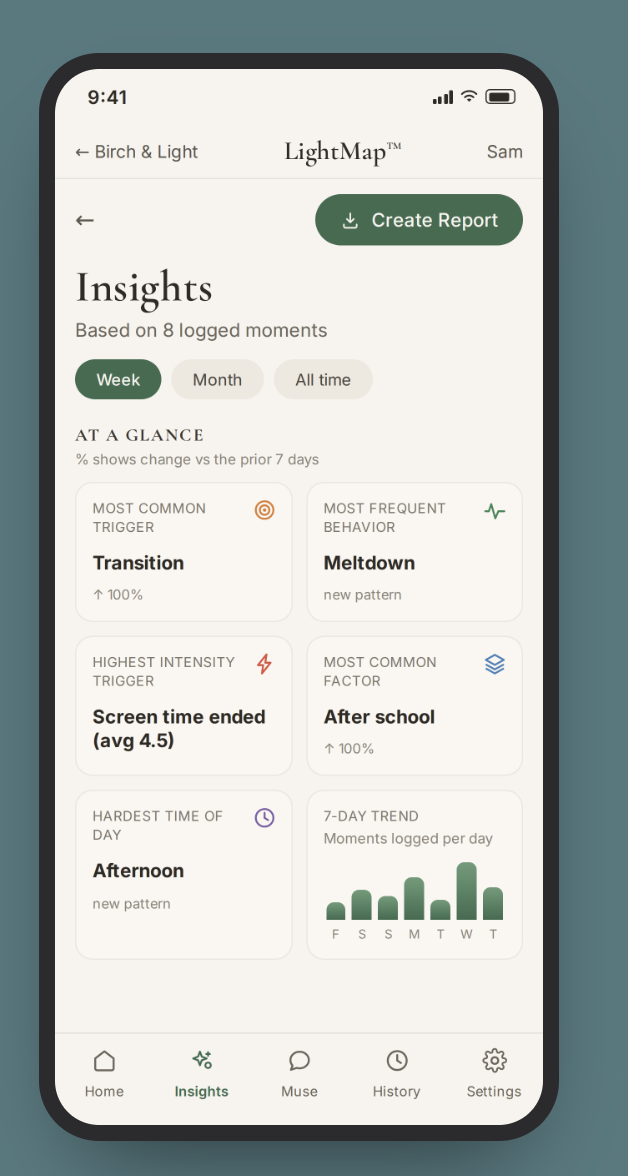

Part of the award-winning Birch & Light Method, honored with the Mom's Choice Gold Award for excellence in family resources.
A story to read together
Sometimes the easiest way in is a story you read side by side.
 The Mosquito Who Thought He Was a Dragonfly
Raised by dragonflies after a summer storm, Miro learns one night that the world sometimes sees him differently than the family who loves him — and that being misunderstood isn’t the same as being bad.
Read the story Otto Filled Everything
Otto can't stop filling things with water. His family doesn't understand — until Grandma Willow helps them listen to what his body is actually asking for.
Read the story
If today was one of those days
A few more from the library, free to read.
Researched and drafted with AI assistance, reviewed before publication. Editorial standards