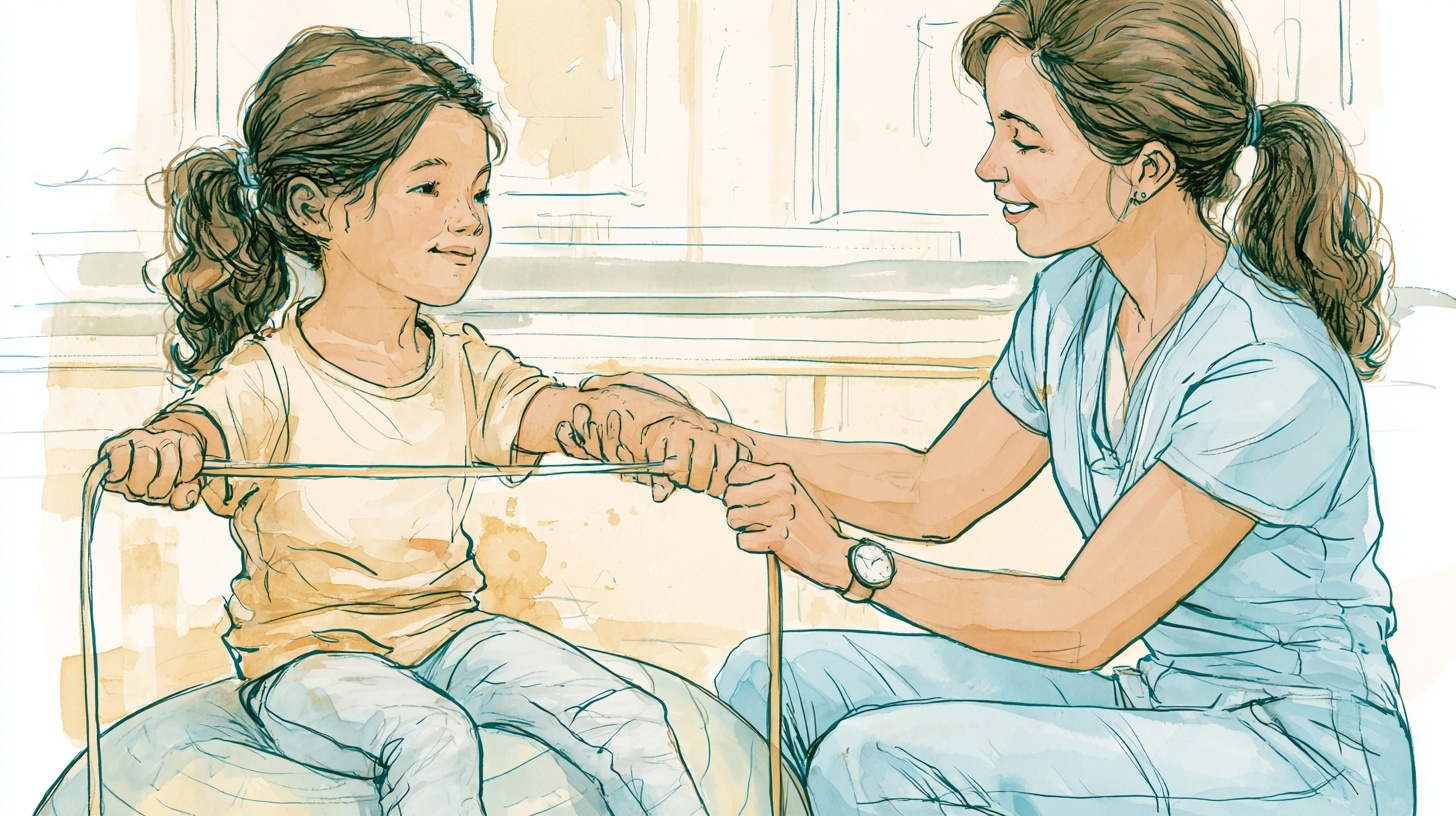
She can bend her thumb to her wrist and put her palms flat on the floor. It has always been the party trick.
She also has legs that ache at night, hands that hurt after half a page of writing, a habit of sitting in positions that look painful, and a level of tiredness nobody can account for.
The names
Generalized joint hypermobility means joints that move beyond the typical range. On its own it is common in children, often familial, and frequently causes no problems at all.
Hypermobility spectrum disorder is the term used when that hypermobility comes with symptoms: pain, instability, repeated injury, fatigue.
Hypermobile Ehlers-Danlos syndrome is a connective tissue disorder with specific diagnostic criteria covering joint findings, skin features, family history, and other systemic signs.
The dividing lines between these are genuinely blurry and the criteria have been revised more than once. What matters for a child is less which label lands and more that the symptoms are recognized as connected rather than treated as five unrelated complaints.
Why this belongs on a neurodivergence site
Because the overlap is substantial and consistently reported. Autistic people and people with ADHD show higher rates of joint hypermobility than the general population, and the association runs in both directions.
Alongside it sit two other frequent travelers: autonomic symptoms such as dizziness on standing, racing heart, and poor temperature regulation, and gastrointestinal problems including reflux, constipation, and nausea. Families often arrive having been told each of these is separate and none of them is serious.
What to look for in a child
- Very bendy fingers, elbows, or knees, and a party trick or two
- Aching legs at night, historically dismissed as growing pains
- Hand pain or fatigue after short periods of writing
- W-sitting, or sitting in unusual positions to gain stability
- Clumsiness, frequent sprains, joints that slip or fully dislocate
- Flat feet, or shoes wearing unevenly
- Fatigue out of proportion to activity, and low stamina for walking
- Soft, stretchy, or easily bruised skin, and scars that heal poorly
- Dizziness on standing up, particularly in the morning or in heat
- Delayed motor milestones or persistent motor coordination difficulty
Handwriting deserves special mention, because a hypermobile child gripping hard to stabilize unstable finger joints will fatigue quickly and produce work that looks like carelessness.
While you're here, take the guide
What's Underneath is free: the three body-state triggers under most meltdowns, what to say in the minute before it tips over, and how to reset afterward.

You'll get the guide instantly, plus five free articles in your inbox every week. Real challenges (meltdowns, school mornings, picky eating, big feelings) and how to actually handle them. Unsubscribe anytime.
Getting it assessed
Start with your pediatrician or GP and ask directly about hypermobility, using the word. The Beighton score is a quick screening measure most clinicians can perform, though it is a screen rather than a diagnosis and it misses children whose hypermobility sits in joints it does not test.
From there, referral options are pediatric rheumatology, physiotherapy, and occupational therapy. If dizziness, fainting, or racing heart on standing are part of the picture, say so explicitly, because that belongs in the same conversation.
Ask for the symptoms to be considered together. The most common failure here is a child being sent to one clinic for joint pain, another for fatigue, and a third for stomach problems, with nobody looking at the whole.
What helps
The mainstay is physiotherapy aimed at strength and joint stability, and at proprioception, which is the sense of where the body is in space and is often unreliable in hypermobile children. This is important: the goal is stability, not flexibility, and stretching-heavy activity is usually not what a hypermobile child needs. Any exercise program should come from a clinician who knows the condition.
Pacing matters. Hypermobile children commonly do far too much on a good day and pay for it for three, and learning to spread activity is a skill worth teaching early.
Practical supports: writing accommodations and keyboarding, a supportive chair with feet flat, supportive footwear or orthotics if recommended, and permission to change position rather than sit still.
For anything involving fluids, salt, medication, or supplements for autonomic symptoms, that is a conversation with the treating clinician rather than something to trial from an article.
If motor coordination is also affected, dyspraxia and DCD often occurs alongside, and dysgraphia covers the handwriting piece in more depth.
Log the pattern, because it is what makes the case: which days involved more activity and what the following days looked like, when the leg pain happens, how long writing lasts before the hand goes. In LightMap, a few weeks of that turns a vague picture into something a rheumatologist can work with.
She is not exaggerating and she is not seeking attention. Bodies that are held together loosely work harder to do ordinary things, and that work has a cost.
Sources: 2017 international classification of the Ehlers-Danlos syndromes and the diagnostic criteria for hypermobile EDS and hypermobility spectrum disorders (Malfait et al.; American Journal of Medical Genetics); Ehlers-Danlos Society resources on pediatric assessment and management; peer-reviewed research on the association between joint hypermobility and neurodevelopmental conditions including autism and ADHD (Csecs et al.; PMC; Frontiers in Psychiatry); research on the co-occurrence of hypermobility with dysautonomia and gastrointestinal symptoms (PMC); physiotherapy evidence reviews on strengthening and proprioceptive training in symptomatic hypermobility (PMC).
For education and reflection, not medical advice. Our terms
See what's underneath
Understand the why, not just the what
LightMap reads your hard days together and gives you answers. Start with one moment today.
Start with 3 moments Not sure where to start? Ask me.Message Tara on WhatsApp. It really is me, I read everything and will personally respond.Click here to message Tara →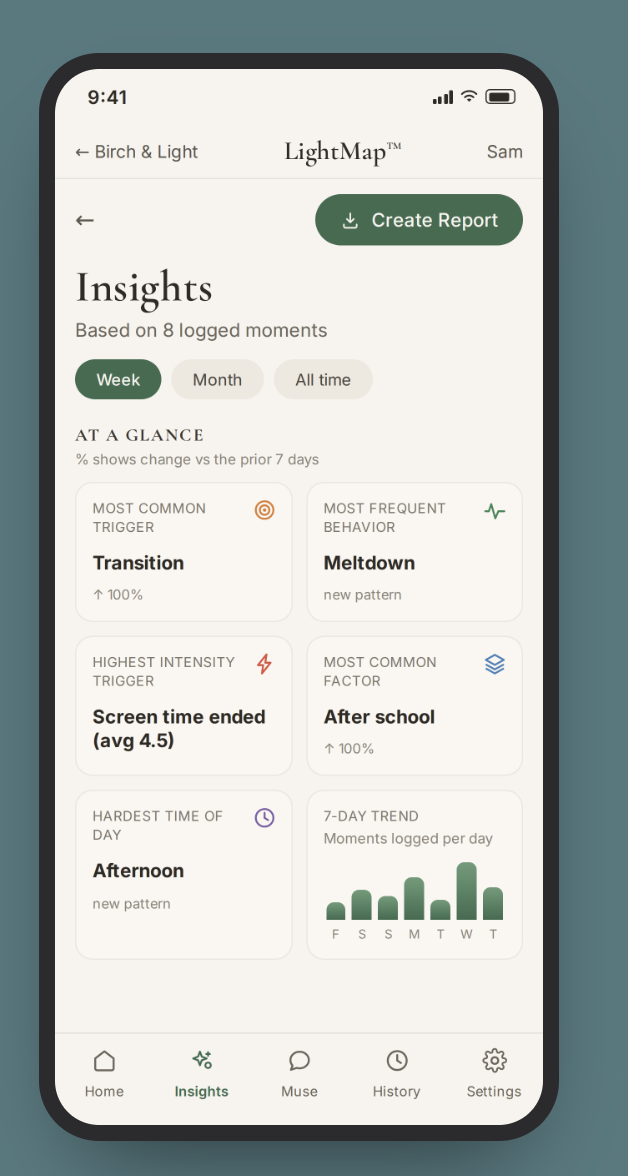

Part of the award-winning Birch & Light Method, honored with the Mom's Choice Gold Award for excellence in family resources.
A story to read together
Sometimes the easiest way in is a story you read side by side.
 The Mosquito Who Thought He Was a Dragonfly
Raised by dragonflies after a summer storm, Miro learns one night that the world sometimes sees him differently than the family who loves him — and that being misunderstood isn’t the same as being bad.
Read the story Otto Filled Everything
Otto can't stop filling things with water. His family doesn't understand — until Grandma Willow helps them listen to what his body is actually asking for.
Read the story
If today was one of those days
A few more from the library, free to read.
Researched and drafted with AI assistance, reviewed before publication. Editorial standards