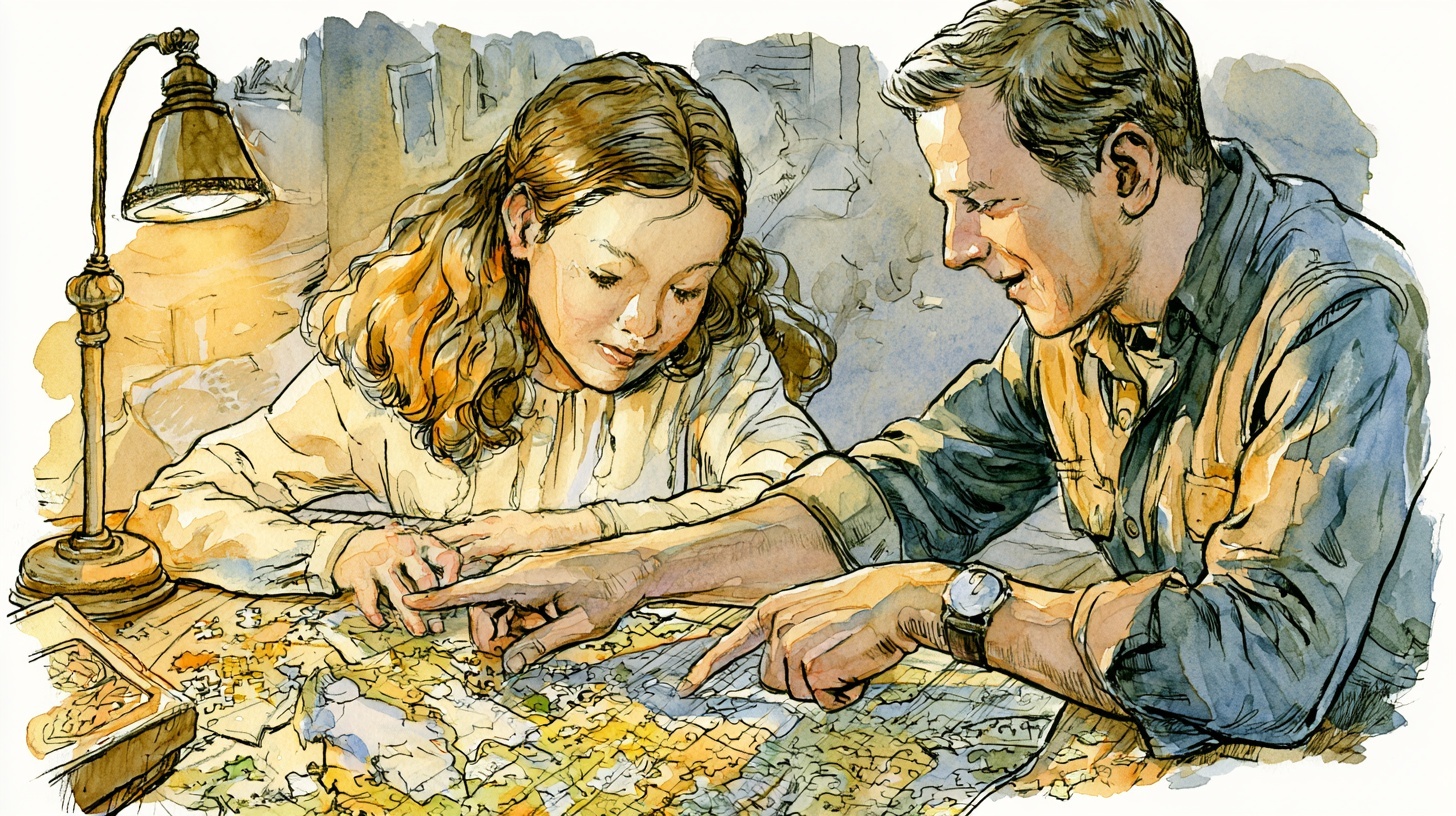
She spoke in sentences before she was two and read before school. Her vocabulary embarrasses adults.
She also cannot find her way around a building she has been in fifty times, cannot do the geometry, cannot tie a bow, and has no idea that the girl she has been talking at for ten minutes wants to leave.
What NVLD describes
Nonverbal learning disability is a profile rather than a formal diagnosis. It is not in the DSM, which matters practically, because a clinician may decline to use the term and a school may not recognize it.
The profile is a marked split: strong verbal ability, including vocabulary, rote verbal memory, and early reading, alongside significant weakness in visual-spatial processing, motor coordination, mathematics, and the nonverbal parts of social communication.
Whether it is a distinct condition is genuinely debated. What is not debated is that this pattern exists and that children who have it are routinely misread.
What it looks like
- Talks early, extensively, and impressively
- Decodes reading early, then struggles with comprehension of anything requiring inference
- Gets lost easily, poor sense of direction, difficulty with maps and diagrams
- Math falls apart around geometry, fractions, and anything spatial
- Handwriting is poor and fine motor tasks are hard
- Misses facial expression, body language, and tone
- Very literal, struggles with sarcasm and implication
- Copes badly with novelty and change, and relies heavily on routine and rules
- Misses the big picture while retaining every detail
Why it is missed for years
Verbal ability is what adults use to estimate a child's intelligence. A child who talks well is assumed to be capable across the board, so the areas where she is not get attributed to effort, carelessness, or attitude.
She also compensates by talking. Asked to demonstrate understanding, she produces a fluent verbal answer, and everyone concludes she has grasped it.
The autism question
The overlap with autism, particularly with the profile once called Asperger's, is substantial, and clinicians disagree about how much daylight there is between them. Some argue NVLD is largely autism identified through a cognitive testing lens.
Practically, this matters because autism is a formal diagnosis that unlocks services and NVLD is not. If your child fits both descriptions, an autism assessment is usually the more useful route, and the NVLD framing can still be a helpful way of explaining her cognitive profile to a school.
While you're here, take the guide
What's Underneath is free: the three body-state triggers under most meltdowns, what to say in the minute before it tips over, and how to reset afterward.
You'll get the guide instantly, plus five free articles in your inbox every week. Real challenges (meltdowns, school mornings, picky eating, big feelings) and how to actually handle them. Unsubscribe anytime.
Getting it assessed
This needs a full neuropsychological evaluation rather than a school academic screen. Ask specifically that visual-spatial reasoning, visual-motor integration, fine motor skill, and social pragmatic language are all assessed separately, and that verbal and nonverbal indices are reported separately rather than combined into one overall score.
A single composite number is the enemy here. A strong verbal score averaged with a weak nonverbal score produces an unremarkable middle figure that describes nobody.
What helps
Put it in words. This is the central principle. Verbal explanation is her strength, so explain visual and spatial information verbally rather than assuming a diagram teaches her anything. Talk her through the map, describe what the graph shows, narrate the steps.
Teach the social rules explicitly. What crossed arms usually means, how to tell someone is finishing a conversation, what a change in tone signals. She will not absorb these by exposure and she will learn them well when they are taught as information.
Check comprehension beyond the words. Ask what the character wanted, or why it happened, rather than what happened.
Reduce the spatial and motor load. Graph paper, keyboarding, pre-drawn axes, worked examples, and a written sequence rather than a demonstration.
Prepare for anything new. Novelty is where this profile struggles most. Walk the route, describe the room, rehearse the plan.
If math is the sharpest difficulty, dyscalculia overlaps here, dysgraphia covers the handwriting side, and why your child feels left out even when included covers the social consequence.
Note where the split shows: what she can explain versus what she can do, which subjects collapse and which do not, what happened in the social moments that went wrong. In LightMap, that contrast is the evidence for the assessment, because the whole diagnosis is the gap between two things she is doing at once.
She is not lazy in the subjects she fails. She is being assessed on the one thing she cannot do, by people who keep hearing the one thing she can.
Sources: peer-reviewed research on the nonverbal learning disability profile and proposed diagnostic criteria (Mammarella and Cornoldi; Fine et al.; PMC); Rourke's original characterization of nonverbal learning disabilities; research on the prevalence of the NVLD profile in children (Margolis et al.; JAMA Network Open); literature on the overlap and differentiation between NVLD and autism spectrum disorder (PMC); guidance on interpreting verbal and nonverbal index discrepancies in cognitive assessment (PMC).
For education and reflection, not medical advice. Our terms
See what's underneath
Understand the why, not just the what
LightMap reads your hard days together and gives you answers. Start with one moment today.
Start with 3 moments Not sure where to start? Ask me.Message Tara on WhatsApp. It really is me, I read everything and will personally respond.Click here to message Tara →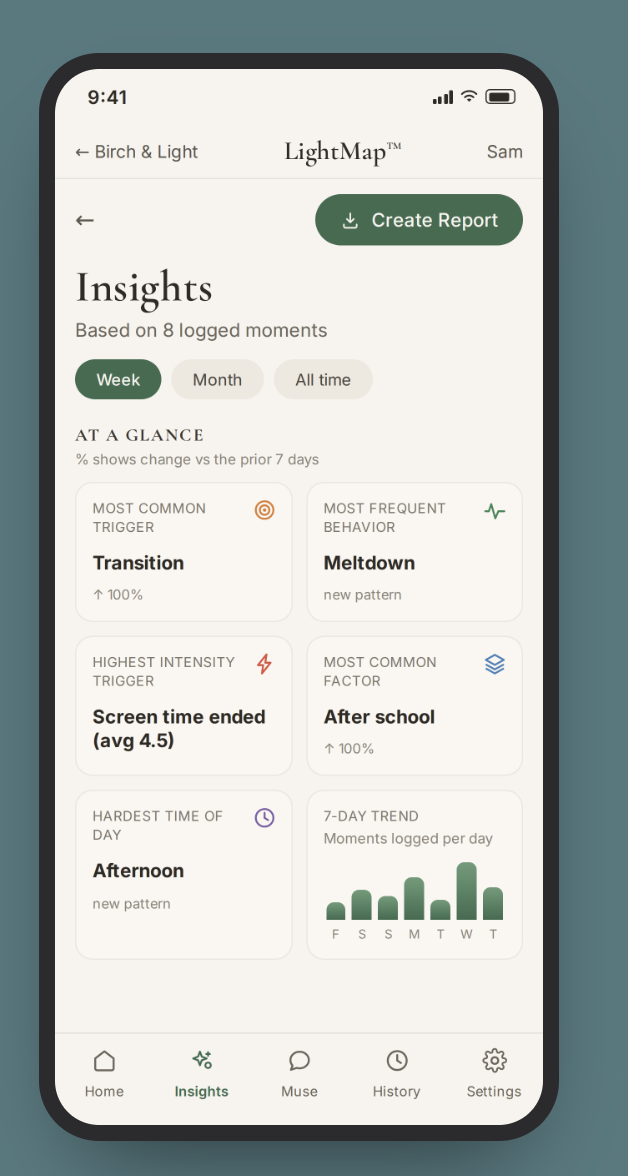

Part of the award-winning Birch & Light Method, honored with the Mom's Choice Gold Award for excellence in family resources.
A story to read together
Sometimes the easiest way in is a story you read side by side.
 The Mosquito Who Thought He Was a Dragonfly
Raised by dragonflies after a summer storm, Miro learns one night that the world sometimes sees him differently than the family who loves him — and that being misunderstood isn’t the same as being bad.
Read the story Otto Filled Everything
Otto can't stop filling things with water. His family doesn't understand — until Grandma Willow helps them listen to what his body is actually asking for.
Read the story
If today was one of those days
A few more from the library, free to read.
Researched and drafted with AI assistance, reviewed before publication. Editorial standards