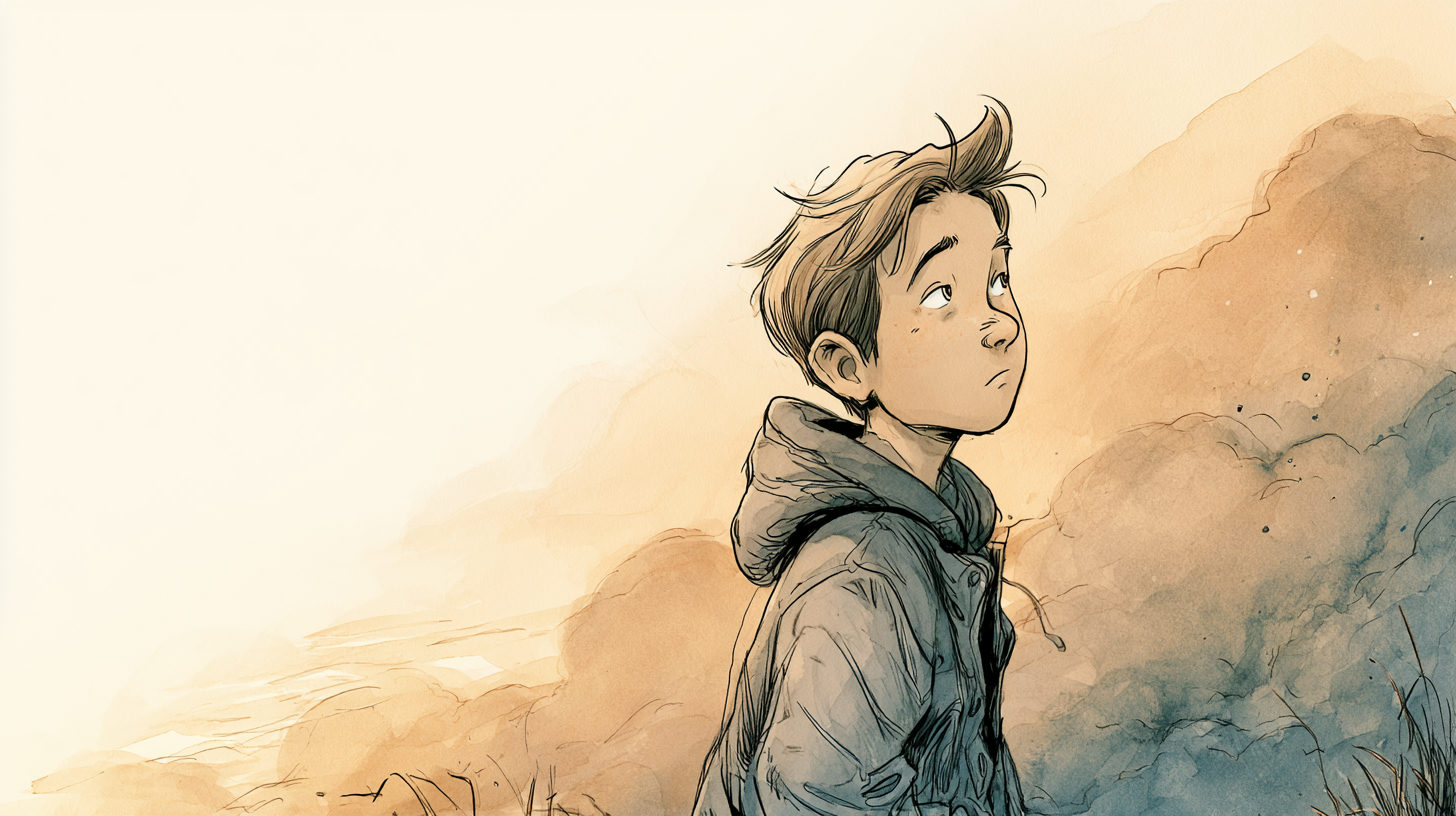
Risky behavior in a tween or teen is often a signal, not just a problem. Underneath it is usually a nervous system that has run out of room and is looking for relief, numbness, or escape. Read the need first, hold the limit anyway, and bring in a professional if safety is at stake.
Most of the time, when a tween or teen does something that looks reckless or out-of-character, the loudest voice in the room is fear. The second loudest is the urge to fix it fast. Neither tends to lead anywhere quiet.
There is another door. Behind a lot of behavior that looks like a problem in itself is a nervous system that has run out of room — and gone looking for a way to discharge, numb, or disappear for a while. Reading the signal underneath doesn't excuse anything. It just gives you somewhere truer to start.
Behavior is rarely the actual story
A behavior is the surface. Underneath it sits a need: relief, sleep, escape from a feeling, a moment of "I don't have to be the version of me everyone expects." The behavior is the strategy the body found. It is not the same thing as the person.
When a parent can hold that distinction — even silently, even imperfectly — the conversation shifts. You stop arguing with the strategy and start getting curious about what it's solving for.
What might a risky behavior be trying to say?
- "I am too full." Overwhelm with nowhere to go.
- "I want to stop feeling for a while." Numbing, not destruction.
- "I'm exhausted from pretending I'm fine." The cost of masking.
- "I want to feel something." Disconnection looking for sensation.
- "I want to belong." Peer behavior as the price of admission.
- "I don't want to be perceived right now." Disappearing into a phone.
None of these are diagnoses. They are openings. They are the kind of thing a teen will sometimes confirm with a small nod months after you stopped asking.
The shift from "what are you doing" to "what's going on underneath this"
The first question puts a teen on trial. The second one offers a chair. They land in completely different places in the body, even when the words are gentle.
In practice, this looks less like a long conversation and more like a different atmosphere. Less interrogation. More noticing. Fewer ultimatums in the doorway. More small check-ins on a Tuesday for no reason.
Why do patterns matter more than single incidents?
A single incident usually doesn't tell you much. The same behavior can mean five different things on five different weeks. What tends to be more useful is the shape it makes over time — the days it clusters, the things that tend to happen before it, the sleep around it, the social context.
That's the work LightMap is built for. Quiet, private logging that turns "I think this is getting worse" into "this tends to follow nights under five hours of sleep" or "this clusters after weekends with that group."
While you're here, take the guide
What's Underneath is free: the three body-state triggers under most meltdowns, what to say in the minute before it tips over, and how to reset afterward.
You'll get the guide instantly, plus five free articles in your inbox every week. Real challenges (meltdowns, school mornings, picky eating, big feelings) and how to actually handle them. Unsubscribe anytime.
What this is not
This isn't a way to talk yourself out of being concerned. If something feels unsafe, treat it as unsafe. Loop in a therapist, a school counselor, a pediatrician. Reading the signal underneath doesn't replace getting help; it just helps you arrive there with a clearer sense of what you're actually seeing.
Act today, not later, if you see signs of self-harm, talk of suicide, escalating substance use, or a change that frightens you. In the US you can call or text 988, the Suicide and Crisis Lifeline, at any hour, or go to the nearest emergency room.
A calm opener works better than a confrontation. Try something like: "I've noticed you seem worn out lately. I'm not angry. What would help right now?" Then stop talking and let the silence do some of the work.
Related
Frequently asked questions
Does treating a risky behavior as communication mean I just let it continue?
No. Reading the signal underneath doesn't replace boundaries — it shapes them. When you understand what a behavior is trying to relieve, you can hold a limit and offer something that actually meets the underlying need, instead of only suppressing the behavior.
What if my teen insists 'it's not a big deal' and won't talk?
That's a normal protective response, not a closed door. The work usually isn't a single big conversation — it's small, consistent, low-pressure presence. Many teens open up sideways: in the car, after a show, late at night, while doing something else.
Is this approach a substitute for professional support?
It isn't. Birch & Light content is calm, nonclinical reading designed to help caregivers think more clearly. Therapists, counselors, and pediatricians remain the right people to consult when you're worried about safety, frequency, or escalation.
Where does LightMap fit in?
LightMap helps you see patterns over weeks — when shutdowns cluster, what tends to happen before an impulsive period, how sleep and overwhelm connect. It's a tool for understanding, not policing.
Sources: Steinberg's dual systems model of adolescent risk-taking (PMC); Khantzian's self-medication hypothesis; research on adolescent risk behavior as affect regulation (PMC); research on experiential avoidance (PMC).
Primary sources: Steinberg L. A social neuroscience perspective on adolescent risk-taking. Developmental Review, 2008, 28, 78-106, on how reward-seeking and self-control develop on different timelines in adolescence. Khantzian EJ. The self-medication hypothesis of addictive disorders: focus on heroin and cocaine dependence. American Journal of Psychiatry, 1985, 142, 1259-1264. That work concerns adults with substance dependence and is cited here for the idea of behavior as a way to manage distress.
For education and reflection, not medical advice. Our terms
See what's underneath
Understand the why, not just the what
LightMap reads your hard days together and gives you answers. Start with one moment today.
Start with 3 moments Not sure where to start? Ask me.Message Tara on WhatsApp. It really is me, I read everything and will personally respond.Click here to message Tara →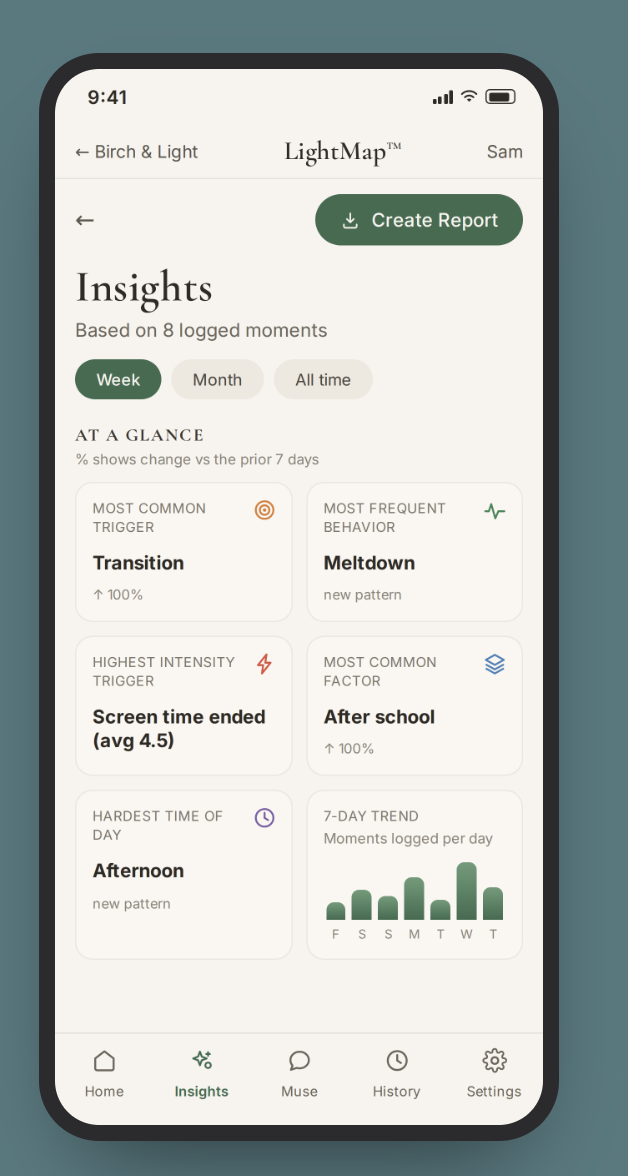

Part of the award-winning Birch & Light Method, honored with the Mom's Choice Gold Award for excellence in family resources.
A story to read together
Sometimes the easiest way in is a story you read side by side.
 The Mosquito Who Thought He Was a Dragonfly
Raised by dragonflies after a summer storm, Miro learns one night that the world sometimes sees him differently than the family who loves him — and that being misunderstood isn’t the same as being bad.
Read the story Otto Filled Everything
Otto can't stop filling things with water. His family doesn't understand — until Grandma Willow helps them listen to what his body is actually asking for.
Read the story
If today was one of those days
A few more from the library, free to read.
Researched and drafted with AI assistance, reviewed before publication. Editorial standards