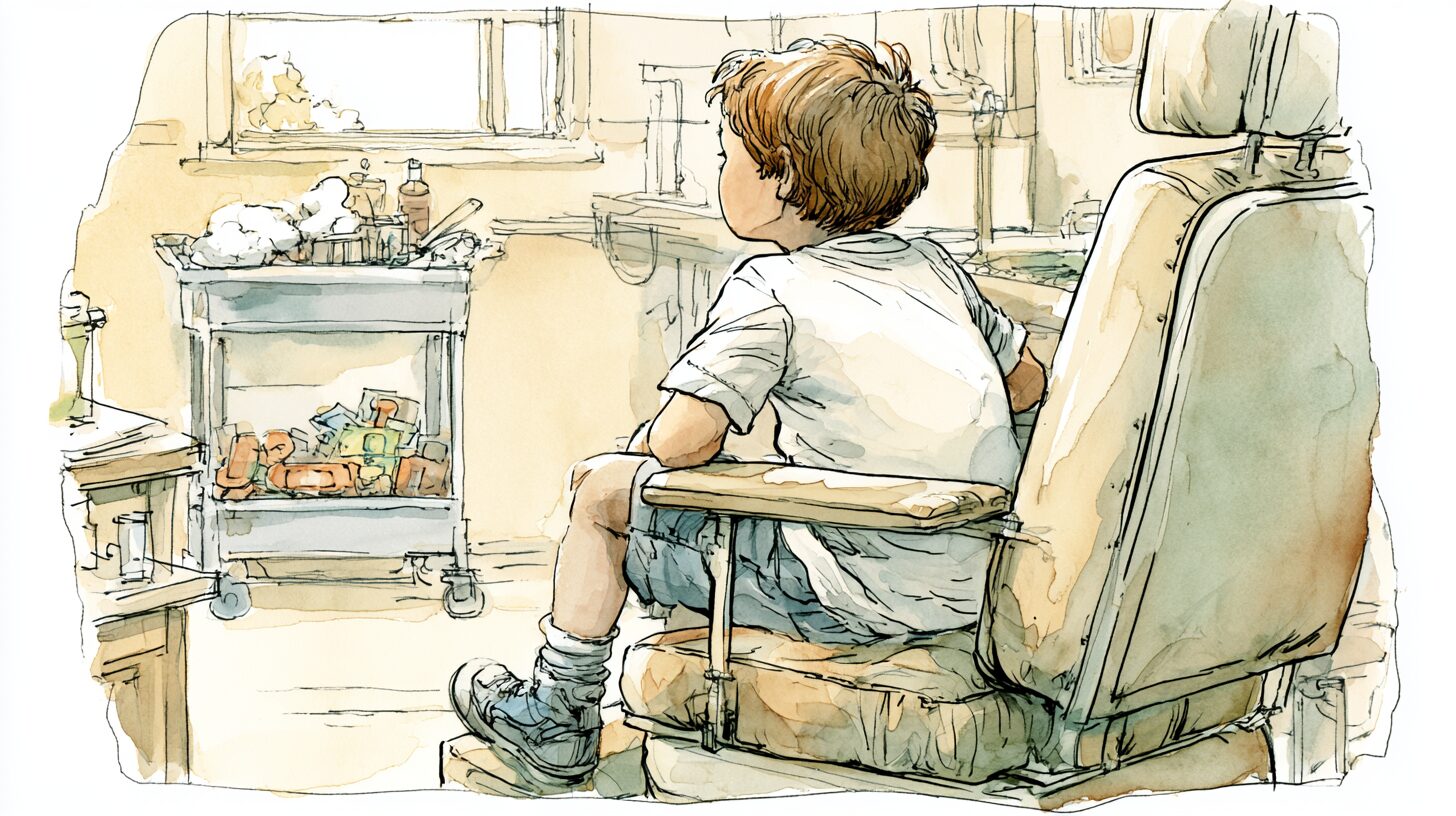
Sudden daytime accidents at school in a child who was dry usually come from voiding postponement, an overactive bladder, or constipation, not from defiance. Clustered accidents point to holding, scattered ones to urgency. Constant wetting with heavy drinking needs a doctor quickly to rule out diabetes or infection.
Your child was potty trained years ago. Dry at school, dry at home, no drama about it since preschool. Then a new grade starts and inside a month there have been three or four accidents, all of them at school, and a teacher is emailing you about it.
The first thing everyone does is reach for a cause. It is the ADHD. It is behavioral. It is laziness. He is doing it for attention. Somebody in your house has already said at least one of those out loud.
For scale before anything else: as many as one in five school age children have at least one symptom of a bladder control problem, and the broader pediatric literature puts lower urinary tract dysfunction at somewhere between 8 and 22 percent of children. This is not a rare thing that happened only to your family.
Skip the cause for a minute. Causes are the second question. The first question is what shape it has, because daytime wetting in a school age child comes in three recognizable shapes, and they point at three completely different answers. Parents who guess at a cause before reading the shape almost always land on the wrong intervention, and the wrong intervention here tends to make things worse rather than neutral.
This is a map, not medical advice. It reflects our best research at the time of writing and is not guaranteed. Your pediatrician is the one who can examine your child.
First, plot the accidents
Before you change anything, write down every accident you know about, with two columns: when it happened, and what was happening around it. Ask the teacher to do the same going forward. You are looking for one of three patterns.
Clustered. The accidents pile into one activity or one part of the day.
During tests. During carpet time. In the pickup line. On the bus. The rest of the day is completely dry.
Scattered. Accidents land anywhere, usually with a sudden dash for the bathroom just before or just after, and the amounts tend to be small. There is often visible urgency, a child who freezes mid-sentence and then bolts.
Constant. Wetting day and night, in large amounts, with a lot of drinking, a lot of bathroom trips, and a child who is producing more urine than usual around the clock.
Those three shapes are three different conversations. Take the constant one first, because it is the only one that can be urgent.
Shape three: when it is medical and moving fast
A child who was reliably dry and is now wetting day and night, in volume, while drinking constantly, needs to be seen soon rather than at the next available appointment.
New onset type 1 diabetes is the reason that matters most here. When blood glucose is high enough, glucose spills into the urine and pulls water with it, so the child produces a large volume of urine continuously and is thirsty constantly trying to keep up. The professional pediatric literature describes the classic presentation as several days to weeks of urinary frequency, excessive thirst and excessive urination, usually with unintentional weight loss, and notes that the increased urination can show up as night waking, bedwetting, or daytime incontinence. Daytime accidents are a genuine presentation, not a footnote, even though bedwetting is the version that gets talked about.
The catch is that wetting is usually not what brings these families in. The clinical literature on enuresis notes that wetting is rarely the presenting complaint in new onset diabetes, because the other symptoms overshadow it. So the question is never just whether your child is wetting. It is what surrounds it: constant thirst, drinking through the night, weight loss with a normal or large appetite, unusual exhaustion, blurry vision, nausea or vomiting. If several of those are present, that is a same day call, not a wait and see.
A urinary tract infection is the other medical cause to rule out, and it is caught by the same two minute test. A urine dip in the pediatrician's office reads glucose and signs of infection at once, which is why "can we get a urine sample" is a reasonable first phone call regardless of which shape your child's accidents have.
A few things push this up the urgency list on their own: constant dribbling that never fully stops, a change in how your child walks or in leg strength, a new dimple, tuft of hair or mark over the lower spine, repeated urinary infections, or a child who strains to start urinating and has a stop and start stream. Those belong with a doctor promptly.
Shape two: the bladder that will not wait
Scattered accidents with visible urgency, small volumes and frequent trips point at an overactive bladder, where the bladder muscle contracts before it is full. The pediatric literature describes detrusor overactivity as the leading cause of daytime urinary incontinence in childhood.
These are the children who are fine and then suddenly are not, who do the dance in the hallway, who make it to the bathroom door and not through it. They often void many times a day in small amounts.
This is a real physiological pattern rather than a discipline problem, and it responds to treatment. It also sits downstream of the thing in the section after next more often than anyone expects.
Shape one: why will my child not go?
Now the shape that matches most school accidents in a child who was previously dry, and the one most likely to be misread as defiance.
The International Children's Continence Society has a name for it: voiding postponement. It describes children who habitually put off urinating in particular situations, using holding maneuvers to do it. Crossing the legs, squatting, pressing a heel into the pelvic floor, jiggling, sitting very still. The literature notes these children often void infrequently, sometimes three or fewer times in a whole day, and that the incontinence, when it comes, comes from a bladder that got too full to hold.
It is a habit of delay attached to specific circumstances. Which is why it clusters, and why the pattern in your notes is the diagnosis in plain sight. A child who has accidents during tests and nowhere else is not a child whose bladder fails during tests. He is a child who will not leave during tests.
At school the reasons are usually mundane and completely invisible to adults:
- He believes he will miss something, or fall behind, or that the class will not wait for him
- Asking in front of everyone is the part he will not do
- The bathroom itself is aversive: loud hand dryers, no doors on the stalls, a smell, older kids, a light that never turns off
- He is deep in something and does not register the signal until it is an emergency
- He asked once, was told to wait, and built a permanent rule out of it
That last one deserves its own paragraph, because it produces the most confusing version of this. A child's rule and the school's rule are two different objects. A teacher can say truthfully that nobody is ever refused, while your child says truthfully that the class does not wait. He built his rule out of what he watched, not out of the policy. Both statements can be accurate, and arguing about which is correct wastes the conversation.
What you want to change is not the policy. It is the moment where a six or seven year old has to decide, in front of everyone, whether this need is big enough to interrupt something.
The other thing worth knowing about voiding postponement is that the research links it repeatedly with behavioral and oppositional presentations. That association gets read backward by adults all the time, into "so it is behavioral, so it is his choice." What it actually means is that the children most likely to be punished for this are the children most likely to have it.
What is the cause almost everyone misses?
Constipation.
Pediatric guidance puts the number at as many as 80 percent: four in five children with a bladder control problem are also constipated. When both are present, clinicians call the combination bladder and bowel dysfunction, and the standard advice is to treat the constipation first, because doing so frequently improves the bladder symptoms on its own.
A population study of more than 800 children and adolescents found constipated children were nearly seven times more likely to have lower urinary tract dysfunction than children who were not constipated. Two of the urinary symptoms that independently predicted constipation in that group were infrequent urination and holding maneuvers, which are the same two things that define the pattern in the section above.
The mechanism is physical and it is simple. The bowel and the lower urinary tract share much of their nerve supply, and a rectum full of stool sits directly behind the bladder and presses on it. The Merck Manual's professional pediatrics reference lists external compression of the bladder by the colon or rectum in constipated children as one of the things that reduces how much urine the bladder can store. A compressed bladder holds less, signals sooner, and empties less completely. So a constipated child gets urgency, frequency, incomplete emptying, and accidents, and none of it looks like a bowel problem from the outside.
Here is why parents miss it. You will say your child goes every day, and that can be true while a large amount is still backed up. Stool can be passing around an impaction daily. Appetite can look fine. Nobody complains of a stomachache. The child does not appear constipated in any way a parent would notice, which is precisely why it stays invisible for months while everyone treats the wetting as psychological.
This is the single highest yield thing to raise at the appointment, and you should raise it by name rather than waiting to be asked. Ask directly whether constipation could be contributing and what the plan would be to treat it. A physical exam and sometimes an abdominal x-ray answer the question quickly.
It also matters because treating constipation is the intervention with the best ratio of effort to result in this whole article. Families who chase the behavior for a year and then treat the bowel often watch months of accidents resolve in weeks.
While you're here, take the guide
What's Underneath is free: the three body-state triggers under most meltdowns, what to say in the minute before it tips over, and how to reset afterward.

You'll get the guide instantly, plus five free articles in your inbox every week. Real challenges (meltdowns, school mornings, picky eating, big feelings) and how to actually handle them. Unsubscribe anytime.
Is this just the ADHD?
Somebody in your child's life is arguing that this is all just the ADHD. Somebody else is arguing that ADHD is being used as an excuse. Both are half right, and the half each one is missing is the same half.
The association is real and well documented. Children with ADHD have higher rates of daytime wetting, bedwetting and soiling than children without it, and studies of children in ADHD treatment find delayed bladder and bowel control compared with controls. The explanations clinicians offer are the ordinary ones: the signal arrives and does not get prioritized over whatever has the child's attention, deep focus swallows the early warning, and the child arrives at the emergency stage without having registered the ordinary one.
So yes, ADHD raises the odds.
What it does not do is explain a change. A child who has been dry for two years and starts having accidents in September did not become more ADHD in September. Something in the situation changed, or something in the body changed. ADHD is a standing risk factor, not an event, and using it as the answer is how families end up not investigating for a year.
The same logic applies to the medication question, which is often running in the background of these arguments. Accidents are not evidence for starting medication and not evidence against it. They are their own problem with their own workup, and they should not become a bargaining chip in a disagreement between adults.
What actually helps
The first line treatment for functional daytime wetting is unglamorous and it works. Clinicians call it standard urotherapy, it is what the International Children's Continence Society recommends first for every type of daytime incontinence, and a 2018 meta-analysis found it effective against spontaneous remission rates. The core of it is scheduled voiding rather than voiding on demand.
Put urination on a clock, not on a signal. For a child who postpones, the published approach is to raise the frequency deliberately, aiming for around seven trips across the day, tracked rather than remembered. The point is to stop asking a child who is bad at noticing, or unwilling to interrupt, to be the one who decides. This is the whole intervention in one sentence: remove the decision.
Anchor the trips to the situations that fail. If the accidents cluster before tests, the trip goes immediately before every test as a fixed part of the routine. Not an offer, not a question, not a reminder that he can go if he needs to. Part of the sequence, like getting a pencil out.
Make asking unnecessary. A silent signal agreed with the teacher, a card on the desk, a standing arrangement that he goes at set times without raising a hand. Whatever removes the public request, because the public request is the part many children will not do.
Treat the bowel. With your pediatrician, and properly, which usually means longer than parents expect. Undertreating is the standard failure.
Fix the fluids. The continence literature notes that some children learn to restrict what they drink in order to reduce accidents, which is understandable and works against them, because it makes constipation worse. Fluid intake is one of the named components of standard urotherapy, alongside timed voiding, voiding posture, cutting caffeine, and treating constipation. Drinking goes up, not down.
Look at the bathroom itself. If the school bathroom is genuinely unpleasant or unsafe feeling, no schedule survives it. Ask whether he can use a different one, a nurse's office bathroom or a single stall, and ask what his is actually like.
What to send the teacher
Keep it short, specific, and about logistics rather than blame. Something close to this:
I have noticed the accidents are clustering around one part of the day rather than happening randomly, and his pediatrician and I are working on the physical side. In the meantime, could we set up a routine bathroom trip right before that activity, every day, so it does not depend on him asking? A silent signal or a standing arrangement would work better than him having to raise his hand, because asking in front of the class seems to be the part he avoids. Could you also let me know if you notice him doing any holding behavior, crossing legs, jiggling, sitting oddly still, and whether he is drinking during the day?
Two things that message does deliberately. It gives the teacher a concrete action instead of a complaint, and it recruits her as an observer, which is the only way you will find out what actually happens in that room.
What not to do
Do not use consequences for the accidents.
Not because a diagnosis excuses behavior, but because of what consequences do to the specific mechanics of this problem. A child who is punished for wetting starts hiding it. He sits in wet clothes rather than telling an adult, he stops reporting, and you lose the only data you have. Many parents discover the accidents have been happening longer than they knew for this reason.
There is also the shame layer. This is a body failure in front of peers at an age when peers have just started to matter enormously, and the child already knows it is bad. Adding adult disappointment does not add motivation, because motivation was never the missing ingredient. He would already have stopped if wanting to stop were sufficient.
What replaces the consequence is a matter of fact clean up routine that he participates in without commentary. Spare clothes in the bag, a bag for the wet ones, a plan he knows so he is not improvising while distressed. Boring and dignified is the goal.
When should I ask for a specialist?
Reasonable triggers for asking your pediatrician about a referral to pediatric urology: accidents continuing after constipation has been genuinely treated and a voiding schedule has been running for a couple of months, repeated urinary infections, straining or a stop and start stream, dribbling that never fully stops, or any neurological sign.
Ask about a voiding diary before you go, since it is what the specialist will want anyway, and about the Dysfunctional Voiding Symptom Score, a short standard questionnaire that puts numbers on the pattern you have been describing in words.
The thing to hold onto
This resolves for most children. It resolves faster when the cause has been read correctly, and slower when a year gets spent on sticker charts for a bowel problem or a bathroom a child is afraid of.
And it is not a referendum on your parenting or on your child's character, whatever is being implied around you. A body that has been reliably dry for two years does not suddenly become undisciplined. Something changed, and the change is usually findable.
Researched and written in 2026. This reflects our best reading of the clinical literature at that time and is offered without any guarantee of accuracy or outcome. It is not medical advice and it is not a diagnosis. Talk to your child's pediatrician.
Sources, tied to the claims they support. Voiding postponement, overactive bladder and dysfunctional voiding definitions, holding maneuvers, low voiding frequency and the association with oppositional presentations: International Children's Continence Society standardization of terminology for lower urinary tract function in children, and the peer reviewed review "The Diagnosis and Treatment of Enuresis and Functional Daytime Urinary Incontinence" in Deutsches Ärzteblatt International, which is also the source for increasing voiding frequency toward roughly seven charted trips a day in voiding postponement. Detrusor overactivity as the principal cause of daytime urinary incontinence in childhood, and the shared innervation and rectal distension mechanism behind bladder and bowel dysfunction: reviews of pediatric lower urinary tract dysfunction in Biomedicines and in Frontiers in Pediatrics. American Academy of Pediatrics guidance on bladder control problems after toilet training, for as many as 20 percent of school-age children having at least one symptom and as many as 80 percent of those children also being constipated, and for the mechanism of a full rectum pressing on the bladder. Constipated children being nearly seven times more likely to have lower urinary tract dysfunction, with infrequent urination and holding maneuvers as independent predictors: "Constipation and Lower Urinary Tract Dysfunction in Children and Adolescents: A Population-Based Study." The 8 to 22 percent prevalence range for pediatric lower urinary tract dysfunction and the clinical spectrum including voiding postponement: "Diagnosis and Management of Bladder Dysfunction in Neurologically Normal Children," Frontiers in Pediatrics. External compression of the bladder by the colon or rectum reducing storage capacity, and the physical exam findings that raise concern including deep sacral dimple, sacral hair patch and lower extremity neurological signs: Merck Manual Professional Edition, urinary incontinence in children. Standard urotherapy as the ICCS first line intervention for all types of daytime urinary incontinence and its effectiveness: Schäfer et al., "Standard urotherapy as first-line intervention for daytime incontinence: a meta-analysis," European Child and Adolescent Psychiatry, 2018, and Maternik, Krzeminska and Zurowska, "The management of childhood urinary incontinence," which lists the components including fluid intake advice, voiding posture, constipation prevention and bladder diaries. The association between ADHD and daytime wetting, bedwetting and soiling, and delayed bladder and bowel control in children treated for ADHD: a controlled study of children in treatment for ADHD published in the Journal of Pediatric Urology, and the Journal of Urology survey of voiding dysfunction in children with ADHD using the Dysfunctional Voiding Symptom Score. Type 1 diabetes presenting as urinary frequency, excessive thirst and excessive urination over days to weeks with unintentional weight loss, and polyuria showing up as nocturia, bedwetting or daytime incontinence: Merck Manual Professional Edition, type 1 diabetes mellitus in children and adolescents. Wetting rarely being the presenting complaint in new onset diabetes because other symptoms overshadow it: Medscape clinical reference on enuresis.
For education and reflection, not medical advice. Our terms
See what's underneath
Understand the why, not just the what
LightMap reads your hard days together and gives you answers. Start with one moment today.
Start with 3 moments Not sure where to start? Ask me.Message Tara on WhatsApp. It really is me, I read everything and will personally respond.Click here to message Tara →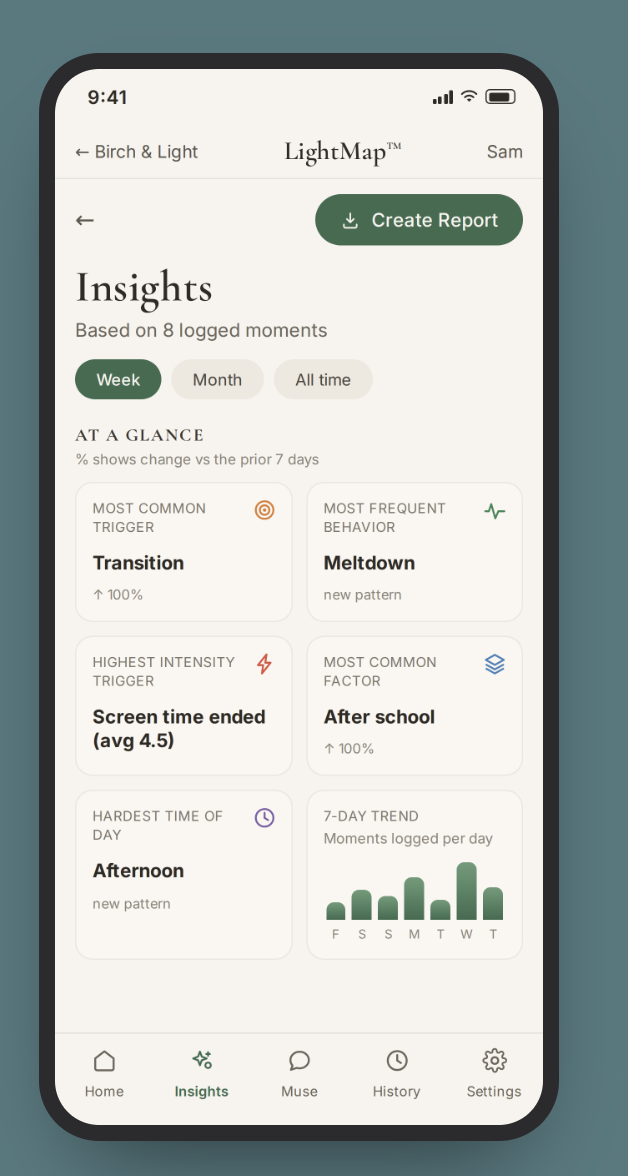

Part of the award-winning Birch & Light Method, honored with the Mom's Choice Gold Award for excellence in family resources.
If today was one of those days
A few more from the library, free to read.
Researched and drafted with AI assistance, reviewed before publication. Editorial standards